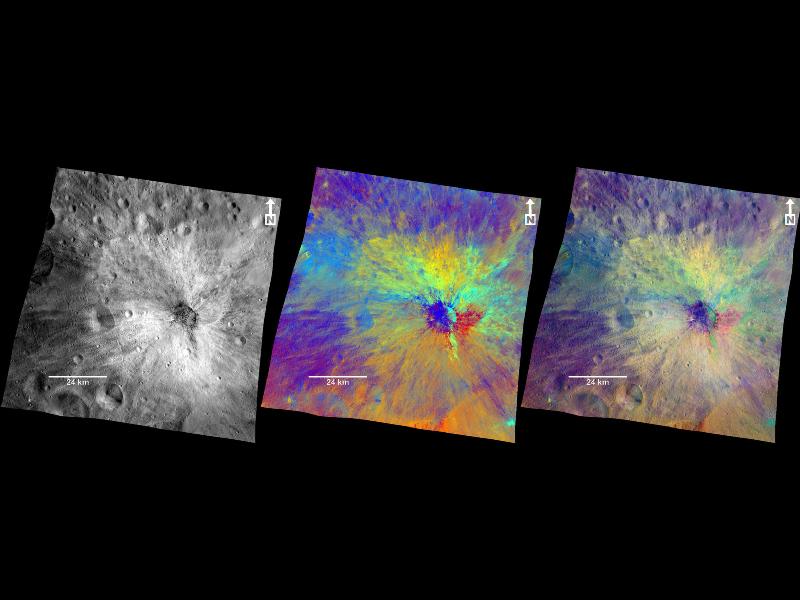
Showing posts with label Asteroids. Show all posts

Dawn Mission Video Shows Vesta's Coat of Many Colors

Posted by carsimulator on Wednesday, June 6, 2012

This animation of Vesta is made from images taken with Dawn's framing camera. Many of the images were taken at different viewing angles to provide stereo for use in determining the topography. Image credit: NASA/JPL-Caltech/UCLA/MPS/DLR/IDA/PSI. Full image and caption

PASADENA, Calif. - A new video from NASA's Dawn mission reveals the dappled, variegated surface of the giant asteroid Vesta. The animation drapes high-resolution false color images over a 3-D model of the Vesta terrain constructed from Dawn's observations. This visualization enables a detailed view of the variation in the material properties of Vesta in the context of its topography.

The video is available online at: http://www.jpl.nasa.gov/video/index.cfm?id=1085 .

The colors were chosen to highlight differences in surface composition that are too subtle for the human eye to see. Scientists are still analyzing what some of the colors mean for the composition of the surface. But it is clear that the orange material thrown out from some impact craters is different from the surrounding surface material. Green shows the relative abundance of iron. Parts of the huge impact basin known as Rheasilvia in Vesta's southern hemisphere, for instance, have areas with less iron than nearby areas.

Dawn has imaged the majority of the surface of Vesta with the framing camera to provide this 3-D map. While some areas in the north were in shadow at the time the images were obtained by the camera, Dawn expects to improve its coverage of Vesta's northern hemisphere with additional observations. Dawn's viewing geometry also prevented mapping of a portion of the mountain of the south pole.

The spacecraft is currently spiraling up from its lowest-altitude orbit into its final science orbit, where its average altitude will be about 420 miles (680 kilometers). Dawn is scheduled to leave Vesta around Aug. 26.

The Dawn mission is managed by NASA's Jet Propulsion Laboratory in Pasadena, Calif., for the agency's Science Mission Directorate in Washington. Dawn is a project of the directorate's Discovery Program, managed by NASA's Marshall Space Flight Center in Huntsville, Ala. UCLA is responsible for overall Dawn mission science. Orbital Sciences Corp. of Dulles, Va., designed and built the Dawn spacecraft. The framing cameras were developed and built under the leadership of the Max Planck Institute for Solar System Research in Katlenburg-Lindau, Germany. The German Aerospace Center (DLR) Institute of Planetary Research in Berlin made significant contributions in coordination with the Institute of Computer and Communication Network Engineering in Braunschweig. The framing camera project is funded by the Max Planck Society, DLR and NASA. JPL is a division of the California Institute of Technology in Pasadena.

For more information about Dawn, visit: http://www.nasa.gov/dawn and http://dawn.jpl.nasa.gov .

Priscilla Vega / Jia-Rui Cook 818-354-1357/0850
Jet Propulsion Laboratory, Pasadena, Calif.
Priscilla.r.vega@jpl.nasa.gov / jccook@jpl.nasa.gov

More aboutDawn Mission Video Shows Vesta's Coat of Many Colors

NASA Survey Counts Potentially Hazardous Asteroids

Posted by carsimulator on Thursday, May 17, 2012

New results from NASA's NEOWISE survey find that more potentially hazardous asteroids, or PHAs, are closely aligned with the plane of our solar system than previous models suggested. PHAs are the subset of near-Earth asteroids (NEAs) with the closest orbits to Earth's orbit, coming within 5 million miles (about 8 million kilometers). They are also defined as being large enough to survive passage through Earth's atmosphere and cause damage on a regional, or greater, scale. Image credit: NASA/JPL-Caltech. Full image and caption

This diagram illustrates the differences between orbits of a typical near-Earth asteroid (blue) and a potentially hazardous asteroid, or PHA (orange). PHAs are a subset of the near-Earth asteroids (NEAs). They have the closest orbits to Earth's orbit, coming within 5 million miles (about 8 million kilometers), and they are large enough to survive passage through Earth's atmosphere and cause damage on a greater, scale. Image credit: NASA/JPL-Caltech. Full image and caption - enlarge image

PASADENA, Calif. -- Observations from NASA's Wide-field Infrared Survey Explorer (WISE) have led to the best assessment yet of our solar system's population of potentially hazardous asteroids. The results reveal new information about their total numbers, origins and the possible dangers they may pose.

Potentially hazardous asteroids, or PHAs, are a subset of the larger group of near-Earth asteroids. The PHAs have the closest orbits to Earth's, coming within five million miles (about eight million kilometers), and they are big enough to survive passing through Earth's atmosphere and cause damage on a regional, or greater, scale.

The new results come from the asteroid-hunting portion of the WISE mission, called NEOWISE. The project sampled 107 PHAs to make predictions about the entire population as a whole. Findings indicate there are roughly 4,700 PHAs, plus or minus 1,500, with diameters larger than 330 feet (about 100 meters). So far, an estimated 20 to 30 percent of these objects have been found.

While previous estimates of PHAs predicted similar numbers, they were rough approximations. NEOWISE has generated a more credible estimate of the objects' total numbers and sizes.

"The NEOWISE analysis shows us we've made a good start at finding those objects that truly represent an impact hazard to Earth," said Lindley Johnson, program executive for the Near-Earth Object Observation Program at NASA Headquarters in Washington. "But we've many more to find, and it will take a concerted effort during the next couple of decades to find all of them that could do serious damage or be a mission destination in the future."

The new analysis also suggests that about twice as many PHAs as previously thought are likely to reside in "lower-inclination" orbits, which are more aligned with the plane of Earth's orbit. In addition, these lower-inclination objects appear to be somewhat brighter and smaller than the other near-Earth asteroids that spend more time far away from Earth. A possible explanation is that many of the PHAs may have originated from a collision between two asteroids in the main belt lying between Mars and Jupiter. A larger body with a low-inclination orbit may have broken up in the main belt, causing some of the fragments to drift into orbits closer to Earth and eventually become PHAs.

Asteroids with lower-inclination orbits would be more likely to encounter Earth and would be easier to reach. The results therefore suggest more near-Earth objects might be available for future robotic or human missions.

"NASA's NEOWISE project, which wasn't originally planned as part of WISE, has turned out to be a huge bonus," said Amy Mainzer, NEOWISE principal investigator, at NASA's Jet Propulsion Laboratory in Pasadena, Calif. "Everything we can learn about these objects helps us understand their origins and fate. Our team was surprised to find the overabundance of low-inclination PHAs. Because they will tend to make more close approaches to Earth, these targets can provide the best opportunities for the next generation of human and robotic exploration."

The discovery that many PHAs tend to be bright says something about their composition; they are more likely to be either stony, like granite, or metallic. This type of information is important in assessing the space rocks' potential hazards to Earth. The composition of the bodies would affect how quickly they might burn up in our atmosphere if an encounter were to take place.

The NEOWISE results have been accepted for publication in the Astrophysical Journal.

The WISE spacecraft scanned the sky twice in infrared light before entering hibernation mode in early 2011. It catalogued hundreds of millions of objects, including super-luminous galaxies, stellar nurseries and closer-to-home asteroids. The NEOWISE project snapped images of about 600 near-Earth asteroids, about 135 of which were new discoveries. Because the telescope detected the infrared light, or heat, of asteroids, it was able to pick up both light and dark objects, resulting in a more representative look at the entire population. The infrared data allowed astronomers to make good measurements of the asteroids' diameters and, when combined with visible light observations, how much sunlight they reflect.

JPL manages, and operates the Wide-field Infrared Survey Explorer for NASA's Science Mission Directorate, Washington. The principal investigator, Edward Wright, is at UCLA. The mission was competitively selected under NASA's Explorers Program managed by the Goddard Space Flight Center, Greenbelt, Md. The science instrument was built by the Space Dynamics Laboratory, Logan, Utah, and the spacecraft was built by Ball Aerospace & Technologies Corp., Boulder, Colo. Science operations and data processing and archiving take place at the Infrared Processing and Analysis Center at the California Institute of Technology in Pasadena. Caltech manages JPL for NASA.

More information is online at http://www.nasa.gov/wise and http://jpl.nasa.gov/wise

Whitney Clavin 818-354-4673
Jet Propulsion Laboratory, Pasadena, Calif.
whitney.clavin@jpl.nasa.gov

J.D. Harrington 202-358-5241
Headquarters, Washington
j.d.harrington@nasa.gov

More aboutNASA Survey Counts Potentially Hazardous Asteroids

NASA Dawn Mission Reveals Secrets of Large Asteroid

Posted by carsimulator on Friday, May 11, 2012

This image, made from data obtained by NASA's Dawn spacecraft, shows the mineral distribution in the southern hemisphere of the giant asteroid Vesta. Image credit: NASA/JPL-Caltech/UCLA/INAF/MPS/DLR/IDA. Full image and caption - Image gallery

This image, made from data obtained by NASA's Dawn spacecraft, shows the mineral distribution in the southern hemisphere of the giant asteroid Vesta. Image credit: NASA/JPL-Caltech/UCLA/INAF/MPS/DLR/IDA . Virtual flight video - Touring craters

This image shows three slices of a class of meteorites that fell to Earth that NASA's Dawn mission has confirmed as originating from the giant asteroid Vesta. Image credit: University of Tennessee. Full image and caption

The giant asteroid Vesta is shown here as the smallest body among other similar bodies in the solar system: Mars, Mercury, Earth's moon and the dwarf planet Ceres. Image credit: NASA/JPL-Caltech/UCLA . Full image and caption - Image gallery

PASADENA, Calif. – NASA's Dawn spacecraft has provided researchers with the first orbital analysis of the giant asteroid Vesta, yielding new insights into its creation and kinship with terrestrial planets and Earth's moon.

Vesta now has been revealed as a special fossil of the early solar system with a more varied, diverse surface than originally thought. Scientists have confirmed a variety of ways in which Vesta more closely resembles a small planet or Earth's moon than another asteroid. Results appear in today's edition of the journal Science.

"Dawn's visit to Vesta has confirmed our broad theories of this giant asteroid's history, while helping to fill in details it would have been impossible to know from afar," said Carol Raymond, deputy principal investigator at NASA's Jet Propulsion Laboratory in Pasadena, Calif. "Dawn's residence at Vesta of nearly a year has made the asteroid's planet-like qualities obvious and shown us our connection to that bright orb in our night sky."

Scientists now see Vesta as a layered, planetary building block with an iron core – the only one known to survive the earliest days of the solar system. The asteroid's geologic complexity can be attributed to a process that separated the asteroid into a crust, mantle and iron core with a radius of approximately 68 miles (110 kilometers) about 4.56 billion years ago. The terrestrial planets and Earth's moon formed in a similar way.

Dawn observed a pattern of minerals exposed by deep gashes created by space rock impacts, which may support the idea the asteroid once had a subsurface magma ocean. A magma ocean occurs when a body undergoes almost complete melting, leading to layered building blocks that can form planets. Other bodies with magma oceans ended up becoming parts of Earth and other planets.

Data also confirm a distinct group of meteorites found on Earth did, as theorized, originate from Vesta. The signatures of pyroxene, an iron- and magnesium-rich mineral, in those meteorites match those of rocks on Vesta's surface. These objects account for about 6 percent of all meteorites seen falling on Earth.

This makes the asteroid one of the largest single sources for Earth's meteorites. The finding also marks the first time a spacecraft has been able to visit the source of samples after they were identified on Earth.

Scientists now know Vesta's topography is quite steep and varied. Some craters on Vesta formed on very steep slopes and have nearly vertical sides, with landslides occurring more frequently than expected.

Another unexpected finding was that the asteroid's central peak in the Rheasilvia basin in the southern hemisphere is much higher and wider, relative to its crater size, than the central peaks of craters on bodies like our moon. Vesta also bears similarities to other low-gravity worlds like Saturn's small icy moons, and its surface has light and dark markings that don't match the predictable patterns on Earth's moon.

"We know a lot about the moon and we're only coming up to speed now on Vesta," said Vishnu Reddy, a framing camera team member at the Max Planck Institute for Solar System Research in Germany and the University of North Dakota in Grand Forks. "Comparing the two gives us two storylines for how these fraternal twins evolved in the early solar system."

Dawn has revealed details of ongoing collisions that battered Vesta throughout its history. Dawn scientists now can date the two giant impacts that pounded Vesta's southern hemisphere and created the basin Veneneia approximately 2 billion years ago and the Rheasilvia basin about 1 billion years ago. Rheasilvia is the largest impact basin on Vesta.

"The large impact basins on the moon are all quite old," said David O'Brien, a Dawn participating scientist from the Planetary Science Institute in Tucson, Ariz. "The fact that the largest impact on Vesta is so young was surprising."

Launched in 2007, Dawn began exploring Vesta in mid-2011. The spacecraft will depart Vesta on August 26 for its next study target, the dwarf planet Ceres, in 2015.

Dawn's mission to Vesta and Ceres is managed by JPL for NASA's Science Mission Directorate in Washington. Dawn is a project of the directorate's Discovery Program managed by NASA's Marshall Space Flight Center in Huntsville, Ala. UCLA is responsible for overall Dawn mission science. Orbital Sciences Corp. in Dulles, Va., designed and built the spacecraft. The German Aerospace Center, the Max Planck Institute for Solar System Research, the Italian Space Agency and the Italian National Astrophysical Institute are international partners on the mission team. The California Institute of Technology in Pasadena manages JPL for NASA.

This image, made from data obtained by NASA's Dawn spacecraft, shows the mineral distribution in the southern hemisphere of the giant asteroid Vesta. Image credit: NASA/JPL-Caltech/UCLA/INAF/MPS/DLR/IDA
Full image and caption - Image gallery

For more information about the Dawn mission, visit: http://www.nasa.gov/dawn and http://dawn.jpl.nasa.gov


Jia-Rui Cook
Jet Propulsion Laboratory, Pasadena, Calif.
818-354-0850
jccook@jpl.nasa.gov

Dwayne Brown 202-358-1726
NASA Headquarters, Washington
dwayne.c.brown@nasa.gov

More aboutNASA Dawn Mission Reveals Secrets of Large Asteroid

Dawn Reveals Secrets of Giant Asteroid Vesta

Posted by carsimulator on Wednesday, April 25, 2012

These composite images from the framing camera aboard NASA’s Dawn spacecraft show three views of a terrain with ridges and grooves near Aquilia crater in the southern hemisphere of the giant asteroid Vesta. Image credit: NASA/JPL-Caltech/UCLA/MPS/DLR/IDA. Full image and caption - View animation

These composite images from the framing camera aboard NASA’s Dawn spacecraft show three views of the comparatively fresh crater named Vibidia on the giant asteroid Vesta. Image credit: NASA/JPL-Caltech/UCLA/MPS/DLR/IDA. Full image and caption

These images of Tarpeia crater, near the south pole of the giant asteroid Vesta, were obtained by the visible and infrared mapping spectrometer on NASA’s Dawn spacecraft. Image credit: NASA/JPL-Caltech/UCLA/INAF. Full image and caption

This colorized image from NASA’s Dawn mission shows temperature variations at Tarpeia crater, near the south pole of the giant asteroid Vesta. Image credit: NASA/JPL-Caltech/UCLA/INAF. Full image and caption

This set of images from NASA's Dawn mission shows topography of the southern hemisphere of the giant asteroid Vesta and a map of Vesta’s gravity variations that have been adjusted to account for Vesta’s shape. Image credit: NASA/JPL-Caltech/UCLA/MPS/DLR/IDA. Full image and caption

PASADENA, Calif. – Findings from NASA's Dawn spacecraft reveal new details about the giant asteroid Vesta, including its varied surface composition, sharp temperature changes and clues to its internal structure. The findings were presented today at the European Geosciences Union meeting in Vienna, Austria, and will help scientists better understand the early solar system and processes that dominated its formation.

Images from Dawn's framing camera and visible and infrared mapping spectrometer, taken 420 miles (680 kilometers) and 130 miles (210 kilometers) above the surface of the asteroid, show a variety of surface mineral and rock patterns. Coded false-color images help scientists better understand Vesta's composition and enable them to identify material that was once molten below the asteroid's surface.

Researchers also see breccias, which are rocks fused during impacts from space debris. Many of the materials seen by Dawn are composed of iron- and magnesium-rich minerals, which often are found in Earth's volcanic rocks. Images also reveal smooth pond-like deposits, which might have formed as fine dust created during impacts settled into low regions.

"Dawn now enables us to study the variety of rock mixtures making up Vesta's surface in great detail," said Harald Hiesinger, a Dawn participating scientist at Münster University in Germany. "The images suggest an amazing variety of processes that paint Vesta's surface."

At the Tarpeia crater near the south pole of the asteroid, Dawn imagery revealed bands of minerals that appear as brilliant layers on the crater's steep slopes. The exposed layering allows scientists to see farther back into the geological history of the giant asteroid.

The layers closer to the asteroid's surface bear evidence of contamination from space rocks bombarding Vesta. Layers below preserve more of their original characteristics. Frequent landslides on the slopes of the craters also have revealed other hidden mineral patterns.

"These results from Dawn suggest Vesta's 'skin' is constantly renewing," said Maria Cristina De Sanctis, lead of the visible and infrared mapping spectrometer team based at Italy's National Institute for Astrophysics in Rome.

Dawn has given scientists a near 3-D view into Vesta's internal structure. By making ultra-sensitive measurements of the asteroid's gravitational tug on the spacecraft, Dawn can detect unusual densities within its outer layers. Data now show an anomalous area near Vesta's south pole, suggesting denser material from a lower layer of Vesta has been exposed by the impact that created a feature called the Rheasilvia basin. The lighter, younger layers coating other parts of Vesta's surface have been blasted away in the basin.

Dawn obtained the highest-resolution surface temperature maps of any asteroid visited by a spacecraft. Data reveal temperatures can vary from as warm as minus 10 degrees Fahrenheit (minus 23 degrees Celsius) in the sunniest spots to as cold as minus 150 degrees Fahrenheit (minus 100 degrees Celsius) in the shadows. This is the lowest temperature measurable by Dawn's visible and infrared mapping spectrometer. These findings show the surface responds quickly to illumination with no mitigating effect of an atmosphere.

"After more than nine months at Vesta, Dawn's suite of instruments has enabled us to peel back the layers of mystery that have surrounded this giant asteroid since humankind first saw it as just a bright spot in the night sky," said Carol Raymond, Dawn deputy principal investigator at NASA's Jet Propulsion Laboratory in Pasadena, Calif. "We are closing in on the giant asteroid's secrets."

Launched in 2007, Dawn began its exploration of the approximately 330-mile-wide (530-kilometers) asteroid in mid-2011. The spacecraft's next assignment will be to study the dwarf planet Ceres in 2015. These two icons of the asteroid belt have been witness to much of our solar system's history.

Dawn's mission is managed by JPL for NASA's Science Mission Directorate in Washington. Dawn is a project of the directorate's Discovery Program, managed by NASA's Marshall Space Flight Center in Huntsville, Ala. UCLA is responsible for overall Dawn mission science. Orbital Sciences Corp. in Dulles, Va., designed and built the spacecraft. The German Aerospace Center, the Max Planck Institute for Solar System Research, the Italian Space Agency and the Italian National Astrophysical Institute are international partners on the mission team. The California Institute of Technology in Pasadena manages JPL for NASA.

To view the new images and for more information about Dawn, visit: http://www.nasa.gov/dawn and http://dawn.jpl.nasa.gov .


Jia-Rui Cook
Jet Propulsion Laboratory, Pasadena, Calif.
818-354-0850
jccook@jpl.nasa.gov

Dwayne Brown 202-358-1726
NASA Headquarters, Washington
dwayne.c.brown@nasa.gov

More aboutDawn Reveals Secrets of Giant Asteroid Vesta

Dawn Sees New Surface Features on Giant Asteroid

Posted by carsimulator on Wednesday, March 21, 2012

In this image from NASA's Dawn spacecraft, bright material extends out from the crater Canuleia on Vesta. The bright material appears to have been thrown out of the crater during the impact that created it. Image credit: NASA/JPL-Caltech/UCLA/MPS/DLR/IDA/UMD. Full image and caption | Image gallery

This image, made from data obtained by NASA's Dawn spacecraft, shows a perspective view of a layered young crater in the Rheasilvia basin at Vesta. Image credit: NASA/JPL-Caltech/UCLA/MPS/DLR/IDA/PSI. Full image and caption


The interplay of bright and dark material at the rim of Marcia crater on Vesta is visible in this image mosaic taken by NASA's Dawn spacecraft. Image credit: NASA/JPL-Caltech/UCLA/MPS/DLR/IDA/LPI/ASU. Full image and caption

This image from NASA's Dawn spacecraft shows a young crater on Vesta that is 9 miles (15 kilometers) in diameter. Image credit: NASA/JPL-Caltech/UCLA/MPS/DLR/IDA. Full image and caption

PASADENA, Calif. – NASA's Dawn spacecraft has revealed unexpected details on the surface of the giant asteroid Vesta. New images and data highlight the diversity of Vesta's surface and reveal unusual geologic features, some of which were never previously seen on asteroids.

These results were discussed today at the Lunar and Planetary Science Conference at The Woodlands, Texas.

Vesta is one of the brightest objects in the solar system and the only asteroid in the so-called main belt between Mars and Jupiter visible to the naked eye from Earth. Dawn has found that some areas on Vesta can be nearly twice as bright as others, revealing clues about the asteroid's history.

"Our analysis finds this bright material originates from Vesta and has undergone little change since the formation of Vesta over 4 billion years ago," said Jian-Yang Li, a Dawn participating scientist at the University of Maryland, College Park. "We're eager to learn more about what minerals make up this material and how the present Vesta surface came to be."

Bright areas appear everywhere on Vesta but are most predominant in and around craters. The areas vary from several hundred feet to around 10 miles (16 kilometers) across. Rocks crashing into the surface of Vesta seem to have exposed and spread this bright material. This impact process may have mixed the bright material with darker surface material.

While scientists had seen some brightness variations in previous images of Vesta from NASA's Hubble Space Telescope, Dawn scientists also did not expect such a wide variety of distinct dark deposits across its surface. The dark materials on Vesta can appear dark gray, brown and red. They sometimes appear as small, well-defined deposits around impact craters. They also can appear as larger regional deposits, like those surrounding the impact craters scientists have nicknamed the "snowman."

"One of the surprises was the dark material is not randomly distributed," said David Williams, a Dawn participating scientist at Arizona State University, Tempe. "This suggests underlying geology determines where it occurs."

The dark materials seem to be related to impacts and their aftermath. Scientists theorize carbon-rich asteroids could have hit Vesta at speeds low enough to produce some of the smaller deposits without blasting away the surface.

Higher-speed asteroids also could have hit Vesta's surface and melted the volcanic basaltic crust, darkening existing surface material. That melted conglomeration appears in the walls and floors of impact craters, on hills and ridges, and underneath brighter, more recent material called ejecta, which is material thrown out from a space rock impact.

Vesta's dark materials suggest the giant asteroid may preserve ancient materials from the asteroid belt and beyond, possibly from the birth of the solar system.

"Some of these past collisions were so intense they melted the surface," said Brett Denevi, a Dawn participating scientist at the Johns Hopkins University Applied Physics Laboratory in Laurel, Md. "Dawn's ability to image the melt marks a unique find. Melting events like these were suspected, but never before seen on an asteroid."

Dawn launched in September 2007. It will reach its second destination, Ceres, in February 2015.

"Dawn's ambitious exploration of Vesta has been going beautifully," said Marc Rayman, Dawn chief engineer at NASA's Jet Propulsion Laboratory in Pasadena, Calif. "As we continue to gather a bounty of data, it is thrilling to reveal fascinating alien landscapes."

To view the new images, visit: http://www.nasa.gov/dawn and http://dawn.jpl.nasa.gov .

Dawn's mission is managed by JPL for NASA's Science Mission Directorate in Washington. Dawn is a project of the directorate's Discovery Program, managed by NASA's Marshall Space Flight Center in Huntsville, Ala. UCLA is responsible for overall Dawn mission science. Orbital Sciences Corp. in Dulles, Va., designed and built the spacecraft. The German Aerospace Center, the Max Planck Institute for Solar System Research, the Italian Space Agency and the Italian National Astrophysical Institute are international partners on the mission team. JPL is managed for NASA by the California Institute of Technology in Pasadena.


Jia-Rui Cook
Jet Propulsion Laboratory, Pasadena, Calif.
818-354-0850
jccook@jpl.nasa.gov

Dwayne Brown 202-358-1726
NASA Headquarters, Washington
dwayne.c.brown@nasa.gov

More aboutDawn Sees New Surface Features on Giant Asteroid

Sagittarius A*: NASA's Chandra Finds Milky Way's Black Hole May be Grazing on Asteroids

Posted by carsimulator on Wednesday, February 8, 2012

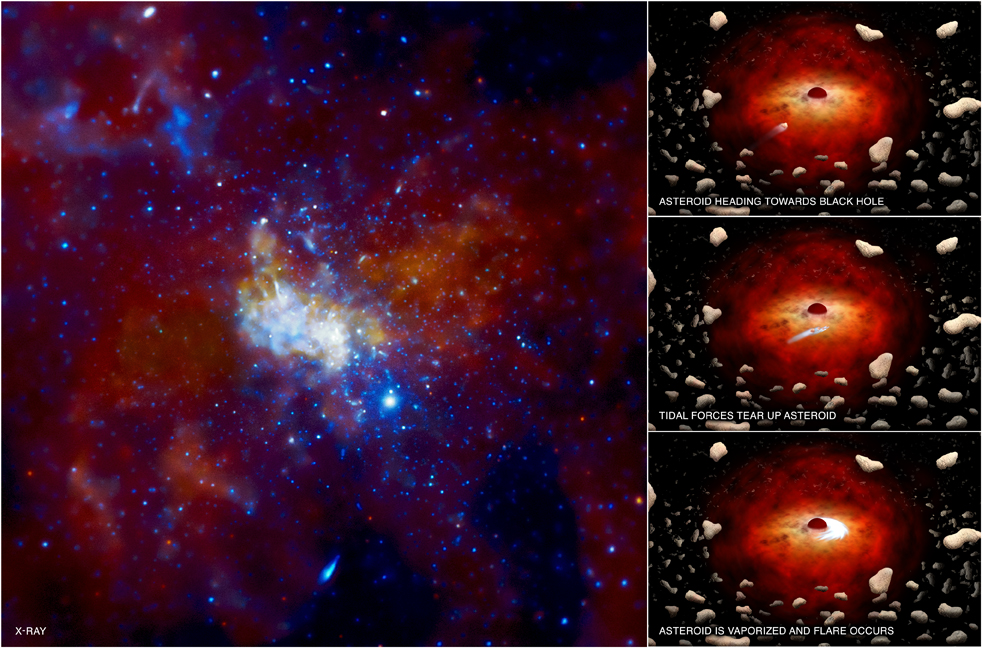
Mysterious X-ray flares caught by Chandra may be asteroids falling into the Milky Way's giant black hole. Credit: X-ray: NASA/CXC/MIT/F. Baganoff et al.; Illustrations: NASA/CXC/M.Weiss


(Runtime: 00:29)


This image from NASA's Chandra X-ray Observatory shows the center of our Galaxy, with a supermassive black hole known as Sagittarius A* (Sgr A* for short) in the center. Using intermittent observations over several years, Chandra has detected X-ray flares about once a day from Sgr A*. The flares have also been seen in infrared data from ESO's Very Large Telescope in Chile.

A new study provides a possible explanation for the mysterious flares. The suggestion is that there is a cloud around Sgr A* containing hundreds of trillions of asteroids and comets, which have been stripped from their parent stars. The panel on the left is an image containing nearly a million seconds of Chandra observing of the region around the black hole, with red representing low-energy X-rays, green as medium-energy X-rays, and blue being the highest.

An asteroid that undergoes a close encounter with another object, such as a star or planet, can be thrown into an orbit headed towards Sgr A*, as seen in a series of artist's illustrations beginning with the top-right panel. If the asteroid passes within about 100 million miles of the black hole, roughly the distance between the Earth and the Sun, it would be torn into pieces by the tidal forces from the black hole (middle-right panel).

These fragments would then be vaporized by friction as they pass through the hot, thin gas flowing onto Sgr A*, similar to a meteor heating up and glowing as it falls through Earth's atmosphere. A flare is produced (bottom-right panel) and eventually the remains of the asteroid are swallowed by the black hole.

Chandra Image of Environment Around Milky Way's Black Hole

Another solar system analogy for this type of event has recently been reported. About once every three days a comet is destroyed when it flies into the hot atmosphere of the Sun. So, despite the significant differences in the two environments, the destruction rate of comets and asteroids by the Sun and Sgr A* may be similar.

Very long observations of Sgr A* will be made with Chandra later in 2012 that will give valuable new information about the frequency and brightness of flares and should help to test the model proposed here to explain them. This work has the potential to understand the ability of asteroids and planets to form in the harsh environment of Sgr A*.

Fast Facts for Sagittarius A*:

Scale: Image is 15 arcmin across (20 light years)
Category:Black Holes, Milky Way Galaxy
Coordinates: (J2000) RA 17h 45m 40s | Dec -29° 00' 28.00"
Constellation: Sagittarius
Observation Dates: 43 pointings from September 21, 1999 to May 18, 2009
Observation Time; 278 hours (11 days 14 hours)
Obs. IDs: 242, 1561, 2943, 2951-2954, 3392, 3393, 3549, 3663, 3665, 4683, 4684, 5360, 5950-5954, 6113, 6363, 6639, 6640-6646, 7554-7759, 9169-9174, 10556
Color Code: X-ray: Energy: Red (2-3.3 keV), Green (3.3-4.7 keV), Blue (4.7-8 keV)
Instrument: ACIS
Also Known As: Galactic Center
References: K. Zubovas et al., 2012, MNRAS, in press; arXiv:1110.6872
Distance Estimate: About 26,000 light years

More aboutSagittarius A*: NASA's Chandra Finds Milky Way's Black Hole May be Grazing on Asteroids

Dawn Obtains First Low Altitude Images of Vesta

Posted by carsimulator on Wednesday, December 21, 2011

NASA's Dawn spacecraft has spiraled closer and closer to the surface of the giant asteroid Vesta. Image credit: NASA/JPL-Caltech/UCLA/MPS/DLR/IDA. Full image and caption

This image, one of the first obtained by NASA's Dawn spacecraft in its low altitude mapping orbit, shows an area within the Rheasilvia basin in the south polar area of the giant asteroid Vesta. Image credit: NASA/ JPL-Caltech/ UCLA/ MPS/ DLR/ IDA. Full image and caption

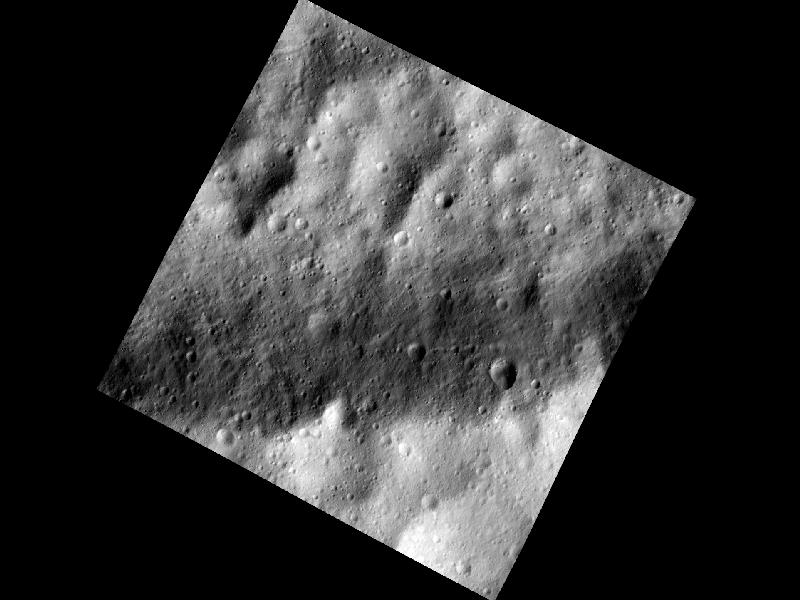
This image, one of the first obtained by NASA's Dawn spacecraft in its low altitude mapping orbit, shows a part of one of the troughs at the equator of the giant asteroid Vesta. Image credit: NASA/ JPL-Caltech/ UCLA/ MPS/ DLR/ IDA. Full image and caption

PASADENA, Calif. – NASA's Dawn spacecraft has sent back the first images of the giant asteroid Vesta from its low-altitude mapping orbit. The images, obtained by the framing camera, show the stippled and lumpy surface in detail never seen before, piquing the curiosity of scientists who are studying Vesta for clues about the solar system's early history.

At this detailed resolution, the surface shows abundant small craters, and textures such as small grooves and lineaments that are reminiscent of the structures seen in low-resolution data from the higher-altitude orbits. Also, this fine scale highlights small outcrops of bright and dark material.

A gallery of images can be found online at: http://www.nasa.gov/mission_pages/dawn/multimedia/gallery-index.html .

The images were returned to Earth on Dec. 13. Dawn scientists plan to acquire data in the low-altitude mapping orbit for at least 10 weeks. The primary science objectives in this orbit are to learn about the elemental composition of Vesta's surface with the gamma ray and neutron detector and to probe the interior structure of the asteroid by measuring the gravity field.

The Dawn mission to the asteroids Vesta and Ceres is managed by NASA's Jet Propulsion Laboratory, a division of the California Institute of Technology in Pasadena, for NASA's Science Mission Directorate, Washington. Dawn is a project of the directorate's Discovery Program, managed by NASA's Marshall Space Flight Center in Huntsville, Ala. UCLA is responsible for overall Dawn mission science. The Dawn Framing Cameras have been developed and built under the leadership of the Max Planck Institute for Solar System Research, Katlenburg-Lindau, Germany, with significant contributions by DLR German Aerospace Center, Institute of Planetary Research, Berlin, and in coordination with the Institute of Computer and Communication Network Engineering, Braunschweig. The framing camera project is funded by the Max Planck Society, DLR, and NASA/JPL.

More information about the Dawn mission is online at: http://www.nasa.gov/dawn and http://dawn.jpl.nasa.gov .


Jia-Rui Cook
Jet Propulsion Laboratory, Pasadena, Calif.
818-354-0850
jccook@jpl.nasa.gov

More aboutDawn Obtains First Low Altitude Images of Vesta

Lutetia: a Rare Survivor from the Birth of the Earth

Posted by carsimulator on Friday, November 11, 2011

An image of the strange asteroid Lutetia from the ESA Rosetta probe

Artist's impression of the asteroid Lutetia making a close approach to a planet in the early Solar System

PR Image eso1144c
Artist's impression of the development of the Solar System

PR Video eso1144a
The unusual history of the asteroid Lutetia

New observations indicate that the asteroid Lutetia is a leftover fragment of the same original material that formed the Earth, Venus and Mercury. Astronomers have combined data from ESA’s Rosetta spacecraft, ESO’s New Technology Telescope, and NASA telescopes. They found that the properties of the asteroid closely match those of a rare kind of meteorites found on Earth and thought to have formed in the inner parts of the Solar System. Lutetia must, at some point, have moved out to its current location in the main asteroid belt between Mars and Jupiter.

A team of astronomers from French and North American universities have studied the unusual asteroid Lutetia in detail at a very wide range of wavelengths [1] to deduce its composition. Data from the OSIRIS camera on ESA’s Rosetta spacecraft [2], ESO’s New Technology Telescope (NTT) at the La Silla Observatory in Chile, and NASA’s Infrared Telescope Facility in Hawaii and Spitzer Space Telescope were combined to create the most complete spectrum of an asteroid ever assembled [3].

This spectrum of Lutetia was then compared with that of meteorites found on Earth that have been extensively studied in the laboratory. Only one type of meteorite — enstatite chondrites— was found to have properties that matched Lutetia over the full range of colours.

Enstatite chondrites are known to be material that dates from the early Solar System. They are thought to have formed close to the young Sun and to have been a major building block in the formation of the rocky planets [4], in particular the Earth, Venus and Mercury [5]. Lutetia seems to have originated not in the main belt of asteroids, where it is now, but much closer to the Sun.

“But how did Lutetia escape from the inner Solar System and reach the main asteroid belt?” asks Pierre Vernazza (ESO), the lead author of the paper.

Astronomers have estimated that less than 2% of the bodies located in the region where Earth formed, ended up in the main asteroid belt. Most of the bodies of the inner Solar System disappeared after a few million years as they were incorporated into the young planets that were forming. However, some of the largest, with diameters of about 100 kilometres or more, were ejected to safer orbits further from the Sun.

Lutetia, which is about 100 kilometres across, may have been tossed out from the inner parts of the young Solar System if it passed close to one of the rocky planets and thus had its orbit dramatically altered [6]. An encounter with the young Jupiter during its migration to its current orbit could also account for the huge change in Lutetia’s orbit [7].

“We think that such an ejection must have happened to Lutetia. It ended up as an interloper in the main asteroid belt and it has been preserved there for four billion years,” continues Pierre Vernazza.

Earlier studies of its colour and surface properties showed that Lutetia is a very unusual and rather mysterious member of the asteroid main belt. Previous surveys have shown that similar asteroids are very rare and represent less than 1% of the asteroid population of the main belt. The new findings explain why Lutetia is different — it is a very rare survivor of the original material that formed the rocky planets.

“Lutetia seems to be the largest, and one of the very few, remnants of such material in the main asteroid belt. For this reason, asteroids like Lutetia represent ideal targets for future sample return missions. We could then study in detail the origin of the rocky planets, including our Earth,” concludes Pierre Vernazza.

Notes

[1] The electromagnetic spectrum represents the complete range of wavelengths covered by the different types of electromagnetic radiation. Visible light is the most familiar form, but many others exist. Many of these types of radiation are used in everyday life, such as radio waves, microwaves, infrared and ultraviolet light and X-rays.

[2] The Rosetta spacecraft, on its way to comet 67P/Churyumov-Gerasimenko, flew past Lutetia on 10 July 2010.

[3] Rosetta’s OSIRIS camera provided data in the ultraviolet, ESO’s NTT provided data in visible light, while NASA’s Infrared Telescope Facility in Hawaii and Spitzer Space Telescope provided data in the near-infrared and mid-infrared respectively.

[4] The enstatite chondrites (E chondrites) are a unique class of meteorites that account for only about 2% of the recovered meteorite falls. The unusual mineralogy and chemistry of E chondrites is consistent with formation relatively close to the Sun. This is further supported by isotope measurements (verified for oxygen, nitrogen, ruthenium, chromium and titanium): E chondrites are the only groups of chondrites that have the same isotopic composition as the Earth and Moon system. This strongly suggests that the Earth formed from enstatite chondrite-type materials and also that E chondrites formed at about the same distance from the Sun as the Earth.

In addition it has been recently shown that formation from enstatite chondrite bodies can explain Mercury's unusual and previously inexplicable composition. This suggests that Mercury — like the Earth — largely accreted from enstatite chondrite-like materials.

[5] Although they all formed from similar material, it remains a mystery why the inner three planets are so different.

[6] This process is very much like the gravitational assist methods used to change the direction and speed of space probes by arranging for them to fly close to a planet.

[7] Some astronomers think that the gaseous giant may have been closer to the Sun in the early days of the Solar System, before moving outwards to its current position. This would have caused havoc in the orbits of other objects of the inner Solar System due to the huge gravitational pull of Jupiter.

More information

This research was presented in a paper, “Asteroid (21) Lutetia as a remnant of Earth’s precursor planetesimals”, to appear in the journal Icarus.

The team is composed of P. Vernazza (Laboratoire d’Astrophysique de Marseille (LAM), France; European Southern Observatory, Germany), P. Lamy (LAM, France), O. Groussin (LAM, France), T. Hiroi (Department of Geological Sciences, Brown University, USA), L. Jorda(LAM, France), P.L. King (Institute for Meteoritics, University of New Mexico, USA), M.R.M. Izawa (Department of Earth Sciences, University of Western Ontario, Canada), F. Marchis (Carl Sagan Center at the SETI Institute, USA; IMCCE, Observatoire de Paris (OBSPM), France), M. Birlan (IMCCE, OBSPM, France), R. Brunetto (Institut d'Astrophysique Spatiale, CNRS, France).

ESO, the European Southern Observatory, is the foremost intergovernmental astronomy organisation in Europe and the world’s most productive astronomical observatory. It is supported by 15 countries: Austria, Belgium, Brazil, the Czech Republic, Denmark, France, Finland, Germany, Italy, the Netherlands, Portugal, Spain, Sweden, Switzerland and the United Kingdom. ESO carries out an ambitious programme focused on the design, construction and operation of powerful ground-based observing facilities enabling astronomers to make important scientific discoveries. ESO also plays a leading role in promoting and organising cooperation in astronomical research. ESO operates three unique world-class observing sites in Chile: La Silla, Paranal and Chajnantor. At Paranal, ESO operates the Very Large Telescope, the world’s most advanced visible-light astronomical observatory and two survey telescopes. VISTA works in the infrared and is the world’s largest survey telescope and the VLT Survey Telescope is the largest telescope designed to exclusively survey the skies in visible light. ESO is the European partner of a revolutionary astronomical telescope ALMA, the largest astronomical project in existence. ESO is currently planning a 40-metre-class European Extremely Large optical/near-infrared Telescope, the E-ELT, which will become “the world’s biggest eye on the sky”.

Links
Photos of La Silla
More information about Rosetta

Contacts

Pierre Vernazza
ESO, Astronomer
Garching bei München,, Germany
Email: pvernazz@eso.org

Philippe Lamy
Laboratoire d'Astrophysique de Marseille, Directeur de Recherche
Marseille, France
Tel: +33 49 105 5932
Email: philippe.lamy@oamp.fr

Richard Hook
ESO, La Silla, Paranal, E-ELT & Survey Telescopes Press Officer
Garching bei München, Germany
Tel: +49 89 3200 6655
Cell: +49 151 1537 3591
Email: rhook@eso.org

More aboutLutetia: a Rare Survivor from the Birth of the Earth

NASA Space Telescope Finds Fewer Asteroids Near Earth

Posted by carsimulator on Thursday, September 29, 2011

NEOWISE observations indicate that there are at least 40 percent fewer near-Earth asteroids in total that are larger than 330 feet, or 100 meters. Our solar system's four inner planets are shown in green, and our sun is in the center. Each red dot represents one asteroid. Object sizes are not to scale. Image credit: NASA/JPL-Caltech. Larger image | See animation

This chart illustrates how infrared is used to more accurately determine an asteroid's size.
Image credit: NASA/JPL-Caltech
Full image and caption | enlarge image

This chart illustrates how infrared is used to more accurately determine an asteroid's size.
Image credit: NASA/JPL-Caltech.
Full image and caption | Related Chart | enlarge image

WISE Finds Fewer Asteroids near Earth
Play video

PASADENA, Calif. -- New observations by NASA's Wide-field Infrared Survey Explorer, or WISE, show there are significantly fewer near-Earth asteroids in the mid-size range than previously thought. The findings also indicate NASA has found more than 90 percent of the largest near-Earth asteroids, meeting a goal agreed to with Congress in 1998.

Astronomers now estimate there are roughly 19,500 -- not 35,000 -- mid-size near-Earth asteroids. Scientists say this improved understanding of the population may indicate the hazard to Earth could be somewhat less than previously thought. However, the majority of these mid-size asteroids remain to be discovered. More research also is needed to determine if fewer mid-size objects (between 330 and 3,300-feet wide) also mean fewer potentially hazardous asteroids, those that come closest to Earth.

The results come from the most accurate census to date of near-Earth asteroids, the space rocks that orbit within 120 million miles (195 million kilometers) of the sun into Earth's orbital vicinity. WISE observed infrared light from those in the middle to large-size category. The survey project, called NEOWISE, is the asteroid-hunting portion of the WISE mission. Study results appear in the Astrophysical Journal.

"NEOWISE allowed us to take a look at a more representative slice of the near-Earth asteroid numbers and make better estimates about the whole population," said Amy Mainzer, lead author of the new study and principal investigator for the NEOWISE project at NASA's Jet Propulsion Laboratory in Pasadena, Calif. "It's like a population census, where you poll a small group of people to draw conclusions about the entire country."

WISE scanned the entire celestial sky twice in infrared light between January 2010 and February 2011, continuously snapping pictures of everything from distant galaxies to near-Earth asteroids and comets. NEOWISE observed more than 100 thousand asteroids in the main belt between Mars and Jupiter, in addition to at least 585 near Earth.

WISE captured a more accurate sample of the asteroid population than previous visible-light surveys because its infrared detectors could see both dark and light objects. It is difficult for visible-light telescopes to see the dim amounts of visible-light reflected by dark asteroids. Infrared-sensing telescopes detect an object's heat, which is dependent on size and not reflective properties.

Though the WISE data reveal only a small decline in the estimated numbers for the largest near-Earth asteroids, which are 3,300 feet (1 kilometer) and larger, they show 93 percent of the estimated population have been found. This fulfills the initial "Spaceguard" goal agreed to with Congress. These large asteroids are about the size of a small mountain and would have global consequences if they were to strike Earth. The new data revise their total numbers from about 1,000 down to 981, of which 911 already have been found. None of them represents a threat to Earth in the next few centuries. It is believed that all near-Earth asteroids approximately 6 miles (10 kilometers) across, as big as the one thought to have wiped out the dinosaurs, have been found.

"The risk of a really large asteroid impacting the Earth before we could find and warn of it has been substantially reduced," said Tim Spahr, the director of the Minor Planet Center at the Harvard Smithsonian Center for Astrophysics in Cambridge, Mass.

The situation is different for the mid-size asteroids, which could destroy a metropolitan area if they were to impact in the wrong place. The NEOWISE results find a larger decline in the estimated population for these bodies than what was observed for the largest asteroids. So far, the Spaceguard effort has found and is tracking more than 5,200 near-Earth asteroids 330 feet or larger, leaving more than an estimated 15,000 still to discover. In addition, scientists estimate there are more than a million unknown smaller near-Earth asteroids that could cause damage if they were to impact Earth.

"NEOWISE was just the latest asset NASA has used to find Earth's nearest neighbors," said Lindley Johnson, program executive for the Near Earth Object Observation Program at NASA Headquarters in Washington. "The results complement ground-based observer efforts over the past 12 years. These observers continue to track these objects and find even more."

WISE is managed and operated by JPL for NASA's Science Mission Directorate in Washington. The principal investigator, Edward Wright, is at the University of California, Los Angeles. The WISE science instrument was built by the Space Dynamics Laboratory in Logan, Utah, and the spacecraft was built by Ball Aerospace and Technologies Corp. in Boulder, Colo. Science operations and data processing occur at the Infrared Processing and Analysis Center at the California Institute of Technology.

For more information about the mission, visit: http://www.nasa.gov/wise

Whitney Clavin 818-354-4673
Jet Propulsion Laboratory, Pasadena, Calif.
Whitney.clavin@jpl.nasa.gov

Dwayne Brown 202-358-1726
NASA Headquarters, Washington
dwayne.c.brown@nasa.gov

More aboutNASA Space Telescope Finds Fewer Asteroids Near Earth

Origin of Dinosaur-Killing Asteroid Remains a Mystery

Posted by carsimulator on Tuesday, September 20, 2011

Scientists think that a giant asteroid, which broke up long ago in the main asteroid belt between Mars and Jupiter, eventually made its way to Earth and led to the extinction of the dinosaurs. This artist's concept shows a broken-up asteroid. Image credit: NASA/JPL-Caltech. Full image and caption
PASADENA, Calif. -- Observations from NASA's Wide-field Infrared Survey Explorer (WISE) mission indicate the family of asteroids some believed was responsible for the demise of the dinosaurs is not likely the culprit, keeping open the case on one of Earth's greatest mysteries.

While scientists are confident a large asteroid crashed into Earth approximately 65 million years ago, leading to the extinction of dinosaurs and some other life forms on our planet, they do not know exactly where the asteroid came from or how it made its way to Earth. A 2007 study using visible-light data from ground-based telescopes first suggested the remnant of a huge asteroid, known as Baptistina, as a possible suspect.

According to that theory, Baptistina crashed into another asteroid in the main belt between Mars and Jupiter about 160 million years ago. The collision sent shattered pieces as big as mountains flying. One of those pieces was believed to have impacted Earth, causing the dinosaurs' extinction.

Since this scenario was first proposed, evidence developed that the so-called Baptistina family of asteroids was not the responsible party. With the new infrared observations from WISE, astronomers say Baptistina may finally be ruled out.

"As a result of the WISE science team's investigation, the demise of the dinosaurs remains in the cold case files," said Lindley Johnson, program executive for the Near Earth Object (NEO) Observation Program at NASA Headquarters in Washington. "The original calculations with visible light estimated the size and reflectivity of the Baptistina family members, leading to estimates of their age, but we now know those estimates were off. With infrared light, WISE was able to get a more accurate estimate, which throws the timing of the Baptistina theory into question."

WISE surveyed the entire celestial sky twice in infrared light from January 2010 to February 2011. The asteroid-hunting portion of the mission, called NEOWISE, used the data to catalogue more than 157,000 asteroids in the main belt and discovered more than 33,000 new ones.

Visible light reflects off an asteroid. Without knowing how reflective the surface of the asteroid is, it's hard to accurately establish size. Infrared observations allow a more accurate size estimate. They detect infrared light coming from the asteroid itself, which is related to the body's temperature and size. Once the size is known, the object's reflectivity can be re-calculated by combining infrared with visible-light data.

The NEOWISE team measured the reflectivity and the size of about 120,000 asteroids in the main belt, including 1,056 members of the Baptistina family. The scientists calculated the original parent Baptistina asteroid actually broke up closer to 80 million years ago, half as long as originally proposed.

This calculation was possible because the size and reflectivity of the asteroid family members indicate how much time would have been required to reach their current locations -- larger asteroids would not disperse in their orbits as fast as smaller ones. The results revealed a chunk of the original Baptistina asteroid needed to hit Earth in less time than previously believed, in just about 15 million years, to cause the extinction of the dinosaurs.

"This doesn't give the remnants from the collision very much time to move into a resonance spot, and get flung down to Earth 65 million years ago," said Amy Mainzer, a study co-author and the principal investigator of NEOWISE at NASA's Jet Propulsion Laboratory (JPL) in Pasadena. Calif. "This process is thought to normally take many tens of millions of years." Resonances are areas in the main belt where gravity nudges from Jupiter and Saturn can act like a pinball machine to fling asteroids out of the main belt and into the region near Earth.

The asteroid family that produced the dinosaur-killing asteroid remains at large. Evidence that a 10-kilometer (about 6.2-mile) asteroid impacted Earth 65 million years ago includes a huge, crater-shaped structure in the Gulf of Mexico and rare minerals in the fossil record, which are common in meteorites but seldom found in Earth's crust. In addition to the Baptistina results, the NEOWISE study shows various main belt asteroid families have similar reflective properties. The team hopes to use NEOWISE data to disentangle families that overlap and trace their histories.

"We are working on creating an asteroid family tree of sorts," said Joseph Masiero, the lead author of the study. "We are starting to refine our picture of how the asteroids in the main belt smashed together and mixed up."

JPL manages and operated WISE for NASA's Science Mission Directorate. The spacecraft was put into hibernation mode after it scanned the entire sky twice, completing its main objectives. The principal investigator, astronomer Edward Wright, is at UCLA. The mission was selected competitively under NASA's Explorers Program managed by the agency's Goddard Space Flight Center in Greenbelt, Md. The science instrument was built by the Space Dynamics Laboratory in Logan. The spacecraft was built by Ball Aerospace & Technologies Corp. in Boulder, Colo. Science operations and data processing take place at the Infrared Processing and Analysis Center at the California Institute of Technology in Pasadena. Caltech manages JPL for NASA.


Whitney Clavin 818-354-4673
Jet Propulsion Laboratory, Pasadena, Calif.
whitney.clavin@jpl.nasa.gov

Trent Perrotto 202-358-0321
Headquarters, Washington
trent.j.perrotto@nasa.gov

More aboutOrigin of Dinosaur-Killing Asteroid Remains a Mystery

NASA Dawn Spacecraft Returns Close-Up Image of Vesta

Posted by carsimulator on Monday, July 18, 2011

Latest Image of Vesta captured by Dawn on July 17, 2011
This is the first image obtained by NASA's Dawn spacecraft after successfully entering orbit around Vesta. Image credit: NASA/JPL-Caltech/UCLA/MPS/DLR/IDA. Full image and caption


Anaglyph Image of Vesta's South Polar Region
This anaglyph image of the asteroid Vesta was taken on July 9, 2011 by the framing camera instrument aboard NASA's Dawn spacecraft. Image credit: NASA/JPL-Caltech/UCLA/MPS/DLR/IDA. Full image and caption

Vesta's South Polar Region
This enhanced image, taken by the framing camera instrument aboard NASA's Dawn spacecraft on July 9, 2011, views the south polar region of this giant asteroid. Image credit: NASA/JPL-Caltech/UCLA/MPS/DLR/IDA. Full image and caption

Vesta Sizes Up
Vesta is the largest asteroid visited by a spacecraft. It is currently being observed by NASA's Dawn spacecraft, which has entered orbit around Vesta. Image credit: NASA/JPL-Caltech/JAXA/ESA. Full image and caption

PASADENA, Calif. -- NASA's Dawn spacecraft has returned the first close-up image after beginning its orbit around the giant asteroid Vesta. On Friday, July 15, Dawn became the first probe to enter orbit around an object in the main asteroid belt between Mars and Jupiter.

The image taken for navigation purposes shows Vesta in greater detail than ever before. When Vesta captured Dawn into its orbit, there were approximately 9,900 miles (16,000 kilometers) between the spacecraft and asteroid. Engineers estimate the orbit capture took place at 10 p.m. PDT Friday, July 15 (1 a.m. EDT Saturday, July 16).

Vesta is 330 miles (530 kilometers) in diameter and the second most massive object in the asteroid belt. Ground- and space-based telescopes have obtained images of Vesta for about two centuries, but they have not been able to see much detail on its surface.

"We are beginning the study of arguably the oldest extant primordial surface in the solar system," said Dawn principal investigator Christopher Russell from the University of California, Los Angeles. "This region of space has been ignored for far too long. So far, the images received to date reveal a complex surface that seems to have preserved some of the earliest events in Vesta's history, as well as logging the onslaught that Vesta has suffered in the intervening eons."

Vesta is thought to be the source of a large number of meteorites that fall to Earth. Vesta and its new NASA neighbor, Dawn, are currently approximately 117 million miles (188 million kilometers) away from Earth. The Dawn team will begin gathering science data in August. Observations will provide unprecedented data to help scientists understand the earliest chapter of our solar system. The data also will help pave the way for future human space missions.

After traveling nearly four years and 1.7 billion miles (2.8 billion kilometers), Dawn also accomplished the largest propulsive acceleration of any spacecraft, with a change in velocity of more than 4.2 miles per second (6.7 kilometers per second), due to its ion engines. The engines expel ions to create thrust and provide higher spacecraft speeds than any other technology currently available.

"Dawn slipped gently into orbit with the same grace it has displayed during its years of ion thrusting through interplanetary space," said Marc Rayman, Dawn chief engineer and mission manager at NASA's Jet Propulsion Laboratory in Pasadena, Calif. "It is fantastically exciting that we will begin providing humankind its first detailed views of one of the last unexplored worlds in the inner solar system."

Although orbit capture is complete, the approach phase will continue for about three weeks. During approach, the Dawn team will continue a search for possible moons around the asteroid; obtain more images for navigation; observe Vesta's physical properties; and obtain calibration data.

In addition, navigators will measure the strength of Vesta's gravitational tug on the spacecraft to compute the asteroid's mass with much greater accuracy than has been previously available. That will allow them to refine the time of orbit insertion.

Dawn will spend one year orbiting Vesta, then travel to a second destination, the dwarf planet Ceres, arriving in February 2015. The mission to Vesta and Ceres is managed by JPL for the agency's Science Mission Directorate in Washington. Dawn is a project of the directorate's Discovery Program, which is managed by NASA's Marshall Space Flight Center in Huntsville, Ala.

UCLA is responsible for Dawn mission science. Orbital Sciences Corp. of Dulles, Va., designed and built the spacecraft. The German Aerospace Center, the Max Planck Institute for Solar System Research, the Italian Space Agency and the Italian National Astrophysical Institute are part of the mission's team.

To view the image and obtain more information about the Dawn mission, visit: http://www.nasa.gov/dawn and http://dawn.jpl.nasa.gov/

To follow the mission on Twitter, visit: http://www.twitter.com/NASA_Dawn .

Priscilla Vega 818-354-1357
Jet Propulsion Laboratory, Pasadena, Calif.
priscilla.r.vega@jpl.nasa.gov

Dwayne C. Brown 202-358-1726
NASA Headquarters, Washington
dwayne.c.brown@nasa.gov

More aboutNASA Dawn Spacecraft Returns Close-Up Image of Vesta