Showing posts with label M31. Show all posts

Neighbor Galaxies May Have Brushed Closely, Astronomers Find

Posted by carsimulator on Tuesday, June 12, 2012

Graphic shows gas "bridge" between M31, right, and M33.
CREDIT: Bill Saxton, NRAO/AUI/NSF

Two of our Milky Way's neighbor galaxies may have had a close encounter billions of years ago, recent studies with the National Science Foundation's Green Bank Telescope (GBT) indicate. The new observations confirm a disputed 2004 discovery of hydrogen gas streaming between the giant Andromeda Galaxy, also known as M31, and the Triangulum Galaxy, or M33.

"The properties of this gas indicate that these two galaxies may have passed close together in the distant past," said Jay Lockman, of the National Radio Astronomy Observatory (NRAO). "Studying what may be a gaseous link between the two can give us a new key to understanding the evolution of both galaxies," he added.

The two galaxies, about 2.6 and 3 million light-years, respectively, from Earth, are members of the Local Group of galaxies that includes our own Milky Way and about 30 others.

The hydrogen "bridge" between the galaxies was discovered in 2004 by astronomers using the Westerbork Synthesis Radio Telescope in the Netherlands, but other scientists questioned the discovery on technical grounds. Detailed studies with the highly-sensitive GBT confirmed the existence of the bridge, and showed six dense clumps of gas in the stream.

Observations of these clumps showed that they share roughly the same relative velocity with respect to Earth as the two galaxies, strengthening the argument that they are part of a bridge between the two.

When galaxies pass close to each other, one result is "tidal tails" of gas pulled into intergalactic space from the galaxies as lengthy streams. "We think it's very likely that the hydrogen gas we see between M31 and M33 is the remnant of a tidal tail that originated during a close encounter, probably billions of years ago," said Spencer Wolfe, of West Virginia University. "The encounter had to be long ago, because neither galaxy shows evidence of disruption today," he added.

"The gas we studied is very tenuous and its radio emission is extremely faint -- so faint that it is beyond the reach of most radio telescopes," Lockman said. "We plan to use the advanced capabilities of the GBT to continue this work and learn more about both the gas and, hopefully, the orbital histories of the two galaxies," he added.

Lockman and Wolfe worked with D.J. Pisano, of West Virginia University, and Stacy McGaigh and Edward Shaya of the University of Maryland. The scientists presented their findings at the American Astronomical Society's meeting in Anchorage, Alaska.

The National Radio Astronomy Observatory is a facility of the National Science Foundation, operated under cooperative agreement by Associated Universities, Inc.

Contact:

Dave Finley, Public Information Officer
Socorro, NM
(575) 835-7302
dfinley@nrao.edu

More aboutNeighbor Galaxies May Have Brushed Closely, Astronomers Find

NASA's Hubble Shows Milky Way is Destined for Head-on Collision with Andromeda Galaxy

Posted by carsimulator on Friday, June 1, 2012

Crash of the Titans: Andromeda Galaxy and the Milky Way Collision
Science Illustration Credit: NASA, ESA,
Z. Levay and R. van der Marel (STScI), and A. Mellinger
More Images

Nighttime Sky View of Future Galaxy Merger
Science Illustration Credit: NASA, ESA, Z. Levay and R. van der Marel (STScI),
T. Hallas, and A. Mellinger


Scientists Reflect on Expected Collision
Between the Milky Way and the Andromeda Galaxy

This video discusses what the science team's challenges and techniques were in their quest to determine the fate of the Milky Way galaxy. They reflect on the encounter's possible influence on the solar system, and how the Hubble Space Telescope was vital to this research.

Credit: NASA, ESA, M. Estacion, F. Summers, G. Bacon, B. Moster, J. Anderson, R. van der Marel, and S.T. Sohn (STScI)

NASA astronomers announced Thursday they can now predict with certainty the next major cosmic event to affect our galaxy, Sun, and solar system: the titanic collision of our Milky Way galaxy with the neighboring Andromeda galaxy.

The Milky Way is destined to get a major makeover during the encounter, which is predicted to happen four billion years from now. It is likely the Sun will be flung into a new region of our galaxy, but our Earth and solar system are in no danger of being destroyed.

"Our findings are statistically consistent with a head-on collision between the Andromeda galaxy and our Milky Way galaxy," said Roeland van der Marel of the Space Telescope Science Institute (STScI) in Baltimore.

The solution came through painstaking NASA Hubble Space Telescope measurements of the motion of Andromeda, which also is known as M31. The galaxy is now 2.5 million light-years away, but it is inexorably falling toward the Milky Way under the mutual pull of gravity between the two galaxies and the invisible dark matter that surrounds them both.

"After nearly a century of speculation about the future destiny of Andromeda and our Milky Way, we at last have a clear picture of how events will unfold over the coming billions of years," said Sangmo Tony Sohn of STScI.

The scenario is like a baseball batter watching an oncoming fastball. Although Andromeda is approaching us more than two thousand times faster, it will take four billion years before the strike.

Computer simulations derived from Hubble's data show that it will take an additional two billion years after the encounter for the interacting galaxies to completely merge under the tug of gravity and reshape into a single elliptical galaxy similar to the kind commonly seen in the local universe.

Although the galaxies will plow into each other, stars inside each galaxy are so far apart that they will not collide with other stars during the encounter. However, the stars will be thrown into different orbits around the new galactic center. Simulations show that our solar system will probably be tossed much farther from the galactic core than it is today.

To make matters more complicated, M31's small companion, the Triangulum galaxy, M33, will join in the collision and perhaps later merge with the M31/Milky Way pair. There is a small chance that M33 will hit the Milky Way first.

The universe is expanding and accelerating, and collisions between galaxies in close proximity to each other still happen because they are bound by the gravity of the dark matter surrounding them. The Hubble Space Telescope's deep views of the universe show such encounters between galaxies were more common in the past when the universe was smaller.

A century ago astronomers did not realize that M31 was a separate galaxy far beyond the stars of the Milky Way. Edwin Hubble measured its vast distance by uncovering a variable star that served as a "milepost marker."

Edwin Hubble went on to discover the expanding universe where galaxies are rushing away from us, but it has long been known that M31 is moving toward the Milky Way at about 250,000 miles per hour. That is fast enough to travel from here to the Moon in one hour. The measurement was made using the Doppler Effect, which is a change in frequency and wavelength of waves produced by a moving source relative to an observer, to measure how starlight in the galaxy has been compressed by Andromeda's motion toward us.

Previously, it was unknown whether the far-future encounter will be a miss, glancing blow, or head-on smashup. This depends on M31's tangential motion. Until now, astronomers have not been able to measure M31's sideways motion in the sky, despite attempts dating back more than a century. The Hubble Space Telescope team, led by van der Marel, conducted extraordinarily precise observations of the sideways motion of M31 that remove any doubt that it is destined to collide and merge with the Milky Way.

"This was accomplished by repeatedly observing select regions of the galaxy over a five- to seven-year period," said Jay Anderson of STScI.

"In the 'worst-case-scenario' simulation, M31 slams into the Milky Way head-on and the stars are all scattered into different orbits," said team member Gurtina Besla of Columbia University in New York, N.Y. "The stellar populations of both galaxies are jostled, and the Milky Way loses its flattened pancake shape with most of the stars on nearly circular orbits. The galaxies' cores merge, and the stars settle into randomized orbits to create an elliptical-shaped galaxy."

The space shuttle servicing missions to Hubble upgraded it with ever more-powerful cameras, which have given astronomers a long-enough time baseline to make the critical measurements needed to nail down M31's motion. The Hubble observations and the consequences of the merger are reported in three papers that will appear in an upcoming issue of the Astrophysical Journal.

The science team that did the investigation is led by Principal Investigator R.P. van der Marel (Space Telescope Science Institute [STScI], Baltimore, Md.), and further consists of S.T. Sohn and J. Anderson (STScI), G. Besla (Columbia University, New York, N.Y.), M. Fardal (University of Massachusetts, Amherst, Mass.), R.L. Beaton (University of Virginia, Charlottesville, Va.), Thomas M. Brown (STScI), P. Guhathakurta (UCO/Lick Observatory, University of California, Santa Cruz, Calif.), and T.J. Cox (Carnegie Observatories, Pasadena, Calif).

CONTACT

Ray Villard
Space Telescope Science Institute, Baltimore, Md.
410-338-4514
villard@stsci.edu

J.D. Harrington
Headquarters, Washington
202-358-5241
jharring@nasa.gov

Roeland van der Marel
Space Telescope Science Institute, Baltimore, Md.
410-338-4931
marel@stsci.edu

More aboutNASA's Hubble Shows Milky Way is Destined for Head-on Collision with Andromeda Galaxy

Spectacularly bright object in Andromeda caused by 'normal' black hole

Posted by carsimulator on Thursday, February 23, 2012

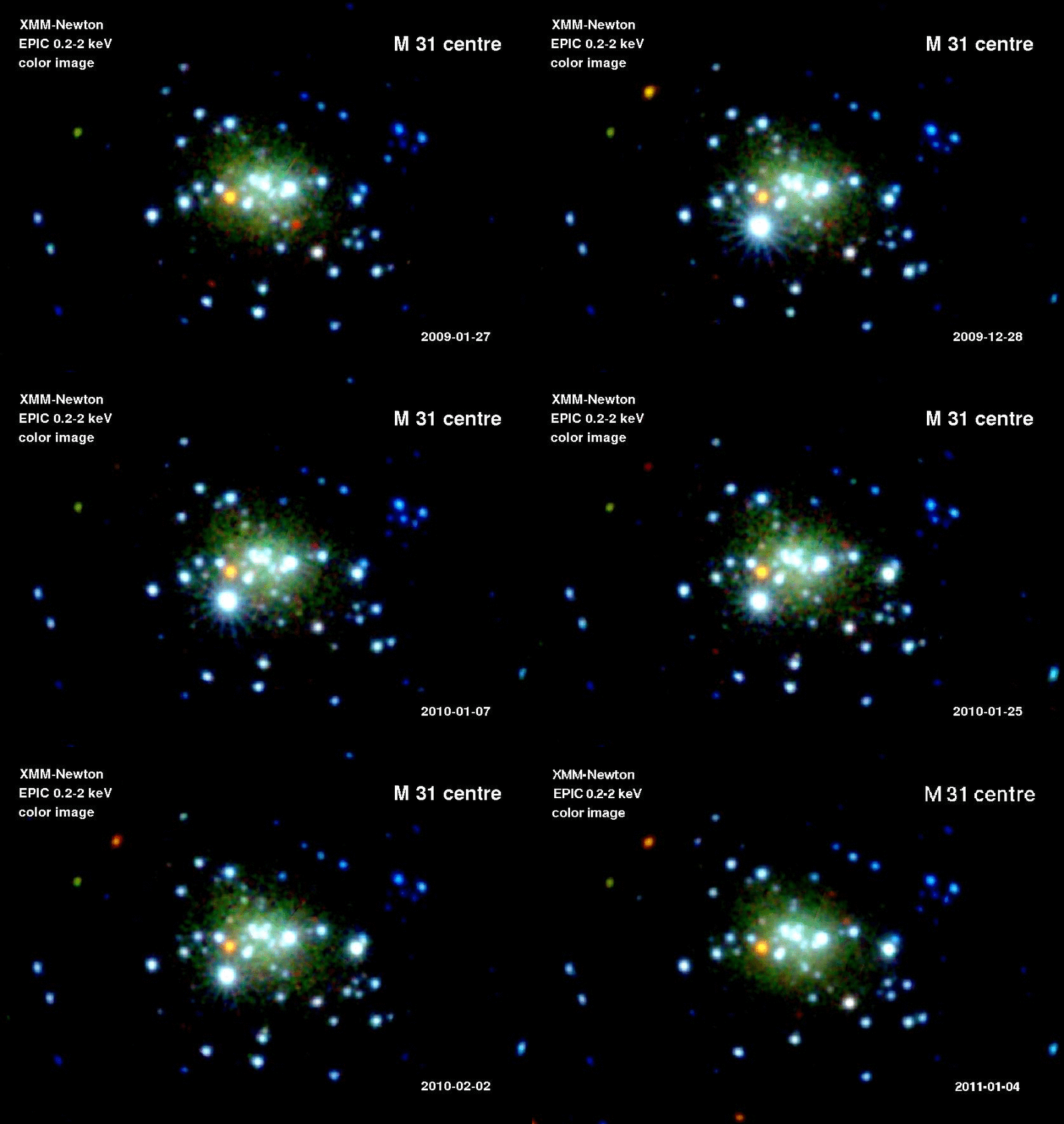
A Hubble Space Telescope optical image of our nearest neighbour galaxy, Andromeda (M31), with the inset an X-ray image of the active centre made with the XMM-Newton observatory. The newly discovered ULX is highlighted. Credit: MPE

An animated gif based on X-ray images from XMM-Newton, showing the ULX from the time it was first seen to enter outburst at the end of 2009 and its decay until it 'switched off' sometime in 2010. Credit: MPE

A spectacularly bright object recently spotted in one of the Milky Way's neighbouring galaxies is the result of a "normal" stellar black hole, astronomers have found.

An international team of scientists, led by Dr Matt Middleton, of Durham University, analysed the Ultraluminous X-ray Source (ULX), which was originally discovered in the Andromeda galaxy by NASA's Chandra x-ray observatory. They publish their results in the journals Monthly Notices of the Royal Astronomical Society and Astronomy and Astrophysics.

Many ULXs are too far away for astronomers to study, but the relatively close proximity of Andromeda to the Milky Way – around 2.5 million light years – gave the team opportunity to study the phenomenon.

The researchers say their study could begin to answer the question about what causes ULXs. Some scientists believe they are caused by relatively small black holes, a few times the mass of our Sun. These black holes rapidly pull in gas and dust which forms an "accretion disc" and heats up causing the material to emit X-rays.

Other scientists say ULXs are caused by material being dragged in by an intermediate-sized black hole formed from the merger of many stellar black holes with a mass perhaps 1,000 times bigger than the Sun.

The Durham-led findings link the ULX spotted in Andromeda to a normal stellar black hole formed after a massive star exploded as a supernova.

Dr Middleton, of Durham University's Department of Physics, said: "ULX sources are still pretty exotic.

"But our work shows that at least some are linked to the normal black holes left behind after the death of massive stars, objects that are found throughout the Universe, and the way that they drag in surrounding material.

"The ULX in Andromeda flared up because of the black hole's voracious appetite for new material."

Using data from Chandra, the XMM-Newton X-ray observatory, the Swift gamma ray observatory and the Hubble Space Telescope the research team were able to watch a sharp decline in the outburst from the ULX that took place over the next few months.

This decline had not been seen in any ULX before, but is common in stellar-mass X-ray binaries in the Milky Way where a normal star is in close orbit around a black hole. Measurement of energy emissions from the ULX also allowed the team to rule out low rates of accretion that would be expected from an intermediate-mass black hole.

They concluded that the Andromeda ULX had the mass of a large star, in this case about 13 times the mass of the Sun.

Dr Middleton said: "We would like to follow up this work by watching another outburst from the Andromeda ULX. The problem is that these are likely to happen only every few decades so we could be in for a long wait before this source erupts again."

The team hope that the ongoing monitoring of Andromeda by orbiting X-ray observatories may find other ULXs in the same galaxy, giving them another chance to test their theory.

Dr Middleton said: "If we do manage to spot another ULX outburst in Andromeda it will be a big help in understanding the extreme behaviour of black holes and the way they pull in matter – something of great importance in shaping the wider universe."

The research work in the UK was funded by the Science and Technology Facilities Council.


SCIENCE CONTACT

Dr Matt Middleton
Department of Physics
Durham University
Tel: +44 (0)191 334 3728
Email: m.j.middleton@durham.ac.uk


MEDIA CONTACTS

Dr Robert Massey
Royal Astronomical Society
Tel: +44 (0)20 7734 3307 x214
Mob: +44 (0)794 124 8035
Email: rm@ras.org.uk

Leighton Kitson
Media Relations Officer
Durham University
Tel: +44 (0)191 334 6074/+44 (0)191 334 6075
Email: leighton.kitson@durham.ac.uk / media.relations@durham.ac.uk

Dr Hannelore Hämmerle
Press officer
Max-Planck Institute for Astrophysics
Garching, Germany
Tel: +49 (0)89 30000 3980
Email: hhaemmerle@mpa-garching.mpg.de


FURTHER INFORMATION

The new work will be published in "The missing link: a low mass X-ray binary in M31 seen as an ultraluminous X-ray source", Middleton, M. J. et al, Monthly Notices of the Royal Astronomical Society, in press.

A preprint can be downloaded from http://adsabs.harvard.edu/abs/2011arXiv1111.1188M

A copy of the paper is available on request from Durham University Media Relations Office on +44 (0)191 334 6075 or email media.relations@durham.ac.uk

German and English language versions of the release are also available from the Max-Planck-Institut für extraterrestrische Physik (MPE, Garching, Germany) http://www.mpe.mpg.de/News/PR20120223/text-d.html and http://www.mpe.mpg.de/News/PR20120223/text.html


NOTES FOR EDITORS

Durham University

Durham University is a World Top-100 university with a global reputation in research and education across the arts and humanities, sciences and social sciences. It is England's third oldest university and Durham has been a leading centre of scholarship for a thousand years. At the University's heart is a UNESCO World Heritage site which it owns, together with Durham Cathedral. Durham is consistently ranked in the top few universities in the UK and the leading university in the North. Its residential Collegiate system enables the University to recruit some of the most talented and motivated students from around the world to develop transferable skills such as leadership, alongside academic excellence, which place Durham graduates in the World Top-15 for global student employability.*

* 2011 QS World University Rankings

The Royal Astronomical Society

The Royal Astronomical Society (RAS, www.ras.org.uk), founded in 1820, encourages and promotes the study of astronomy, solar-system science, geophysics and closely related branches of science. The RAS organizes scientific meetings, publishes international research and review journals, recognizes outstanding achievements by the award of medals and prizes, maintains an extensive library, supports education through grants and outreach activities and represents UK astronomy nationally and internationally. Its more than 3500 members (Fellows), a third based overseas, include scientific researchers in universities, observatories and laboratories as well as historians of astronomy and others.

Follow the RAS on Twitter via @royalastrosoc

More aboutSpectacularly bright object in Andromeda caused by 'normal' black hole

Rare Ultra-blue Stars Found in Neighboring Galaxy's Hub

Posted by carsimulator on Wednesday, January 11, 2012

Andromeda Galaxy
Credit for the Hubble images: NASA, ESA, B.F. Williams (University of Washington, Seattle), D. Lang (Princeton University, N.J.), J. Kalirai (Space Telescope Science Institute, Baltimore), and J. Dalcanton (University of Washington, Seattle)

Peering deep inside the hub of the neighboring Andromeda galaxy, NASA's Hubble Space Telescope has uncovered a large, rare population of hot, bright stars.

Blue is typically an indicator of hot, young stars. In this case, however, the stellar oddities are aging, Sun-like stars that have prematurely cast off their outer layers of material, exposing their extremely blue-hot cores.

Astronomers were surprised when they spotted these stars because physical models show that only an unusual type of old star can be as hot and as bright in ultraviolet light.

While Hubble has spied these ultra-blue stars before in Andromeda, the new observation covers a much broader area, revealing that these stellar misfits are scattered throughout the galaxy's bustling center. Astronomers used Hubble's Wide Field Camera 3 to find roughly 8,000 of the ultra-blue stars in a stellar census made in ultraviolet light, which traces the glow of the hottest stars. The study is part of the multi-year Panchromatic Hubble Andromeda Treasury survey to map stellar populations across the Andromeda galaxy.

"We were not looking for these stars. They stood out because they were bright in ultraviolet light and very different from the stars we expected to see," said Julianne Dalcanton of the University of Washington in Seattle, leader of the Hubble survey.

The team's results are being presented today at the American Astronomical Society meeting in Austin, Texas.

The telescope spied the stars within 2,600 light-years of Andromeda's core. After analyzing the stars for nearly a year, Dalcanton's team determined that they were well past their prime. "The stars are dimmer and have a range of surface temperatures different from the extremely bright stars we see in the star-forming regions of Andromeda," said team member Phil Rosenfield of the University of Washington.

As these stars evolved, puffing up to become red giants, they ejected most of their outer layers to expose their blue-hot cores. When normal Sun-like stars swell up to become red giants, they lose much less material and therefore never look as bright in the ultraviolet.

"We caught these stars when they're the brightest, just before they become white dwarfs," said team member Leo Girardi of the National Institute for Astrophysics's Astronomical Observatory of Padua. "It is likely that there are many other similarly hot stars in this central part of Andromeda at earlier stages of their lives. But such stars are too dim for Hubble to see because they're mixed in with a crowd of normal stars."

The astronomers have proposed two possible scenarios to explain why these blue stars evolve differently. According to Rosenfield, the most likely scenario is that the stars are rich in chemical elements other than hydrogen and helium. Observations with ground-based telescopes have shown the stars in the galaxy's hub have an abundant supply of "heavy elements," which makes it easier for stars to eject lots of material into space late in life.

In this scenario radiation from the star is more efficient at pushing on gas laced with heavy elements, which drives away the material, like wind moving a thick sail. Although all the stars in the core are enriched in heavy elements, the bright blue stars may contain especially high amounts, which help trigger the mass loss.

The study also shows that the number of blue stars decreases with distance from the core, tracing the drop in the amount of heavy elements.

Another possible explanation is that the blue stars are in close binary systems and have lost mass to their partners. This mass loss would expose the stars' hot cores. The astronomers were surprised to find that the ultra-blue stars are distributed in the galaxy in the same way as a population of binary stars with similar masses that were found in X-ray observations by NASA's Chandra X-ray Observatory.

The astronomers' next step is to create simulations of these stars to try to determine which scenario is the one that leads them on a different evolutionary path.

CONTACT

Donna Weaver / Ray Villard
Space Telescope Science Institute, Baltimore, Md.
410-338-4493 / 410-338-4514
dweaver@stsci.edu / villard@stsci.edu

Julianne Dalcanton
University of Washington, Seattle, Wash.
206-685-2155
jd@astro.washington.edu

More aboutRare Ultra-blue Stars Found in Neighboring Galaxy's Hub

Four Unusual Views of the Andromeda Galaxy

Posted by carsimulator on Thursday, July 21, 2011

PR Image heic1112a
Stars in the Andromeda Galaxy’s disc

PR Image heic1112b
Stars in the Andromeda Galaxy’s giant stellar stream

PR Image heic1112c
Stars in the Andromeda Galaxy’s halo with background galaxies (1)

PR Image heic1112d
Stars in the Andromeda Galaxy’s halo with background galaxies (2)

PR Image heic1112e
Labelled wide-field view of the Andromeda Galaxy

PR Image heic1112f
Wide-field view of the Andromeda Galaxy

PR Video heic1112a
Hubblecast 48: Deep Observations of the Andromeda Galaxy

PR Video heic1112b
Zooming in on the Andromeda Galaxy

PR Video heic1112c
Panning across Hubble observations of the Andromeda Galaxy

PR Video heic1112d
Zooming in on stars in the Andromeda Galaxy’s disc

PR Video heic1112e
Zooming in on stars in the Andromeda Galaxy’s giant stellar stream

PR Video heic1112f - PR Video heic1112g
Zooming in on stars in the Andromeda Galaxy’s halo (1) and (2)

The Andromeda Galaxy is revealed in unprecedented detail in four archive observations from the NASA/ESA Hubble Space Telescope. They show stars and structure in the galaxy’s disc, the halo of stars that surrounds it, and a stream of stars left by a companion galaxy as it was torn apart and pulled in by the galaxy’s gravitational forces.

These four observations made by Hubble’s Advanced Camera for Surveys give a close up view of the Andromeda Galaxy, also known as Messier 31 (M 31). Observations of most galaxies do not show the individual stars — even the most powerful telescopes cannot normally resolve the cloudy white shapes into their hundreds of millions of constituent stars.

In the case of the Andromeda Galaxy, however, astronomers have a few tricks up their sleeves. Firstly, images from Hubble Space Telescope have unparalleled image quality as a result of the telescope’s position above the atmosphere. Secondly, M 31 is closer to our own galaxy than any other spiral galaxy (so close that it can even be seen with the naked eye on a very dark night [1]). And thirdly, these observations avoid the crowded centre of the galaxy, where the stars are closest together and hardest to separate from each other.

The resulting images offer a different perspective on a spiral galaxy. Far from being an opaque, dense object, Hubble reminds us that the dominant feature of a galaxy is the huge voids between its stars. Thus, these images do not only show stars in the Andromeda Galaxy (and a handful of bright Milky Way stars that are in the foreground): they also let us see right through the galaxy, revealing far more distant galaxies in the background.

The four images in this release look superficially similar, but on closer inspection they reveal some important differences.

The two images taken in M 31’s halo show the lowest density of stars. The halo is the huge and sparse sphere of stars that surrounds a galaxy. While there are relatively few stars in a galaxy’s halo, studies of the rotation rate of galaxies suggest that there is a great deal of invisible dark matter.

Meanwhile, the images of stars in the Andromeda Galaxy’s disc and a region known as the giant stellar stream show stars far more densely packed, largely outshining the background galaxies. The galaxy’s disc includes the distinctive spiral arms (as well as dimmer and less numerous stars in the gaps between them), while the stream is a large structure which extends out from the disc, and is probably a remnant of a smaller galaxy that was absorbed by the Andromeda Galaxy in the past.

These observations were made between 2004 and 2007 to observe a wide variety of stars in Andromeda, ranging from faint main sequence stars like our own Sun, to the much brighter RR Lyrae stars, which are a type of variable star. With these measurements, astronomers can determine the chemistry and ages of the stars in each part of the Andromeda Galaxy.

The purpose of these observations also explains their exceptional depth: to gain useful data on dim, distant stars, a long series of individual exposures had to be made in each field. Together they combine to make images with a long exposure time. This has the side-effect of also revealing the faint background galaxies, which would otherwise have been invisible.
Notes

The Hubble Space Telescope is a project of international cooperation between ESA and NASA.

[1] The Andromeda Galaxy’s full diameter in the sky is actually around three degrees, six times the width of the full Moon. But the outer regions of the galaxy are much too faint to see without a telescope.

Image credit: NASA, ESA and T. M. Brown (STScI)

Links
Images of Hubble

Contacts

Oli Usher
Hubble/ESA
Garching, Germany
Tel: +49-89-3200-6855
Email: ousher@eso.org

More aboutFour Unusual Views of the Andromeda Galaxy