Showing posts with label Supermassive Black Hole. Show all posts

Radio Galaxies in the Distant Universe

Posted by carsimulator on Tuesday, June 26, 2012

A small section from a Hubble image of distant galaxies. A new paper has detected and studied infrared counterparts to all the galaxies in the main image with strong radio emission, the first time such a complete sample has been obtained. Credit: NASA/Hubble. Low Resolution Image (jpg)

For over a decade astronomers have been probing a region of the northern sky, not far from the handle of the Big Dipper, that is relatively free of bright stars and the diffuse glow of the Milky Way. The scientists want to take advantage of the clarity of the sky there to peer beyond our galaxy to study remote galaxies in the distant universe. This region, about half the angular size of the full moon, is now known to have over 50,000 galaxies.

CfA astronomers Steve Willner, Matt Ashby, and Jia-Sheng Huang and their colleagues studied the region using the SAO-led Infrared Array Camera (IRAC) on the Spitzer Space Telescope. Surveys have detected 1122 galaxies in this region that emit strongly at radio wavelengths, a consequence of their undergoing active star formation or of hosting active supermassive black holes at their nuclei. Since the radio observations alone are unable to estimate the distances to the galaxies or unravel the precise mechanisms powering their emission, the team undertook to use infrared data to provide that information.

In a paper to appear in the Astrophysical Journal, the team reports that it has detected essentially 100% of the radio galaxies in their infrared images. This is the first sample of the deep sky that has been able to completely associate radio galaxies with infrared counterparts, and it means that the conclusions they reach will be much more reliable. The team finds that 10-15% of the galaxies, most of them within a few billion light-years of us, are undergoing bursts of star formation. Roughly another quarter of the galaxies have supermassive black holes that are actively accreting matter; this group lies at greater distances (light from the most distant ones has been traveling for over eleven billion years). The remainder of the galaxies are still of uncertain nature, but now that both radio and infrared observations are available for all of them, future follow-up studies will have a strong basis for proceeding.

More aboutRadio Galaxies in the Distant Universe

Black Hole Growth Found to be Out of Synch

Posted by carsimulator on Tuesday, June 12, 2012

New results based on the two objects shown here are challenging the prevailing ideas as to how supermassive black holes grow in the centers of galaxies. NGC 4342 and NGC 4291, the two galaxies in the study, are nearby in cosmic terms at distances of 75 million and 85 million light years respectively. In these composite images, X-rays from NASA's Chandra X-ray Observatory are colored blue, while infrared data from the 2MASS project are seen in red.Credit: NASA/CXC/SAO/A.Bogdan et al; Infrared: 2MASS/UMass/IPAC-Caltech/NASA/NSF. Low Resolution Image (jpg)

Cambridge, MA - New evidence from NASA's Chandra X-ray Observatory challenges prevailing ideas about how supermassive black holes grow in the centers of galaxies. Astronomers long have thought that a supermassive black hole and the bulge of stars at the center of its host galaxy grow at the same rate -- the bigger the bulge, the bigger the black hole. A new study of Chandra data has revealed two nearby galaxies whose supermassive black holes are growing faster than the galaxies themselves.

The mass of a giant black hole at the center of a galaxy typically is a tiny fraction (about 0.2 percent) of the mass contained in the bulge, or region of densely packed stars, surrounding it. The targets of the latest Chandra study, galaxies NGC 4342 and NGC 4291, have black holes that are 10 times to 35 times more massive than they should be compared to their bulges. The new observations with Chandra show that the halos, or massive envelopes of dark matter in which these galaxies reside, also are overweight.

The new study suggests the two supermassive black holes and their evolution are tied to their dark matter halos and they did not grow in tandem with the galactic bulges. In this view, the black holes and dark matter halos are not overweight, but the total mass in the galaxies is too low.

"This gives us more evidence of a link between two of the most mysterious and darkest phenomena in astrophysics -- black holes and dark matter -- in these galaxies," said Akos Bogdan of the Harvard-Smithsonian Center for Astrophysics (CfA) in Cambridge, Mass, who led the new study.

NGC 4342 and NGC 4291 are close to Earth in cosmic terms, at distances of 75 million and 85 million light years, respectively. Astronomers had known from previous observations that these galaxies host black holes with relatively large masses, but astronomers are not certain what is responsible for the disparity. Based on the new Chandra observations, however, they are able to rule out a phenomenon known as tidal stripping.

Tidal stripping occurs when some of a galaxy's stars are stripped away by gravity during a close encounter with another galaxy. If such tidal stripping had taken place, the halos also mostly would have been missing. Because dark matter extends farther away from the galaxies, it is more loosely tied to them than the stars and is more likely to be pulled away.

To rule out tidal stripping, astronomers used Chandra to look for evidence of hot, X-ray emitting gas around the two galaxies. Because the pressure of hot gas – estimated from X-ray images -- balances the gravitational pull of all the matter in the galaxy, the new Chandra data can provide information about the dark matter halos. The hot gas was found to be widely distributed around both NGC 4342 and NGC 4291, implying that each galaxy has an unusually massive dark matter halo, and therefore that that tidal stripping is unlikely.

"This is the clearest evidence we have, in the nearby universe, for black holes growing faster than their host galaxy," said co-author Bill Forman, also of CfA. "It's not that the galaxies have been compromised by close encounters, but instead they had some sort of arrested development."

How can the mass of a black hole grow faster than the stellar mass of its host galaxy? The study's authors suggest that a large concentration of gas spinning slowly in the galactic center is what the black hole consumes very early in its history. It grows quickly, and as it grows, the amount of gas it can accrete, or swallow, increases along with the energy output from the accretion. Once the black hole reaches a critical mass, outbursts powered by the continued consumption of gas prevent cooling and limits the production of new stars.

"It's possible that the supermassive black hole reached a hefty size before there were many stars at all in the galaxy," said Bogdan. "That is a significant change in our way of thinking about how galaxies and black holes evolve together."

These results were presented June 11 at the 220th meeting of the American Astronomical Society in Anchorage, Alaska. The study also has been accepted for publication in The Astrophysical Journal.

NASA's Marshall Space Flight Center in Huntsville, Ala., manages the Chandra program for the agency's NASA's Science Mission Directorate in Washington. The Smithsonian Astrophysical Observatory in Cambridge, Mass., controls Chandra's science and flight operations.

For Chandra images, multimedia and related materials, visit: http://www.nasa.gov/chandra

For an additional interactive image, podcast, and video on the finding, visit: http://chandra.si.edu.

Headquartered in Cambridge, Mass., the Harvard-Smithsonian Center for Astrophysics (CfA) is a joint collaboration between the Smithsonian Astrophysical Observatory and the Harvard College Observatory. CfA scientists, organized into six research divisions, study the origin, evolution and ultimate fate of the universe.

For more information, contact:

Megan Watzke
Public Affairs Specialist
Harvard-Smithsonian Center for Astrophysics
617-496-7998
mwatzke@cfa.harvard.edu

David A. Aguilar
Director of Public Affairs
Harvard-Smithsonian Center for Astrophysics
617-495-7462
daguilar@cfa.harvard.edu

Christine Pulliam
Public Affairs Specialist
Harvard-Smithsonian Center for Astrophysics
617-495-7463
cpulliam@cfa.harvard.edu

More aboutBlack Hole Growth Found to be Out of Synch

Ghostly Gamma-ray Beams Blast from Milky Way's Center

Posted by carsimulator on Tuesday, May 29, 2012

This artist's conception shows an edge-on view of the Milky Way galaxy. Newly discovered gamma-ray jets (pink) extend for 27,000 light-years above and below the galactic plane, and are tilted at an angle of 15 degrees. Previously known gamma-ray bubbles are shown in purple. The bubbles and jets suggest that our galactic center was much more active in the past than it is today. Credit: David A. Aguilar (CfA).

Cambridge, MA - As galaxies go, our Milky Way is pretty quiet. Active galaxies have cores that glow brightly, powered by supermassive black holes swallowing material, and often spit twin jets in opposite directions. In contrast, the Milky Way's center shows little activity. But it wasn't always so peaceful. New evidence of ghostly gamma-ray beams suggests that the Milky Way's central black hole was much more active in the past.

"These faint jets are a ghost or after-image of what existed a million years ago," said Meng Su, an astronomer at the Harvard-Smithsonian Center for Astrophysics (CfA), and lead author of a new paper in the Astrophysical Journal.

"They strengthen the case for an active galactic nucleus in the Milky Way's relatively recent past," he added.

The two beams, or jets, were revealed by NASA's Fermi space telescope. They extend from the galactic center to a distance of 27,000 light-years above and below the galactic plane. They are the first such gamma-ray jets ever found, and the only ones close enough to resolve with Fermi.

The newfound jets may be related to mysterious gamma-ray bubbles that Fermi detected in 2010. Those bubbles also stretch 27,000 light-years from the center of the Milky Way. However, where the bubbles are perpendicular to the galactic plane, the gamma-ray jets are tilted at an angle of 15 degrees. This may reflect a tilt of the accretion disk surrounding the supermassive black hole.

"The central accretion disk can warp as it spirals in toward the black hole, under the influence of the black hole's spin," explained co-author Douglas Finkbeiner of the CfA. "The magnetic field embedded in the disk therefore accelerates the jet material along the spin axis of the black hole, which may not be aligned with the Milky Way."

The two structures also formed differently. The jets were produced when plasma squirted out from the galactic center, following a corkscrew-like magnetic field that kept it tightly focused. The gamma-ray bubbles likely were created by a "wind" of hot matter blowing outward from the black hole's accretion disk. As a result, they are much broader than the narrow jets.

Both the jets and bubbles are powered by inverse Compton scattering. In that process, electrons moving near the speed of light collide with low-energy light, such as radio or infrared photons. The collision increases the energy of the photons into the gamma-ray part of the electromagnetic spectrum.

The discovery leaves open the question of when the Milky Way was last active. A minimum age can be calculated by dividing the jet's 27,000-light-year length by its approximate speed. However, it may have persisted for much longer.

"These jets probably flickered on and off as the supermassive black hole alternately gulped and sipped material," said Finkbeiner.

It would take a tremendous influx of matter for the galactic core to fire up again. Finkbeiner estimates that a molecular cloud weighing about 10,000 times as much as the Sun would be required.

"Shoving 10,000 suns into the black hole at once would do the trick. Black holes are messy eaters, so some of that material would spew out and power the jets," he said.

Headquartered in Cambridge, Mass., the Harvard-Smithsonian Center for Astrophysics (CfA) is a joint collaboration between the Smithsonian Astrophysical Observatory and the Harvard College Observatory. CfA scientists, organized into six research divisions, study the origin, evolution and ultimate fate of the universe.

For more information, contact:

David A. Aguilar
Director of Public Affairs
Harvard-Smithsonian Center for Astrophysics
617-495-7462
daguilar@cfa.harvard.edu

Christine Pulliam
Public Affairs Specialist
Harvard-Smithsonian Center for Astrophysics
617-495-7463
cpulliam@cfa.harvard.edu

More aboutGhostly Gamma-ray Beams Blast from Milky Way's Center

Fuel for the black hole

Posted by carsimulator on Wednesday, May 16, 2012

First investigations of a galactic nucleus with the AMBER instrument of the Very Large Telescope Interferometer in Chile


An international research team led by Gerd Weigelt from the Max-Planck-Institut für Radioastronomie in Bonn reports on high-resolution studies of an active galactic nucleus in the near-infrared. The observations were carried out with the Very Large Telescope Interferometer (VLTI) of the European Southern Observatory (ESO). The use of near-infrared interferometry allowed the team to resolve a ring-shaped dust distribution (generally called "dust torus") in the inner region of the nucleus of the active galaxy NGC 3783. This dust torus probably represents the reservoir of gaseous and dusty material that "feeds" the hot gas disk ("accretion disk") and the supermassive black hole in the center of this galaxy. The resolved dust torus has an angular radius of only 0.7 milli-arcseconds on the sky, an angle that is 5 million times smaller than one degree. This angular radius corresponds to a radius of approximately 0.5 light years for a distance of 150 million light years. Studies of the physical properties of these dust tori are very important to improve our understanding of their structure and interaction with the accretion disk. To obtain these measurements, the light from up to three telescopes of the Very Large Telescope Interferometer was interferometrically combined. This method is able to achieve an angular resolution equivalent to the resolution of a telescope with a diameter of 130 Meters.

Figure 1: Artist's view of a dust torus surrounding the accretion disk and the central black hole in active galactic nuclei. Credit: NASA E/PO - Sonoma State University, Aurore Simonnet (http://epo.sonoma.edu/). (Click here for higher resolution)

Extreme physical processes occur in the innermost regions of galactic nuclei. Supermassive black holes were discovered in many galaxies. The masses of these black holes are often a millionfold larger than the mass of our sun. These central black holes are surrounded by hot and bright gaseous disks, called "accretion disks". The emitted radiation from these accretion disks is probably generated by infalling material. To maintain the high luminosity of the accretion disk, fresh material has to be permanently supplied. The dust tori (see Fig. 1) surrounding the accretion disks are most likely the reservoir of the material that flows through the accretion disk and finally "feeds" the growing black hole.

Observations of these dust tori are very challenging since their sizes are very small. A giant telescope with a mirror diameter of more than 100 Meters would be able to provide the required angular resolution, but unfortunately telescopes of this size will not be available in the near future. This raises the question: Is there an alternative approach that provides the high resolution required?

The solution is to simultaneously combine ("interfere") the light from two or more telescopes since these multi-telescope images, which are called interferograms, contain high-resolution information. In the reported NGC 3783 observations, the AMBER interferometry instrument was used to combine the infrared light from two or three telescopes of ESO's Very Large Telescope Interferometer (VLTI, see Fig. 2). This interferometric method is able to achieve an extreme angular resolution that is proportional to the distance between the telescopes. Since the largest distance between the four telescopes of the VLTI is 130 Meters, an angular resolution is obtained that is as high as the theoretical resolution of a telescope with a mirror diameter of 130 Meters - a resolution that is 15 times higher than the resolution of one of the VLTI telescopes, which have a mirror diameter of 8 Meters.

"The ESO VLTI provides us with a unique opportunity to improve our understanding of active galactic nuclei,", says Gerd Weigelt from the Max-Planck-Institut für Radioastronomie in Bonn. "It allows us to study fascinating physical processes with unprecedented resolution over a wide range of infrared wavelengths. This is needed to derive physical properties of these sources."

And Makoto Kishimoto emphasizes: "We hope to obtain more detailed information in the next few years by additional observations at shorter wavelengths, with longer baselines, and with higher spectral resolution. Most importantly, in a few years, two further interferometric VLTI instruments will be available, which can provide complementary information."

To resolve the nucleus of the active galaxy NGC 3783, the research team recorded thousands of two- and three-telescope interferograms with the VLTI. The telescope distances were in the range of 45 to 114 Meters. The evaluation of these interferograms allowed the team to derive the radius of the compact dust torus in NGC 3783. A very small angular torus radius of 0.74 milli-arcsecond was measured, which corresponds to a radius of 0.52 light years. These near-infrared radius measurements, together with previously obtained mid-infrared measurements, allowed the team to derive important physical parameters of the torus of NGC 3783.

"The high resolution of the VLTI is also important for studying many other types of astrophysical key objects", underlines Karl-Heinz Hofmann. "It is clear that infrared interferometry will revolutionize infrared astronomy in a similar way as radio interferometry has revolutionized radio astronomy."

Fig. 2: The Very Large Telescope Interferometer of the European Southern Observatory.Photo: Gerd Weigelt/MPIfR. (Click here for higher resolution).

The research team comprises scientists from the Universities of Florence, Grenoble, Nice, Santa Barbara, and from the MPI für Radioastronomie.


Original Paper:

VLTI/AMBER observations of the Seyfert nucleus of NGC 3783, G. Weigelt, K.-H. Hofmann, M. Kishimoto, S. Hönig, D. Schertl, A. Marconi,, F. Millour, R. Petrov, D. Fraix-Burnet, F. Malbet, K. Tristram and M. Vannier, Astronomy & Astrophysics (Volume 541, L9, 2012). DOI: 10.1051/0004-6361/201219213.


Parallel Press Releases:

Buco nero in HD , Media INAF 16/05/2012 (in Italian)


Further Information:

Max-Planck-Institut für Radioastronomie (MPIfR)

Infrared Astronomy Group at MPIfR

European Southern Observatory (ESO)

AMBER - Astronomical Multi-BEam combineR, ESO Homepage

Astronomical Multi-BEam combineR, Grenoble Homepage

Institute for Planetology and Astrophysics (IPAG), Grenoble, France

Laboratoire Lagrange, Nice, France

Observatoire de la Côte d'Azur, Nice, France

Arcetri Astrophysical Observatory, Firenze, Italy

Department of Physics, UCSB, U.S.A.


Contact:

Prof. Dr. Gerd Weigelt,
Head of Research group "Infrared Astronomy",
Max-Planck-Institut für Radioastronomie, Bonn.
Fon: +49(0)228-525-243
E-mail: gweigelt@mpifr-bonn.mpg.de

Dr. Makoto Kishimoto,
Max-Planck-Institut für Radioastronomie:
Fon: +49(0)228-525-189
E-mail: mk@mpifr-bonn.mpg.de

Dr. Norbert Junkes,
Press and Public Outreach,
Max-Planck-Institut für Radioastronomie:
Fon: +49(0)228-525-399
E-mail: njunkes@mpifr-bonn.mpg.de

More aboutFuel for the black hole

A Deeper Look at Centaurus A

Posted by carsimulator

PR Image eso1221a
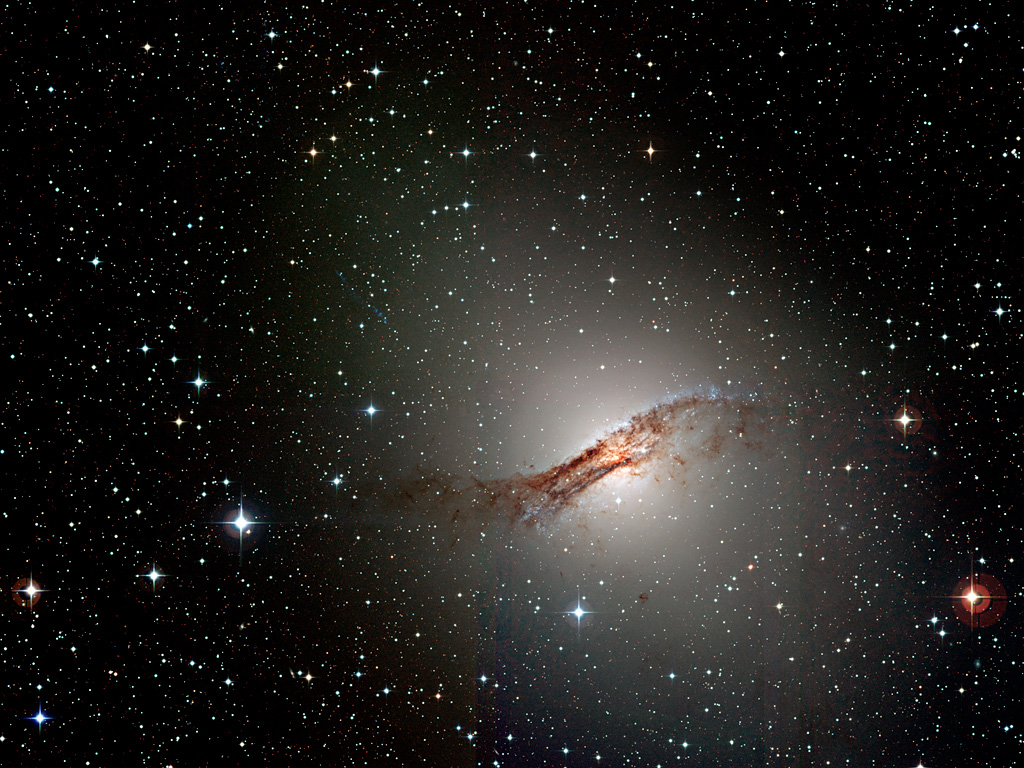
A deep look at the strange galaxy Centaurus A

PR Image eso1221b
The strange galaxy Centaurus A in the constellation of Centaurus

Videos

Zooming in on the strange galaxy Centaurus A

Panning over a deep view at the strange galaxy Centaurus A

The strange galaxy Centaurus A is pictured in a new image from the European Southern Observatory. With a total exposure time of more than 50 hours this is probably the deepest view of this peculiar and spectacular object ever created. The image was produced by the Wide Field Imager of the MPG/ESO 2.2-metre telescope at ESO’s La Silla Observatory in Chile.


Centaurus A, also known as NGC 5128 [1], is a peculiar massive elliptical galaxy with a supermassive black hole at its heart. It lies about 12 million light-years away in the southern constellation of Centaurus (The Centaur) and has the distinction of being the most prominent radio galaxy in the sky. Astronomers think that the bright nucleus, strong radio emission and jet features of Centaurus A are produced by a central black hole with a mass of about 100 million times that of the Sun. Matter from the dense central parts of the galaxy releases vast amounts of energy as it falls towards the black hole.

This Wide Field Imager (WFI) picture allows us to appreciate the galaxy’s elliptical nature, which shows up as the elongated shape of the fainter outer parts. The glow that fills much of the picture comes from hundreds of billions of cooler and older stars. Unlike most elliptical galaxies, however, Centaurus A’s smooth shape is disturbed by a broad and patchy band of dark material that obscures the galaxy’s centre.

The dark band harbours large amounts of gas, dust and young stars. Bright young star clusters appear at the upper-right and lower-left edges of the band along with the red glow of star-forming clouds of hydrogen, whilst some isolated dust clouds are silhouetted against the stellar background. These features, and the prominent radio emission, are strong evidence that Centaurus A is the result of a merger between two galaxies. The dusty band is probably the mangled remains of a spiral galaxy in the process of being ripped apart by the gravitational pull of the giant elliptical galaxy.

The new set of images from WFI include long exposures through red, green and blue filters as well as filters specially designed to isolate the light from glowing hydrogen and oxygen. The latter help us to spot the known optical jet features around Centaurus A, which were barely visible in a previous image from the Wide Field Imager (eso0315a).

Extending from the galaxy to the upper left corner of the image are two groups of reddish filaments, which are roughly lined up with the huge jets that are prominent in radio images. Both sets of filaments are stellar nurseries, containing hot young stars [2]. Above the left side of the dusty band, we find the inner filaments, lying about 30 000 light-years away of the nucleus. Further out, around 65 000 light-years away from the galaxy’s nucleus and close to the upper left corner of the image, the outer filaments are visible. There is also possibly a very much fainter trace of a counter jet extending to the lower right.

Centaurus A has been extensively studied at wavelengths ranging from radio all the way to gamma-rays. In particular, radio and X-ray observations have been crucial for studying the interaction between the energetic output of the central supermassive black hole and its surroundings, see eso0903. Studies of Centaurus A with ALMA are just beginning.

Many of the observations of Centaurus A used to make this image were taken to see whether it was possible to use ground-based surveys to detect and study variable stars in galaxies like Centaurus A outside the local group [3]. More than 200 new variable stars in Centaurus A were discovered.

Notes

[1] The galaxy was first documented by British astronomer James Dunlop at the Parramatta observatory in Australia on August 4, 1826. This galaxy is often called Centaurus A because was the first major source of radio waves discovered in the constellation of Centaurus back in the 1950s.

[2] The origin of both filaments is not clear and astronomers still debate whether they are the result of the ionisation produced by radiation from the nucleus or the result of shocks within the gas clumps.

[3] More information is presented in the paper by J.T.A. de Jong et al. 2008.

More information

The year 2012 marks the 50th anniversary of the founding of the European Southern Observatory (ESO). ESO is the foremost intergovernmental astronomy organisation in Europe and the world’s most productive astronomical observatory. It is supported by 15 countries: Austria, Belgium, Brazil, the Czech Republic, Denmark, France, Finland, Germany, Italy, the Netherlands, Portugal, Spain, Sweden, Switzerland and the United Kingdom. ESO carries out an ambitious programme focused on the design, construction and operation of powerful ground-based observing facilities enabling astronomers to make important scientific discoveries. ESO also plays a leading role in promoting and organising cooperation in astronomical research. ESO operates three unique world-class observing sites in Chile: La Silla, Paranal and Chajnantor. At Paranal, ESO operates the Very Large Telescope, the world’s most advanced visible-light astronomical observatory and two survey telescopes. VISTA works in the infrared and is the world’s largest survey telescope and the VLT Survey Telescope is the largest telescope designed to exclusively survey the skies in visible light. ESO is the European partner of a revolutionary astronomical telescope ALMA, the largest astronomical project in existence. ESO is currently planning a 40-metre-class European Extremely Large optical/near-infrared Telescope, the E-ELT, which will become “the world’s biggest eye on the sky”.

Links
Photos of the MPG/ESO 2.2-metre Telescope
Other photos taken with the MPG/ESO 2.2-metre Telescope
Photos of La Silla

Contacts

Richard Hook
ESO, La Silla, Paranal, E-ELT and Survey Telescopes Public Information Officer
Garching bei München, Germany
Tel: +49 89 3200 6655
Cell: +49 151 15 37 35 91
Email: rhook@eso.org

More aboutA Deeper Look at Centaurus A

Overfed Black Holes Shut Down Galactic Star-Making

Posted by carsimulator on Wednesday, May 9, 2012

This artistically modified image of the local galaxy Arp 220, captured by the Hubble Space Telescope, helps illustrate the Herschel results. The bright core of the galaxy, paired with an overlaid artist's impression of jets emanating from it, indicate that the central black hole's activity is intensifying. As the active black hole continues to rev up, the rate of star formation will, in turn, be tamped down in the galaxy. Astronomers want to further study how star formation and black hole activity are intertwined. Image credit: NASA/JPL-Caltech. Full image and caption

PASADENA, Calif. -- The Herschel Space Observatory has shown galaxies with the most powerful, active black holes at their cores produce fewer stars than galaxies with less active black holes. The results are the first to demonstrate black holes suppressed galactic star formation when the universe was less than half its current age.

Herschel is a European Space Agency-led mission with important NASA contributions.

"We want to know how star formation and black hole activity are linked," said Mathew Page of University College London's Mullard Space Science Laboratory in the United Kingdom and lead author of a paper describing these findings in this week's journal Nature. "The two processes increase together up to a point, but the most energetic black holes appear to turn off star formation."

Supermassive black holes, weighing as much as millions of suns, are believed to reside in the hearts of all large galaxies. When gas falls upon these monsters, the material is accelerated and heated around the black hole, releasing great torrents of energy. Earlier in the history of the universe, these giant, luminous black holes, called active galactic nuclei, were often much brighter and more energetic. Star formation was also livelier back then.

Studies of nearby galaxies suggest active black holes can squash star formation. The revved-up, central black holes likely heat up and disperse the galactic reservoirs of cold gas needed to create new stars. These studies have only provided "snapshots" in time, however, leaving the overall relationship of active galactic nuclei and star formation unclear, especially over the cosmic history of galaxy formation.

"To understand how active galactic nuclei affect star formation over the history of the universe, we investigated a time when star formation was most vigorous, between eight and 12 billion years ago," said co-author James Bock, a senior research scientist at NASA's Jet Propulsion Laboratory in Pasadena, Calif., and co-coordinator of the Herschel Multi-tiered Extragalactic Survey. "At that epoch, galaxies were forming stars 10 times more rapidly than they are today on average. Many of these galaxies are incredibly luminous, more than 1,000 times brighter than our Milky Way."

For the new study, Page and colleagues used Herschel data that probed 65 galaxies at wavelengths equivalent to the thickness of several sheets of office paper, a region of the light spectrum known as far-infrared. These wavelengths reveal the rate of star formation, because most of the energy released by developing stars heats surrounding dust, which then re-radiates starlight out in far-infrared wavelengths.

The researchers compared their infrared readings with X-rays streaming from the active central black holes in the survey's galaxies, measured by NASA's Chandra X-ray Observatory. At lower intensities, the black holes' brightness and star formation increased in sync. However, star formation dropped off in galaxies with the most energetic central black holes. Astronomers think inflows of gas fuel new stars and supermassive black holes. Feed a black hole too much, however, and it starts spewing radiation into the galaxy that prevents raw material from coalescing into new stars.

"Now that we see the relationship between active supermassive black holes and star formation, we want to know more about how this process works," said Bill Danchi, Herschel program scientist at NASA Headquarters in Washington. "Does star formation get disrupted from the beginning with the formation of the brightest galaxies of this type, or do all active black holes eventually shut off star formation, and energetic ones do this more quickly than less active ones?"

Herschel is a European Space Agency cornerstone mission, with science instruments provided by consortia of European institutes and important participation by NASA. NASA's Herschel Project Office is based at JPL. JPL contributed mission-enabling technology for two of Herschel's three science instruments. The NASA Herschel Science Center, part of the Infrared Processing and Analysis Center at Caltech, supports the United States astronomical community. Caltech manages JPL for NASA.

For NASA's Herschel website, visit http://www.nasa.gov/herschel/ . For ESA's Herschel website, visit http://www.esa.int/SPECIALS/Herschel/index.html .

Whitney Clavin 818-354-4673
Jet Propulsion Laboratory, Pasadena, Calif.
whitney.clavin@jpl.nasa.gov

J.D. Harrington 202-358-5241
Headquarters, Washington
j.d.harrington@nasa.gov

More aboutOverfed Black Holes Shut Down Galactic Star-Making

Black Hole Caught Red-handed in a Stellar Homicide

Posted by carsimulator on Wednesday, May 2, 2012

This computer-simulated image shows gas from a tidally shredded star falling into a black hole. Some of the gas also is being ejected at high speeds into space. Astronomers observed a flare in ultraviolet and optical light from the gas falling into the black hole and glowing helium from the stars's helium-rich gas expelled from the system. Credit: NASA, S. Gezari (The Johns Hopkins University), and J. Guillochon (University of California, Santa Cruz). Release Images

Before/after Flare (GALEX/Pan-STARRS1)
Credit:NASA, S. Gezari (The Johns Hopkins University),
A. Rest (STScI), and R. Chornock (Harvard-Smithsonian Center for Astrophysics)

Black Hole Flare Simulation: Wide View with Inset & Time
Credit: NASA, S. Gezari (The Johns Hopkins University),
and J. Guillochon (University of California, Santa Cruz)
Release Videos

Astronomers have gathered the most direct evidence yet of a supermassive black hole shredding a star that wandered too close.

Supermassive black holes, weighing millions to billions times more than the Sun, lurk in the centers of most galaxies. These hefty monsters lay quietly until an unsuspecting victim, such as a star, wanders close enough to get ripped apart by their powerful gravitational clutches.

Astronomers have spotted these stellar homicides before, but this is the first time they can identify the victim. Using a slew of ground- and space-based telescopes, a team of astronomers led by Suvi Gezari of The Johns Hopkins University in Baltimore, Md., has identified the victim as a star rich in helium gas. The star resides in a galaxy 2.7 billion light-years away.

Her team's results will appear May 2 in the online edition of the journal Nature.

"When the star is ripped apart by the gravitational forces of the black hole, some part of the star's remains falls into the black hole, while the rest is ejected at high speeds. We are seeing the glow from the stellar gas falling into the black hole over time. We're also witnessing the spectral signature of the ejected gas, which we find to be mostly helium. It is like we are gathering evidence from a crime scene. Because there is very little hydrogen and mostly helium in the gas we detect from the carnage, we know that the slaughtered star had to have been the helium-rich core of a stripped star," Gezari explained.

This observation yields insights about the harsh environment around black holes and the types of stars swirling around them.

This is not the first time the unlucky star had a brush with the behemoth black hole. Gezari and her team think the star's hydrogen-filled envelope surrounding its core was lifted off a long time ago by the same black hole. In their scenario, the star may have been near the end of its life. After consuming most of its hydrogen fuel, it had probably ballooned in size, becoming a red giant. The astronomers think the bloated star was looping around the black hole in a highly elliptical orbit, similar to a comet's elongated orbit around the Sun. On one of its close approaches, the star was stripped of its puffed-up atmosphere by the black hole's powerful gravity. Only its core remained intact. The stellar remnant continued its journey around the black hole, until it ventured even closer to the behemoth monster and faced its ultimate demise.

Astronomers have predicted that stripped stars circle the central black hole of our Milky Way galaxy, Gezari pointed out. These close encounters, however, are rare, occurring roughly every 100,000 years. To find this one event, Gezari's team monitored hundreds of thousands of galaxies in ultraviolet light with the NASA's Galaxy Evolution Explorer (GALEX), a space-based observatory, and in visible light with the Pan-STARRS1 telescope on the summit of Haleakala in Hawaii. Pan-STARRS, short for Panoramic Survey Telescope and Rapid Response System, scans the entire night sky for all kinds of transient phenomena, including supernovae.

The team was looking for a bright flare in ultraviolet light from the nucleus of a galaxy with a previously dormant black hole. They found one in June 2010, which was spotted with both telescopes. Both telescopes continued to monitor the flare as it reached peak brightness a month later and then slowly began to fade over the next 12 months. The brightening event was similar to that of a supernova, but the rise to the peak was much slower, taking nearly one and a half months.

"The longer the event lasted, the more excited we got, since we realized that this is either a very unusual supernova or an entirely different type of event, such as a star being ripped apart by a black hole," said team member Armin Rest of the Space Telescope Science Institute in Baltimore, Md.

By measuring the increase in brightness, the astronomers calculated the black hole's mass to be several million suns, which is comparable to the size of our Milky Way's black hole.

Spectroscopic observations with the MMT (Multiple Mirror Telescope) Observatory on Mount Hopkins in Arizona showed that the black hole was swallowing lots of helium. Spectroscopy divides light into its rainbow colors, which yields an object's characteristics, such as its temperature and gaseous makeup.

"The glowing helium was a tracer for an extraordinarily hot accretion event," Gezari said. "So that set off an alarm for us. And, the fact that no hydrogen was found set off a big alarm that this was not typical gas. You can't find gas like that lying around near the center of a galaxy. It's processed gas that has to have come from a stellar core. There's nothing about this event that could be easily explained by any other phenomenon."

The observed speed of the gas also linked the material to a black hole's gravitational pull. MMT measurements revealed that the gas was moving at more than 20 million miles an hour (over 32 million kilometers an hour). However, measurements of the speed of gas in the interstellar medium reveal velocities of only about 224,000 miles an hour (360,000 kilometers an hour).

"The place we also see these kinds of velocities are in supernova explosions," Rest said. "But the fact that it is still shining in ultraviolet light is incompatible with any supernova we know."

To completely rule out the possibility of an active nucleus flaring up in the galaxy, the team used NASA's Chandra X-ray Observatory to study the hot gas. Chandra showed that the characteristics of the gas didn't match those from an active galactic nucleus.

"This is the first time where we have so many pieces of evidence, and now we can put them all together to weigh the perpetrator (the black hole) and determine the identity of the unlucky star that fell victim to it," Gezari said. "These observations also give us clues to what evidence to look for in the future to find this type of event."

The Space Telescope Science Institute (STScI) in Baltimore, Md., is operated for NASA by the Association of Universities for Research in Astronomy, Inc., in Washington, D.C. STScI conducts science operations for the Hubble Space Telescope and is the science and mission operations center for the James Webb Space Telescope.

The California Institute of Technology in Pasadena, Calif., leads the Galaxy Evolution Explorer mission and is responsible for science operations and data analysis. NASA's Jet Propulsion Laboratory, also in Pasadena, manages the mission and built the science instrument. The mission was developed under NASA's Explorers Program managed by the Goddard Space Flight Center, Greenbelt, Md. Researchers sponsored by Yonsei University in South Korea and the Centre National d'Etudes Spatiales (CNES) in France collaborated on this mission.

Graphics and additional information about the Galaxy Evolution Explorer are online at http://www.nasa.gov/galex and http://www.galex.caltech.edu

The Pan-STARRS Project is being led by the University of Hawaii Institute for Astronomy, and exploits the unique combination of superb observing sites and technical and scientific expertise available in Hawaii. Funding for the development of the observing system has been provided by the United States Air Force Research Laboratory. The PS1 Surveys have been made possible through contributions by the Institute for Astronomy, the University of Hawaii, the Pan-STARRS Project Office, the Max-Planck Society and its participating institutes, the Max Planck Institute for Astronomy, Heidelberg and the Max Planck Institute for Extraterrestrial Physics, Garching, The Johns Hopkins University, Durham University, the University of Edinburgh, the Queen's University Belfast, the Harvard-Smithsonian Center for Astrophysics, the Las Cumbres Observatory Global Telescope Network, Incorporated, the National Central University of Taiwan, and the National Aeronautics and Space Administration under Grant No. NNX08AR22G issued through the Planetary Science Division of the NASA Science Mission Directorate.

CONTACT

Donna Weaver
Space Telescope Science Institute, Baltimore, Md.
410-338-4493
dweaver@stsci.edu

Suvi Gezari
The Johns Hopkins University, Baltimore, Md.
410-516-3462
suvi@pha.jhu.edu

Armin Rest
Space Telescope Science Institute, Baltimore, Md.
410-338-4358
arest@stsci.edu

More aboutBlack Hole Caught Red-handed in a Stellar Homicide

NASA's WISE Mission Sees Skies Ablaze With Blazars

Posted by carsimulator on Friday, April 13, 2012

This artist's concept shows a "feeding," or active, supermassive black hole with a jet streaming outward at nearly the speed of light. Such active black holes are often found at the hearts of elliptical galaxies. Not all black holes have jets, but when they do, the jets can be pointed in any direction. If a jet happens to shine at Earth, the object is called a blazar. Image credit: NASA/JPL-Caltech. Full image and caption

This image taken by NASA's Wide-field Infrared Survey Explorer (WISE) shows a blazar -- a voracious supermassive black hole inside a galaxy with a jet that happens to be pointed right toward Earth. These objects are rare and hard to find, but astronomers have discovered that they can use the WISE all-sky infrared images to uncover new ones. So far, researchers have found more than 200 new blazars, and they say WISE has the potential to find many more. Image credit: NASA/JPL-Caltech/Kavli. Full image and caption - enlarge image

PASADENA, Calif. - Astronomers are actively hunting a class of supermassive black holes throughout the universe called blazars thanks to data collected by NASA's Wide-field Infrared Survey Explorer (WISE). The mission has revealed more than 200 blazars and has the potential to find thousands more.

Blazars are among the most energetic objects in the universe. They consist of supermassive black holes actively "feeding," or pulling matter onto them, at the cores of giant galaxies. As the matter is dragged toward the supermassive hole, some of the energy is released in the form of jets traveling at nearly the speed of light. Blazars are unique because their jets are pointed directly at us.

"Blazars are extremely rare because it's not too often that a supermassive black hole's jet happens to point towards Earth," said Francesco Massaro of the Kavli Institute for Particle Astrophysics and Cosmology near Palo Alto, Calif., and principal investigator of the research, published in a series of papers in the Astrophysical Journal. "We came up with a crazy idea to use WISE's infrared observations, which are typically associated with lower-energy phenomena, to spot high-energy blazars, and it worked better than we hoped."

The findings ultimately will help researchers understand the extreme physics behind super-fast jets and the evolution of supermassive black holes in the early universe.

WISE surveyed the entire celestial sky in infrared light in 2010, creating a catalog of hundreds of millions of objects of all types. Its first batch of data was released to the larger astronomy community in April 2011 and the full-sky data were released last month.

Massaro and his team used the first batch of data, covering more than one-half the sky, to test their idea that WISE could identify blazars. Astronomers often use infrared data to look for the weak heat signatures of cooler objects. Blazars are not cool; they are scorching hot and glow with the highest-energy type of light, called gamma rays. However, they also give off a specific infrared signature when particles in their jets are accelerated to almost the speed of light.

One of the reasons the team wants to find new blazars is to help identify mysterious spots in the sky sizzling with high-energy gamma rays, many of which are suspected to be blazars. NASA's Fermi mission has identified hundreds of these spots, but other telescopes are needed to narrow in on the source of the gamma rays.

Sifting through the early WISE catalog, the astronomers looked for the infrared signatures of blazars at the locations of more than 300 gamma-ray sources that remain mysterious. The researchers were able to show that a little more than half of the sources are most likely blazars.

"This is a significant step toward unveiling the mystery of the many bright gamma-ray sources that are still of unknown origin," said Raffaele D'Abrusco, a co-author of the papers from Harvard Smithsonian Center for Astrophysics in Cambridge, Mass. "WISE's infrared vision is actually helping us understand what's happening in the gamma-ray sky."

The team also used WISE images to identify more than 50 additional blazar candidates and observed more than 1,000 previously discovered blazars. According to Massaro, the new technique, when applied directly to WISE's full-sky catalog, has the potential to uncover thousands more.

"We had no idea when we were building WISE that it would turn out to yield a blazar gold mine," said Peter Eisenhardt, WISE project scientist at NASA's Jet Propulsion Laboratory in Pasadena, Calif., who is not associated with the new studies. "That's the beauty of an all-sky survey. You can explore the nature of just about any phenomenon in the universe."

Other authors include: A. Paggi and H.A. Smith of Harvard's Smithsonian Astrophysical Observatory; G. Tosti of the University of Perugia, Italy; M. Ajello of Stanford University, Stanford, Calif.; J.E. Grindlay of the Harvard College Observatory, Cambridge, Mass; and D. Gasparrini of the Italian Space Agency, Science Data Center, Italy.

The Kavli Institute for Particle Astrophysics and Cosmology is a joint institute of Stanford University and SLAC National Accelerator Laboratory in Menlo Park, Calif.

JPL manages and operates WISE for NASA's Science Mission Directorate in Washington. The principal investigator for WISE, Edward Wright, is at UCLA. The mission was competitively selected under NASA's Explorers Program, managed by the Goddard Space Flight Center in Greenbelt, Md. The science instrument was built by the Space Dynamics Laboratory in Logan, Utah, and the spacecraft was built by Ball Aerospace & Technologies Corp. in Boulder, Colo. Science operations and data processing and archiving take place at the Infrared Processing and Analysis Center at the California Institute of Technology in Pasadena. Caltech manages JPL for NASA.


Whitney Clavin 818-354-4673
Jet Propulsion Laboratory, Pasadena, Calif.
Whitney.clavin@jpl.nasa.gov

J.D. Harrington 202-358-5241
NASA Headquarters, Washington
j.d.harrington@nasa.gov

More aboutNASA's WISE Mission Sees Skies Ablaze With Blazars

Centaurus A

Posted by carsimulator on Wednesday, April 4, 2012

Centaurus A
ESA/Herschel/PACS/SPIRE/VNGS ;
ESA/XMM-Newton/EPIC


Observations by the two of the European Space Agency's space observatories have provided a multi-wavelength view of the mysterious galaxy Centaurus A. The new images, from the Herschel Space Observatory and the XMM-Newton x-ray satellite, are revealing further hints about its cannibalistic past and energetic processes going on in its core.

At a distance of around 12 million light years, Centaurus A is the closest large elliptical galaxy to our own Milky Way. It has been marked as unusual since shortly after its discovery in the 19th century due to a thick lane of dust across its centre – an unusual feature for an elliptical galaxy. But it wasn't until a century later that the galaxy’s true nature was revealed.

Emanating from its core are two massive jets of material streaming from a massive black hole in the heart of Centaurus A. When observed by radio telescopes, the jets stretch for up to a million light years, though the Herschel and XMM-Newton results focus on the inner regions.

“Centaurus A is the closest example of a galaxy to us with massive jets from its central black hole,” explained Prof Christine Wilson of McMaster University, Canada, who is leading the study of Centaurus A with Herschel. “Observations with Herschel, XMM-Newton and telescopes at many other wavelengths allow us to study their effects on the galaxy and its surroundings.”

Centaurus A in visible light, showing the dark dust lane across its centre
Image credit: ESO.

Centaurus A as seen in far-infrared light by Herschel, showing the twisted disc in the centre, the jets from the black hole, and two clumps of dust. Image credit: ESA/Herschel/SPIRE/PACS

Strong radio emission is caused by electrons travelling at close to the speed of light through strong magnetic fields, and is so bright that the jets are even visible in the far-infrared images from the Herschel Space Observatory. As well as the jets, the images from this infrared observatory also show a twisted disc of dust near the galaxy’s centre.

This odd shape is strong evidence that Centaurus A underwent a cosmic collision with another galaxy in the distant past. The colliding galaxy was ripped apart to form the warped disc, and the formation of young stars heats the dust to cause the infrared glow seen by Herschel.

Such collisions often result in shells and rings of gas and dust, and Centaurus A is no exception. Herschel observations have now confirmed the presence of two clumps of dust that seem to be lined up with the two lobes of the jets.

“The apparent alignment of two clumps with the two jets now seems to be a cosmic coincidence, and it appears that the dust originated from one of the colliding galaxies.” explained Dr Robbie Auld, of Cardiff University. “Unlike most dust Herschel sees, which is heated by nearby star formation, the dust in these clumps is being heated by old stars in Centaurus A itself, up to 50,000 light years away.”

Centaurus A as seen in x-rays by XMM-Newton, showing the jets from the black hole and the super-heated gas. Image credit: ESA/XMM-Newton/EPIC

In x-rays the effect of the two jets of material is clearly visible. Showing the presence of extremely hot gas, the images from the XMM-Newton x-ray satellite clearly show the axis of the one of the jets. While the other jet itself is not seen in by XMM-Newton, the gas it is ploughing into is shocked and heated to very high temperatures, creating a bright x-ray glow.

“XMM-Newton is the observatory most suited to detecting extended weak X-ray emission, often allowing us to see halos around galaxies for the first time,” notes Norbert Schartel, XMM-Newton Project Scientist.

In the centre of the galaxy, the massive black hole is also having an effect on its immediate surroundings. The material around it glows brightly in x-rays, but there Herschel has identified an apparent deficit of dust within a few thousand light years of the black hole.

“This could be due to intense x-rays destroying the tiny dust grains, or due to the way the warped ring of dust is affecting star formation” said Prof Wilson. “Either way, Centaurus A is the ideal place to study the extreme processes that occur near super-massive black holes"

Centaurus A at visible, far-infrared and x-ray wavelengths. Image credit:ESA/Herschel/SPIRE/PACS/VNGS (far-infrared) ; ESA/XMM-Newton/EPIC (x-ray) ; ESO (visible). Click view

More aboutCentaurus A

Cosmic 'Leaf Blower' Robs Galaxy of Star-Making Fuel

Posted by carsimulator on Tuesday, April 3, 2012

Time is running out for the galaxy NGC 3801, seen in this composite image combining light from across the spectrum, ranging from ultraviolet to radio. NASA's Galaxy Evolution Explorer and other instruments have helped catch the galaxy NGC 3801 in the act of destroying its cold, gaseous fuel for new stars. Astronomers believe this marks the beginning of its transition from a vigorous spiral galaxy to a quiescent elliptical galaxy whose star-forming days are long past. Image credit: NASA/JPL-Caltech/SDSS/NRAO/ASIAA. Full image and caption

Astronomers believe they have caught the galaxy NGC 3810 at a critical point in its history, just as it is making the transition from a vigorous spiral galaxy to a quiescent elliptical galaxy whose star-forming days are long past. This diagram sketches out the stages leading up to its current observed state and beyond. Image credit: NASA/JPL-Caltech. Full image and caption - enlarge image

Supernova explosions and the jets of a monstrous black hole are scattering a galaxy's star-making gas like a cosmic leaf blower, a new study finds. The findings, which relied on ultraviolet observations from NASA's Galaxy Evolution Explorer and a host of other instruments, fill an important gap in the current understanding of galactic evolution.

It has long been known that gas-rich spiral galaxies like our Milky Way smash together to create elliptical galaxies such as the one observed in the study. These big, round galaxies have very little star formation. The reddish glow of aging stars comes to dominate the complexion of elliptical galaxies, so astronomers refer to them as "red and dead."

The process that drives the dramatic transformation from spiral galactic youth to elderly elliptical is the rapid loss of cool gas, the fuel from which new stars form. Supernova explosions can start the decline in star formation, and then shock waves from the supermassive black hole finish the job. Now astronomers think they have identified a recently merged galaxy where this gas loss has just gotten underway.

"We have caught a galaxy in the act of destroying its gaseous fuel for new stars and marching toward being a red-and-dead type of galaxy," said Ananda Hota, lead author of a new paper in the Monthly Notices of the Royal Astronomical Society. Hota, an astronomer in Pune, India, conducted the study as a post-doctoral research fellow at the Institute of Astronomy & Astrophysics at Academia Sinica in Taipei, Taiwan.

"We have found a crucial missing piece to connect and solve the puzzle of this phase of galaxy evolution," Hota added.

The supermassive black holes that reside in the centers of galaxies can flare up when engorged by gas during galactic mergers. As a giant black hole feeds, colossal jets of matter shoot out from it, giving rise to what is known as an active galactic nucleus. According to theory, shock waves from these jets heat up and disperse the reservoirs of cold gas in elliptical galaxies, thus preventing new stars from taking shape.

The galaxy Hota and his team looked at, called NGC 3801, shows signs of such a process. NGC 3801 is unique in that evidence of a past merger is clearly seen, and the shock waves from the central black hole's jets have started to spread out very recently. The researchers used the Galaxy Evolution Explorer to determine the age of the galaxy's stars and decipher its evolutionary history. The ultraviolet observations show that NGC 3801's star formation has petered out over the last 100 to 500 million years, demonstrating that the galaxy has indeed begun to leave behind its youthful years. The lack of many big, new, blue stars makes NGC 3801 look yellowish and reddish in visible light, and thus middle-aged.

What's causing the galaxy to age and make fewer stars? The short-lived blue stars that formed right after it merged with another galaxy have already blown up as supernovae. Data from NASA's Hubble Space Telescope revealed that those stellar explosions have triggered a fast outflow of heated gas from NGC 3801's central regions. That outflow has begun to banish the reserves of cold gas, and thus cut into NGC 3801's overall star making.

Some star formation is still happening in NGC 3801, as shown in ultraviolet wavelengths observed by the Galaxy Evolution Explorer, and in infrared wavelengths detected by NASA's Spitzer Space Telescope. But that last flicker of youth will soon be extinguished by colossal shock waves from the black hole's jets, seen in X-ray light by NASA's Chandra X-ray Observatory. These blast waves are rushing outward from the galactic center at a velocity of nearly two million miles per hour (nearly 900 kilometers per second). The waves will reach the outer portions of NGC 3801 in about 10 million years, scattering any remaining cool hydrogen gas and rendering the galaxy truly red and dead.

Astronomers think the transition captured early-on in the case of NGC 3801 -- from the merger of gas-rich galaxies to the rise of an old-looking elliptical -- happens very quickly on cosmic time scales.

"The quenching of star formation by feedback from the active galactic nucleus probably occurs in just a billion years. That's not very long compared to the 10-billion-year age of a typical big galaxy," said Hota. "The explosive shock wave event caused by the central black hole is so powerful that it can dramatically change the future course of the evolution of an entire galaxy."

Additional observations for the study in optical light come from the Sloan Digital Sky Survey and in radio using the Very Large Array in New Mexico.

Other authors of the paper include Soo-Chang Rey, Suk Kim and Jiwon Chung of Chungnam National University, Daejeon, Republic of Korea; Yongbeom Kang, also of Chungnam National University and Johns Hopkins University, Baltimore, Md.; and Satoki Matsushita, also of the Academia Sinica Institute of Astronomy and Astrophysics, Taipei, Taiwan.

Caltech leads the Galaxy Evolution Explorer mission and is responsible for science operations and data analysis. NASA's Jet Propulsion Laboratory, also in Pasadena, manages the mission and built the science instrument. The mission was developed under NASA's Explorers Program managed by the Goddard Space Flight Center, Greenbelt, Md. Researchers sponsored by Yonsei University in South Korea and the Centre National d'Etudes Spatiales (CNES) in France collaborated on this mission. Graphics and additional information about the Galaxy Evolution Explorer are online at http://www.nasa.gov/galex and http://www.galex.caltech.edu .

JPL manages the Spitzer Space Telescope mission for NASA's Science Mission Directorate, Washington. Science operations are conducted at the Spitzer Science Center at the California Institute of Technology in Pasadena. Caltech manages JPL for NASA. For more information about Spitzer, visit http://spitzer.caltech.edu and http://www.nasa.gov/spitzer

Written by Adam Hadhazy

Media Contact:
Whitney Clavin 818-354-4673
Jet Propulsion Laboratory, Pasadena, Calif.
whitney.clavin@jpl.nasa.gov

More aboutCosmic 'Leaf Blower' Robs Galaxy of Star-Making Fuel

How Black Holes Grow

Posted by carsimulator on Monday, April 2, 2012

Artist’s conception of a supermassive black hole (lower left) with its tremendous gravity capturing one star (bluish, center) from a pair of binary stars, while hurling the second star (yellowish, upper right) away at a hypervelocity of more than 1 million mph. The grayish blobs are other stars captured in a cluster near the black hole. They appear distorted because the black hole’s gravity curves spacetime and thus bends the starlight. Photo Credit: Ben Bromley, University of Utah. Click to view


University of Utah astrophysicist Ben Bromley and colleagues at the Smithsonian Astrophysical Observatory say that calculations and observations provide strong evidence that supermassive black holes grow so big by repeatedly capturing one star from pairs of binary stars, while hurling the other binary partner into space at a hypervelocity of more than 1 million mph. Photo Credit: Lee J. Siegel, University of Utah. Click to view


Evidence Indicates They Eat Binary Star Partners


April 2, 2012 – A study led by a University of Utah astrophysicist found a new explanation for the growth of supermassive black holes in the center of most galaxies: they repeatedly capture and swallow single stars from pairs of stars that wander too close.

Using new calculations and previous observations of our own Milky Way and other galaxies, “we found black holes grow enormously as a result of sucking in captured binary star partners,” says physics and astronomy Professor Ben Bromley, lead author of the study, which is set for online publication April 2 in Astrophysical Journal Letters.

“I believe this has got to be the dominant method for growing supermassive black holes,” he adds. “There are two ways to grow a supermassive black hole: with gas clouds and with stars. Sometimes there’s gas and sometimes there is not. We know that from observations of other galaxies. But there are always stars.”

“Our mechanism is an efficient way to bring a star to a black hole,” Bromley says. “It’s really hard to target a single star at a black hole. It’s a lot easier to throw a binary at it,” just as it’s more difficult to hit a target using a slingshot, which hurls a single stone, than with a bola, which hurls two weights connected by a cord.

A binary pair of stars orbiting each other “is essentially a single object much bigger than the size of the individual stars, so it is going to interact with the black hole more efficiently,” he explains. “The binary doesn’t have to get nearly as close for one of the stars to get ripped away and captured.”

But to prove the theory will require more powerful telescopes to find three key signs: large numbers of small stars captured near supermassive black holes, more observations of stars being “shredded” by gravity from black holes, and large numbers of “hypervelocity stars” that are flung from galaxies at more than 1 million mph when their binary partners are captured.

Bromley, a University of Utah astrophysicist, did the study with astronomers Scott Kenyon, Margaret Geller and Warren Brown, all of the Smithsonian Astrophysical Observatory in Cambridge, Mass. The study was funded by both institutions.

What Does a Supermassive Black Hole Eat: Gas or Stars?

Black holes are objects in space so dense that not even light can escape their gravity, although powerful jets of light and energy can be emitted from a black hole’s vicinity as gas and stars are sucked into it.

Small black holes result from the collapse of individual stars. But the centers of most galaxies, including our own Milky Way, are occupied by what are popularly known as “supermassive” black holes that contain mass ranging from 1 million to 10 billion stars the size of our sun.

Astrophysicists long have debated how supermassive black holes grew during the 14 billion years since the universe began in a great expansion of matter and energy named the Big Bang. One side believes black holes grow larger mainly by sucking in vast amounts of gas; the other side says they grow primarily by capturing and sucking in stars.

Just last month, other researchers published a theory that a black hole sucks in “food” by tipping its “plates” – two tilted gas disks colliding as they orbit the black hole – in a way that makes the speeding gas slow down so the black hole can swallow it.

Bromley says that theory overcomes a key problem: gas flows into black holes inefficiently. “But are misaligned gas disks common enough to be important for black hole growth?” he asks. “It’s fair to say that gas contributes to the growth of black holes, but it is still uncertain how.”

The new theory about binary stars – a pair of stars that orbit each other – arose from Bromley’s earlier research to explain hypervelocity stars, which have been observed leaving our Milky Way galaxy at speeds ranging from 1.1 million to 1.8 million mph, compared with the roughly 350,000 mph speed of most stars.

Munching Binaries: One is Captured, One Speeds Away

“The hypervelocity stars we see come from binary stars that stray close to the galaxy’s massive black hole,” he says. “The hole peels off one binary partner, while the other partner – the hypervelocity star – gets flung out in a gravitational slingshot.”

“We put the numbers together for observed hypervelocity stars and other evidence, and found that the rate of binary encounters [with our galaxy’s supermassive black hole] would mean most of the mass of the galaxy’s black hole came from binary stars,” Bromley says. “We estimated these interactions for supermassive black holes in other galaxies and found that they too can grow to billions of solar masses in this way.”

As many as half of all stars are in binary pairs, so they are plentiful in the Milky Way and other galaxies, he adds. But the study assumed conservatively that only 10 percent of stars exist in binary pairs.

The new study looked at each step in the process of a supermassive black hole eating binary stars, and calculated what would be required for the process to work in terms of the rates at which hypervelocity stars are produced, binary partners are captured, the captured stars are bound to the black hole in elongated orbits and then sucked into it.

The scientists then compared the results with actual observations of supermassive black holes, stars clustering near them and “tidal disruption events” in which black holes in other galaxies are seen to shred stars while pulling them into the hole.

“It fits together, and it works,” Bromley says. “When we look at observations of how stars are accumulating in our galactic center, it’s clear that much of the mass of the black hole likely came from binary stars that were torn apart.”

He refers to the process of a supermassive black hole capturing stars from binary pairs as “filling the bathtub.” Once the tub – the area near the black hole – is occupied by a cluster of captured stars, they go “down the drain” into the black hole over millions of years. His study shows the “tub” fills at about the same rate it drains, meaning stars captured by a supermassive black hole eventually are swallowed.

The study’s key conclusions:

  • The theory accurately predicts the rate (one every 1,000 to 100,000 years) at which hypervelocity stars are observed leaving our galaxy and at which stars are captured into the star cluster seen near our galaxy’s supermassive black hole.
  • The rate of “tidal disruption events,” which are stars being shredded and pulled into supermassive black holes in other galaxies, also matches what the theory predicts, based on the limited number seen since they first were observed in the early 2000s. That rate also is one every 1,000 to 100,000 years.
  • The calculations show how the theory’s rate of binary capture and consumption can explain how the Milky Way’s supermassive black hole has at least doubled to quadrupled in mass during the past 5 billion to 10 billion years.

When the researchers considered the number of stars near the Milky Way’s center, their speed and the odds they will encounter the supermassive black hole, they estimated that one binary star will be torn apart every 1,000 years by the hole’s gravity.

During the last 10 billion years, that would mean the Milky Way’s supermassive black hole ate 10 million solar masses – more than enough to account for the hole’s actual size of 4 million solar masses.

“We found a wide range of black hole masses can be explained by this process,” Bromley says.

Confirmation of the theory must await more powerful orbiting and ground-based telescopes. To confirm the theory, such telescopes should find many more stars in the cluster near the Milky Way’s supermassive black hole (we now see only the brightest ones), a certain rate of hypervelocity stars in southern skies, and more observations of stars being shredded in other galaxies.

The full study is available on the arXiv preprint server at:

http://arxiv.org/abs/1203.6685

The study will be published online by late April 2 by Astrophysical Journal Letters, but only the abstract may be available to nonsubscribers: http://iopscience.iop.org/2041-820


Media Contacts For This Story

Benjamin Bromley
professor of physics and astronomy
Office Phone: 801-581-8227
Email address: bromley@physics.utah.edu


Lee J. Siegel
science news specialist, the University of Utah
Office Phone: 801-581-8993
Cell Phone: 801-244-5399
Email address: lee.siegel@utah.edu

Source: The University of Utah - News Center

More aboutHow Black Holes Grow