Showing posts with label Dark Matter. Show all posts

Plenty of dark matter near the Sun

Posted by carsimulator on Thursday, August 9, 2012

The high resolution simulation of the Milky Way used to test the mass-measuring technique. Credit: Dr A. Hobbs.

Astronomers at the University of Zürich, the ETH Zurich, the University of Leicester and NAOC Beijing have found large amounts of invisible "dark matter" near the Sun. Their results are consistent with the theory that the Milky Way Galaxy is surrounded by a massive "halo" of dark matter, but this is the first study of its kind to use a method rigorously tested against mock data from high quality simulations. The authors also find tantalising hints of a new dark matter component in our Galaxy. The team's results will be published in the journal Monthly Notices of the Royal Astronomical Society.

Dark matter was first proposed by the Swiss astronomer Fritz Zwicky in the 1930s. He found that clusters of galaxies were filled with a mysterious dark matter that kept them from flying apart. At nearly the same time, Jan Oort in the Netherlands discovered that the density of matter near the Sun was nearly twice what could be explained by the presence of stars and gas alone. In the intervening decades, astronomers developed a theory of dark matter and structure formation that explains the properties of clusters and galaxies in the Universe, but the amount of dark matter in the solar neighbourhood has remained more mysterious. For decades after Oort's measurement, studies found 3-6 times more dark matter than expected. Then last year new data and a new method claimed far less than expected. The community was left puzzled, generally believing that the observations and analyses simply weren't sensitive enough to perform a reliable measurement.

In this latest study, the authors are much more confident in their measurement and its uncertainties. This is because they used a state-of-the-art simulation of our Galaxy to test their mass-measuring technique before applying it to real data. This threw up a number of surprises. They found that standard techniques used over the past 20 years were biased, always tending to underestimate the amount of dark matter. They then devised a new unbiased technique that recovered the correct answer from the simulated data. Applying their technique to the positions and velocities of thousands of orange K dwarf stars near the Sun, they obtained a new measure of the local dark matter density.

Lead author Silvia Garbari says: "We are 99% confident that there is dark matter near the Sun. In fact, our favoured dark matter density is a little high. There is a 10% chance that this is merely a statistical fluke. But with 90% confidence, we find more dark matter than expected. If future data confirms this high value, the implications are exciting. It could be the first evidence for a "disc" of dark matter in our Galaxy, as recently predicted by theory and numerical simulations of galaxy formation. Or it could be that the dark matter halo of our Galaxy is squashed, boosting the local dark matter density."

Many physicists are placing their bets on dark matter being a new fundamental particle that interacts only very weakly with normal matter -- but strongly enough to be detected in experiments deep underground where confusing cosmic ray events are screened by over a kilometre of solid rock.

An accurate measure of the local dark matter density is vital for such experiments as co-author Prof. George Lake explains: "If dark matter is a fundamental particle, billions of these particles will have passed through your body by the time your finish reading this article. Experimental physicists hope to capture just a few of these particles each year in experiments like XENON and CDMS currently in operation. Knowing the local properties of dark matter is the key to revealing just what kind of particle it consists of."


Science contacts

Silvia Garbari
Tel: +41 76 211 05 12

silvia@physik.uzh.ch

Prof. Justin Read
Tel: +41 76 200 5394

justin.read@phys.ethz.ch

Media contact

Robert Massey
Royal Astronomical Society
Mob: +44 (0)794 124 8035

rm@ras.org.uk


Image and caption

An image from the simulation can be downloaded from: http://www.astro.phys.ethz.ch/~jread/Press/mw_hr_00260_disk.jpg

Caption: The high resolution simulation of the Milky Way used to test the mass-measuring technique. Credit: Dr A. Hobbs


Further information


The new work appears in: "A new determination of the local dark matter density from the kinematics of K dwarfs", Monthly Notices of the Royal Astronomical Society, in press. A preprint of the paper is available from
http://arxiv.org/pdf/1206.0015v2.pdf


Notes for editors


The Royal Astronomical Society (RAS,
www.ras.org.uk), founded in 1820, encourages and promotes the study of astronomy, solar-system science, geophysics and closely related branches of science. The RAS organizes scientific meetings, publishes international research and review journals, recognizes outstanding achievements by the award of medals and prizes, maintains an extensive library, supports education through grants and outreach activities and represents UK astronomy nationally and internationally. Its more than 3500 members (Fellows), a third based overseas, include scientific researchers in universities, observatories and laboratories as well as historians of astronomy and others.

Follow the RAS on Twitter via @royalastrosoc

More aboutPlenty of dark matter near the Sun

Under 'dark halo' old galaxies have many more stars

Posted by carsimulator on Thursday, April 26, 2012

Omega Centauri: the tiny red stars (blue is hot red is cold) are just the sort of faint stars that can be imaged in a nearby cluster like this one but cannot be seen in distant galaxies. However, by measuring their combined mass contribution it is possible to discover that old galaxies are dominated by little red stars like these. Click here for a high res image

Some of the oldest galaxies in the Universe have three times more stellar mass, and so many more stars, than all current models of galaxy evolution predict. The finding comes from the Atlas3D international team, led by Michele Cappellari (Oxford), and including ASTRON astronomers Paolo Serra, Raffaella Morganti and Tom Oosterloo, who found a way to remove the 'halo' of dark matter that has clouded previous calculations.

The team's analysis means that all current models, which assumed for decades that the light we observe from a galaxy can be used to infer its stellar mass, will have to be revised. It also suggests that researchers have a new riddle to ponder: exactly how galaxies forming so early in the life of the Universe got to be massive so fast. A report of the research is published in this week's Nature.

'The light we see from galaxies is just the tip of the iceberg, but what we really need to measure are galaxy masses that all models directly predict,' said Dr Michele Cappellari of Oxford University's Department of Physics, who led the work. 'Galaxies can contain huge numbers of small stars, planets or black holes that have lots of mass but give out very little or no light at all. Up until now models assumed that stellar light could be used to infer the stellar masses and any remaining discrepancy with the observed total mass could be hidden behind a 'halo' of dark matter. Our analysis shows that they can't hide any longer: galaxies are diverse and some have many more stars and are even stranger than we'd assumed.'

Up to now the key limitation on what it was possible to say about the stellar mass of galaxies was the difficulty in separating this out from the mass contributed by dark matter. Various attempts from independent groups failed to provide a conclusive answer. he new analysis succeeded thanks to the availability of two-dimensional maps of stellar motions for a large sample of galaxies, combined with sophisticated models. By disentangling stellar mass from dark matter the team was able to show that instead of the relationship between observable light and stellar mass being universal, it varies between different types of galaxies - with some older galaxies having three times the mass suggested by the light they give off.

'The question of how you should turn light from a galaxy into a prediction of its mass has been hotly debated but up until now nobody has been able to kill off the idea that there's a simple and universal way to convert observed light into mass,' said Dr Cappellari. 'We now think we've done that by eliminating the 'fuzziness' in models caused by dark matter. It's exciting because it reveals how much more there is to discover about how galaxies, and the early Universe itself, evolved.'

This research is part of the Atlas3D project and is part-funded by the Science and Technology Facilities Council, the UK sponsors of astronomy and of the William Herschel Telescope (WHT) which was used by the team. More information about the project and its team can be found here: http://www-astro.physics.ox.ac.uk/atlas3d/

For more information contact Prof. Dr Tom Oosterloo +31 (0)521 595 100 or Dr Michele Cappellari +44 (0)1865 273647

More aboutUnder 'dark halo' old galaxies have many more stars

Do the Milky Way’s companions spell trouble for dark matter?

Posted by carsimulator on Wednesday, April 25, 2012

The galaxy pair UGC 9618 / VV 340, two spiral galaxies at the beginning of a collision. Credit: NASA, ESA, the Hubble Heritage (STScI/AURA)-ESA/Hubble Collaboration, and A. Evans (University of Virginia, Charlottesville/NRAO/Stony Brook University)

The Milky Way, the galaxy we live in, consists of around three hundred thousand million stars as well as large amounts of gas and dust arranged with arms in a flat disk that wind out from a central bar. The diameter of the main part of the Milky Way is about 100,000 light years, meaning that a beam of light takes 100,000 years to travel across it. A number of smaller satellite galaxies and spherical clusters of stars (so-called globular clusters) orbit at various distances from the main Galaxy.

Conventional models for the origin and evolution of the universe (cosmology) are based on the presence of ‘dark matter’, invisible material thought to make up about 23% of the content of the cosmos that has never been detected directly. In this model, the Milky Way is predicted to have far more satellite galaxies than are actually seen.

In their effort to understand exactly what surrounds our Galaxy, the scientists used a range of sources from twentieth century photographic plates to images from the robotic telescope of the Sloan Deep Sky Survey. Using all these data they assembled a picture that includes bright ‘classical’ satellite galaxies, more recently detected fainter satellites and the younger globular clusters.

“Once we had completed our analysis, a new picture of our cosmic neighbourhood emerged”, says Pawlowski. The astronomers found that all the different objects are distributed in a plane at right angles to the galactic disk. The newly-discovered structure is huge, extending from as close as 33,000 light years to as far away as one million light years from the centre of the Galaxy.

Team member Pavel Kroupa, professor for astronomy at the University of Bonn, adds “We were baffled by how well the distributions of the different types of objects agreed with each other”. As the different companions move around the Milky Way, they lose material, stars and sometimes gas, which forms long streams along their paths. The new results show that this lost material is aligned with the plane of galaxies and clusters too. “This illustrates that the objects are not only situated within this plane right now, but that they move within it”, says Pawlowski. “The structure is stable.”

The various dark matter models struggle to explain this arrangement. “In the standard theories, the satellite galaxies would have formed as individual objects before being captured by the Milky Way”, explains Kroupa. “As they would have come from many directions, it is next to impossible for them to end up distributed in such a thin plane structure.”

Postdoctoral researcher and team member Jan Pflamm-Altenburg suggests an alternative explanation. “The satellite galaxies and clusters must have formed together in one major event, a collision of two galaxies.” Such collisions are relatively common and lead to large chunks of galaxies being torn out due to gravitational and tidal forces acting on the stars, gas and dust they contain, forming tails that are the birthplaces of new objects like star clusters and dwarf galaxies.

Pawlowski adds, “We think that the Milky Way collided with another galaxy in the distant past. The other galaxy lost part of its material, material that then formed our Galaxy’s satellite galaxies and the younger globular clusters and the bulge at the galactic centre. The companions we see today are the debris of this 11 billion year old collision.”

Kroupa concludes by highlighting the wider significance of the new work. “Our model appears to rule out the presence of dark matter in the universe, threatening a central pillar of current cosmological theory. We see this as the beginning of a paradigm shift, one that will ultimately lead us to a new understanding of the universe we inhabit.”


Images, movie and captions

Images of two galaxies that are set to collide, a galaxy being torn apart in a collision and a movie showing the distribution of satellite galaxies and globular clusters around the Milky Way can be downloaded from http://www.astro.uni-bonn.de/~mpawlow/pr2012.html (The animation is also available on YouTube at http://youtu.be/nUwxv-WGfHM)


Science contacts

Dipl.-Phys. Marcel S. Pawlowski
Argelander-Institut fuer Astronomie der Universitaet Bonn
Tel: +49 228 73 3649
Email: mpawlow@astro.uni-bonn.de

Dr. Jan Pflamm-Altenburg
Argelander-Institut fuer Astronomie der Universitaet Bonn
Tel: +49 228 73 3461
Email: jpflamm@astro.uni-bonn.de

Professor Dr Pavel Kroupa
Argelander-Institut fuer Astronomie der Universitaet Bonn
Tel: 49 228 73 6140
Email: pavel@astro.uni-bonn.de


Media contact

Robert Massey
Royal Astronomical Society
Tel: +44 (0)20 7734 3307 x214
Mob: +44 (0)794 124 8035
Email: rm@ras.org.uk


Further information

The work appears in "The VPOS: a vast polar structure of satellite galaxies, globular clusters and streams around the Milky Way", M. S. Pawlowski, J. Pflamm-Altenburg, P. Kroupa, Monthly Notices of the Royal Astronomical Society, in press. A preprint of the paper can be downloaded from http://arxiv.org/abs/1204.5176


Notes for editors

The Royal Astronomical Society

The Royal Astronomical Society (RAS: www.ras.org.uk), founded in 1820, encourages and promotes the study of astronomy, solar-system science, geophysics and closely related branches of science. The RAS organises scientific meetings, publishes international research and review journals, recognizes outstanding achievements by the award of medals and prizes, maintains an extensive library, supports education through grants and outreach activities and represents UK astronomy nationally and internationally. Its more than 3500 members (Fellows), a third based overseas, include scientific researchers in universities, observatories and laboratories as well as historians of astronomy and others.

More aboutDo the Milky Way’s companions spell trouble for dark matter?

Serious Blow to Dark Matter Theories?

Posted by carsimulator on Wednesday, April 18, 2012

Artist’s impression of the expected dark matter
distribution around the Milky Way

Artist’s impression of the expected dark matter
distribution around the Milky Way (annotated)

Video

Artist’s impression of the expected dark matter
distribution around the Milky Way


New study finds mysterious lack of dark matter in Sun’s neighbourhood

The most accurate study so far of the motions of stars in the Milky Way has found no evidence for dark matter in a large volume around the Sun. According to widely accepted theories, the solar neighbourhood was expected to be filled with dark matter, a mysterious invisible substance that can only be detected indirectly by the gravitational force it exerts. But a new study by a team of astronomers in Chile has found that these theories just do not fit the observational facts. This may mean that attempts to directly detect dark matter particles on Earth are unlikely to be successful.

A team using the MPG/ESO 2.2-metre telescope at ESO’s La Silla Observatory, along with other telescopes, has mapped the motions of more than 400 stars up to 13 000 light-years from the Sun. From this new data they have calculated the mass of material in the vicinity of the Sun, in a volume four times larger than ever considered before.

“The amount of mass that we derive matches very well with what we see — stars, dust and gas — in the region around the Sun,” says team leader Christian Moni Bidin (Departamento de Astronomía, Universidad de Concepción, Chile). “But this leaves no room for the extra material — dark matter — that we were expecting. Our calculations show that it should have shown up very clearly in our measurements. But it was just not there!”

Dark matter is a mysterious substance that cannot be seen, but shows itself by its gravitational attraction for the material around it. This extra ingredient in the cosmos was originally suggested to explain why the outer parts of galaxies, including our own Milky Way, rotated so quickly, but dark matter now also forms an essential component of theories of how galaxies formed and evolved.

Today it is widely accepted that this dark component constitutes about the 80% of the mass in the Universe [1], despite the fact that it has resisted all attempts to clarify its nature, which remains obscure. All attempts so far to detect dark matter in laboratories on Earth have failed.

By very carefully measuring the motions of many stars, particularly those away from the plane of the Milky Way, the team could work backwards to deduce how much matter is present [2]. The motions are a result of the mutual gravitational attraction of all the material, whether normal matter such as stars, or dark matter.

Astronomers’ existing models of how galaxies form and rotate suggest that the Milky Way is surrounded by a halo of dark matter. They are not able to precisely predict what shape this halo takes, but they do expect to find significant amounts in the region around the Sun. But only very unlikely shapes for the dark matter halo — such as a highly elongated form — can explain the lack of dark matter uncovered in the new study [3].

The new results also mean that attempts to detect dark matter on Earth by trying to spot the rare interactions between dark matter particles and “normal” matter are unlikely to be successful.

“Despite the new results, the Milky Way certainly rotates much faster than the visible matter alone can account for. So, if dark matter is not present where we expected it, a new solution for the missing mass problem must be found. Our results contradict the currently accepted models. The mystery of dark matter has just become even more mysterious. Future surveys, such as the ESA Gaia mission, will be crucial to move beyond this point.” concludes Christian Moni Bidin.

Notes

[1] According to current theories dark matter is estimated to constitute 83% of the matter in the Universe with the remaining 17% in the form of normal matter. A much larger amount of dark energy also seems present in the Universe, but is not expected to affect the motions of the stars within the Milky Way.

[2] The observations were made using the FEROS spectrograph on the MPG/ESO 2.2-metre telescope, the Coralie instrument on the Swiss 1.2-metre Leonhard Euler Telescope, the MIKE instrument on the Magellan II Telescope and the Echelle Spectrograph on the Irene du Pont Telescope. The first two telescopes are located at ESO’s La Silla Observatory and the latter two telescopes are located at the Las Campanas Observatory, both in Chile. A total of more than 400 red giant stars at widely differing heights above the plane of the galaxy in the direction towards the south galactic pole were included in this work.

[3] Theories predict that the average amount of dark matter in the Sun’s part of the galaxy should be in the range 0.4-1.0 kilograms of dark matter in a volume the size of the Earth. The new measurements find 0.00±0.07 kilograms of dark matter in a volume the size of the Earth.

More information

This research was presented in a paper, “Kinematical and chemical vertical structure of the Galactic thick disk II. A lack of dark matter in the solar neighborhood”, by Moni-Bidin et al. to appear in The Astrophysical Journal.

The team is composed of C. Moni Bidin (Departamento de Astronomía, Universidad de Concepción, Chile), G. Carraro (European Southern Observatory, Santiago, Chile), R. A. Méndez (Departamento de Astronomía, Universidad de Chile, Santiago, Chile) and R. Smith (Departamento de Astronomía, Universidad de Concepción, Chile).

The year 2012 marks the 50th anniversary of the founding of the European Southern Observatory (ESO). ESO is the foremost intergovernmental astronomy organisation in Europe and the world’s most productive astronomical observatory. It is supported by 15 countries: Austria, Belgium, Brazil, the Czech Republic, Denmark, France, Finland, Germany, Italy, the Netherlands, Portugal, Spain, Sweden, Switzerland and the United Kingdom. ESO carries out an ambitious programme focused on the design, construction and operation of powerful ground-based observing facilities enabling astronomers to make important scientific discoveries. ESO also plays a leading role in promoting and organising cooperation in astronomical research. ESO operates three unique world-class observing sites in Chile: La Silla, Paranal and Chajnantor. At Paranal, ESO operates the Very Large Telescope, the world’s most advanced visible-light astronomical observatory and two survey telescopes. VISTA works in the infrared and is the world’s largest survey telescope and the VLT Survey Telescope is the largest telescope designed to exclusively survey the skies in visible light. ESO is the European partner of a revolutionary astronomical telescope ALMA, the largest astronomical project in existence. ESO is currently planning a 40-metre-class European Extremely Large optical/near-infrared Telescope, the E-ELT, which will become “the world’s biggest eye on the sky”.

Links
Research paper: ApJ preprint.
Photos of the MPG/ESO 2.2-metre telescope
Photos of the Swiss 1.2-metre Leonhard Euler Telescope

Contacts

Christian Moni Bidin
Universidad de Concepción
Concepción, Chile
Tel: +56 9 9210 3235
Email: cmbidin@astro-udec.cl

Giovanni Carraro
ESO
Santiago, Chile
Tel: +56 2 463 3106
Email: gcarraro@eso.org

René A. Méndez
Department of Astronomy, University of Chile
Santiago, Chile
Email: rmendez@u.uchile.cl

Rory Smith
Universidad de Concepción
Concepción, Chile
Email: rsmith@astro-udec.cl

Richard Hook
ESO, La Silla, Paranal, E-ELT and Survey Telescopes Public Information Officer
Garching bei München, Germany
Tel: +49 89 3200 6655
Cell: +49 151 1537 3591
Email: rhook@eso.org

More aboutSerious Blow to Dark Matter Theories?

DLSCL J0916.2+2951: Discovery of the Musket Ball Cluster

Posted by carsimulator on Thursday, April 12, 2012

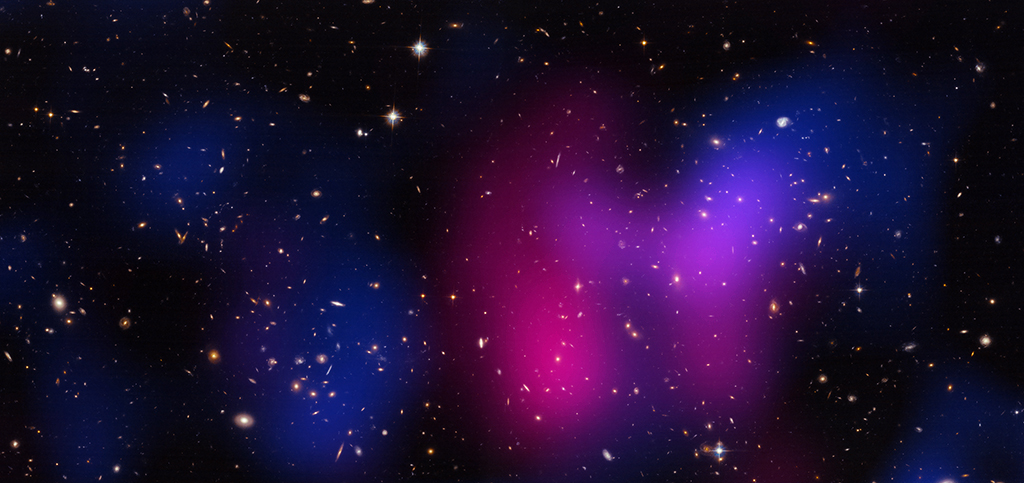
Musket Ball Cluster
Credit X-ray: NASA/CXC/UCDavis/W.Dawson et al;


Using a combination of powerful observatories in space and on the ground, astronomers have observed a violent collision between two galaxy clusters in which so-called normal matter has been wrenched apart from dark matter through a violent collision between two galaxy clusters.


The newly discovered galaxy cluster is called DLSCL J0916.2+2951. It is similar to the Bullet Cluster, the first system in which the separation of dark and normal matter was observed, but with some important differences. The newly discovered system has been nicknamed the "Musket Ball Cluster" because the cluster collision is older and slower than the Bullet Cluster.

Finding another system that is further along in its evolution than the Bullet Cluster gives scientists valuable insight into a different phase of how galaxy clusters - the largest known objects held together by gravity - grow and change after major collisions. Researchers used observations from NASA's Chandra X-ray Observatory and Hubble Space Telescope as well as the Keck, Subaru and Kitt Peak Mayall telescopes to show that hot, X-ray bright gas in the Musket Ball Cluster has been clearly separated from dark matter and galaxies.

In this composite image, the hot gas observed with Chandra is colored red, and the galaxies in the optical image from Hubble appear as mostly white and yellow. The location of the majority of the matter in the cluster (dominated by dark matter) is colored blue. When the red and the blue regions overlap, the result is purple as seen in the image. The matter distribution is determined by using data from Subaru, Hubble and the Mayall telescope that reveal the effects of gravitational lensing, an effect predicted by Einstein where large masses can distort the light from distant objects.

In addition to the Bullet Cluster, five other similar examples of merging clusters with separation between normal and dark matter and varying levels of complexity, have previously been found. In these six systems, the collision is estimated to have occurred between 170 million and 250 million years

Credit X-ray: NASA/CXC/CfA/M.Markevitch et al.;
Optical: NASA/STScI; Magellan/U.Arizona/D.Clowe et al.;
Lensing Map: NASA/STScI; ESO WFI; Magellan/U.Arizona/D.Clowe et al.

In the Musket Ball Cluster, the system is observed about 700 million years after the collision. Taking into account the uncertainties in the age estimate, the merger that has formed the Musket Ball Cluster is two to five times further along than in previously observed systems. Also, the relative speed of the two clusters that collided to form the Musket Ball cluster was lower than most of the other Bullet Cluster-like objects.

The special environment of galaxy clusters, including the effects of frequent collisions with other clusters or groups of galaxies and the presence of large amounts of hot, intergalactic gas, is likely to play an important role in the evolution of their member galaxies. However, it is still unclear whether cluster mergers trigger star formation, suppress it, or have little immediate effect. The Musket Ball Cluster holds promise for deciding between these alternatives.

The Musket Ball Cluster also allows an independent study of whether dark matter can interact with itself. This information is important for narrowing down the type of particle that may be responsible for dark matter. No evidence is reported for self-interaction in the Musket Ball Cluster, consistent with the results for the Bullet Cluster and the other similar clusters.

The Musket Ball Cluster is located about 5.2 billion light years away from Earth. A paper describing these results was led by Will Dawson from University of California, Davis and was published in the March 10, 2012 issue of The Astrophysical Journal Letters. The other co-authors were David Wittman, M. James Jee and Perry Gee from UC Davis, Jack Hughes from Rutgers University in NJ, J. Anthony Tyson, Samuel Schmidt, Paul Thorman and Marusa Bradac from UC Davis, Satoshi Miyazaki from the Graduate University for Advanced Studies (GUAS) in Tokyo, Japan, Brian Lemaux from UC Davis, Yousuke Utsumi from GUAS and Vera Margoniner from California State University, Sacramento.
NASA's Marshall Space Flight Center in Huntsville, Ala., manages the Chandra program for NASA's Science Mission Directorate in Washington. The Smithsonian Astrophysical Observatory controls Chandra's science and flight operations from Cambridge, Mass.

Fast Facts for DLSCL J0916.2+2951:

Scale: 6.4 arcmin across (about 8 million light years)
Category: Groups & Clusters of Galaxies
Coordinates (J2000): RA 09h 16m 14.64s | Dec +29° 54' 24.00"
Constellation: Cancer
Observation Date: Jan 2, 2011
Observation Time: 11 hours 6 min.
Obs. ID: 12913
Color Code: Optical (Red, Green, Blue); X-ray (Red-Purple); Mass Map (Blue)
Instrument: ACIS
References: Dawson, W. et al, 2012, ApJ 747, 42; arXiv:1110.4391
Distance Estimate: 5.23 billion light years (z=0.53)

More aboutDLSCL J0916.2+2951: Discovery of the Musket Ball Cluster

Fermi Observations of Dwarf Galaxies Provide New Insights on Dark Matter

Posted by carsimulator on Tuesday, April 3, 2012

There's more to the cosmos than meets the eye. About 80 percent of the matter in the universe is invisible to telescopes, yet its gravitational influence is manifest in the orbital speeds of stars around galaxies and in the motions of clusters of galaxies. Yet, despite decades of effort, no one knows what this "dark matter" really is. Many scientists think it's likely that the mystery will be solved with the discovery of new kinds of subatomic particles, types necessarily different from those composing atoms of the ordinary matter all around us. The search to detect and identify these particles is underway in experiments both around the globe and above it.

Scientists working with data from NASA's Fermi Gamma-ray Space Telescope have looked for signals from some of these hypothetical particles by zeroing in on 10 small, faint galaxies that orbit our own. Although no signals have been detected, a novel analysis technique applied to two years of data from the observatory's Large Area Telescope (LAT) has essentially eliminated these particle candidates for the first time.


No one knows what dark matter is, but it constitutes 80 percent of the matter in our universe. By studying numerous dwarf galaxies -- satellite systems that orbit our own Milky Way galaxy -- NASA's Fermi Gamma-ray Space Telescope has produced some of the strongest limits yet on the nature of the hypothetical particles suspected of making up dark matter. (Credit: NASA's Goddard Space Flight Center).
Download this video in broadcast quality formats from NASA Goddard's Scientific Visualization Studio

"In effect, the Fermi LAT analysis compresses the theoretical box where these particles can hide," said Jennifer Siegal-Gaskins, a physicist at the California Institute of Technology in Pasadena, Calif., and a member of the Fermi LAT Collaboration. Earlier today, she discussed the latest results of space-based dark matter searches in an invited talk at a meeting of the American Physical Society (APS) in Atlanta, Ga.

WIMPs, or Weakly Interacting Massive Particles, represent a favored class of dark matter candidates. Some WIMPs may mutually annihilate when pairs of them interact, a process expected to produce gamma rays -- the most energetic form of light -- that the LAT is designed to detect.

"One of the best places to look for these faint gamma-ray signals is in dwarf spheroidal galaxies, small satellites of our own Milky Way galaxy that we know possess large amounts of dark matter," Siegal-Gaskins explained. "From an astrophysical perspective, these are downright boring systems, with little gas or star formation and no objects like pulsars or supernova remnants that emit gamma rays."

In addition, many dwarfs lie far away from the plane of our galaxy, which produces a broad band of diffuse gamma-ray emission that stretches all around the sky. Selecting only dwarf galaxies at great distances from this plane helps minimize interference from the Milky Way.

This dwarf spheroidal galaxy in the constellation Fornax is a satellite of our Milky Way and is one of 10 used in Fermi's dark matter search. The motions of the galaxy's stars indicate that it is embedded in a massive halo of matter that cannot be seen. (Credit: ESO/Digital Sky Survey 2).
Larger image

The team examined two years of LAT-detected gamma rays with energies in the range from 200 million to 100 billion electron volts (GeV) from 10 of the roughly two dozen dwarf galaxies known to orbit the Milky Way. Instead of analyzing the results for each galaxy separately, the scientists developed a statistical technique -- they call it a "joint likelihood analysis" -- that evaluates all of the galaxies at once without merging the data together. No gamma-ray signal consistent with the annihilations expected from four different types of commonly considered WIMP particles was found.

For the first time, the results show that WIMP candidates within a specific range of masses and interaction rates cannot be dark matter. A paper detailing these results appeared in the Dec. 9, 2011, issue of Physical Review Letters.

"The fact that we look at 10 dwarf galaxies jointly not only increases the statistics, but it also makes the analysis much less sensitive to fluctuations in the gamma-ray background and to uncertainties in the way the dark matter may be distributed around the dwarfs," said Maja Llena Garde, a graduate student at Stockholm University in Sweden and a co-author of the study.

For any given properties of a dark matter particle, the distribution of the particles has a significant impact on the expected gamma-ray signal, a wrinkle that often is handled inadequately, if at all, in previous studies.

The motions of a dwarf galaxy's stars trace out the profile of the massive dark matter halo in which they're embedded, but these tiny galaxies often have very few stars to track. The result is uncertainty in the way dark matter is distributed along the line of sight to the dwarf, which affects the expected flux of gamma rays detected by the LAT. By addressing uncertainties in the dwarfs' dark matter profiles, the LAT team's results are among the most accurate.

"An important element of this work is that we were able to take the statistical uncertainties from an updated study of the dwarf stellar motions and factor it into the LAT data analysis," said Johann Cohen-Tanugi, a physicist at the Laboratory of the Universe and Particles at the University of Montpellier 2 in France and a member of the research team.

"This treatment constitutes a significant step forward, and we hope that future studies will follow our example," noted co-author Jan Conrad, a physics professor at Stockholm University.


Fermi’s Large Area Telescope (LAT) is the spacecraft’s main scientific instrument. This animation shows a gamma ray (purple) entering the LAT, where it is converted into an electron (red) and a positron (blue). The paths of the particles point back to the gamma-ray source. The LAT maps the whole sky every three hours. (Credit: NASA's Goddard Space Flight Center).
Download this video in broadcast quality formats from NASA Goddard's Scientific Visualization Studio


The team is in the process of following up the two-year analysis with new ones that will incorporate additional Fermi observing time, improvements made to the LAT's sensitivity and the inclusion of higher-energy gamma rays. Additionally, sky surveys now ramping up may discover new dwarf galaxies that can be included in future studies.

Other members of the LAT Collaboration presenting APS talks on Fermi's dark matter work include Alex Drlica-Wagner and Elliott Bloom, both from the Kavli Institute for Particle Astrophysics and Cosmology (KIPAC), jointly located at SLAC National Accelerator Laboratory and Stanford University, Calif.

On Tuesday, April 3, William Atwood, a physicist at the Santa Cruz Institute for Particle Physics at the University of California Santa Cruz, will deliver his APS prize lecture on the development of Fermi. Atwood was the originator and principal architect of Fermi's LAT. He also played a role in shaping the alliance of physicists from the U.S., Europe, and Japan that forms the LAT Collaboration. For his leading work on the design, construction and use of Fermi's Large Area Telescope, the society awarded him its 2012 W. K. H. Panofsky Prize in Experimental Particle Physics.

Related Links

Gamma Rays Carry No Trace of Dark Matter
Physicist Bill Atwood Awarded Panofsky Prize in Experimental Particle Physics


Francis Reddy
NASA's Goddard Space Flight Center, Greenbelt, Md.

More aboutFermi Observations of Dwarf Galaxies Provide New Insights on Dark Matter

Abell 383: Getting a Full Picture of an Elusive Subject

Posted by carsimulator on Wednesday, March 14, 2012

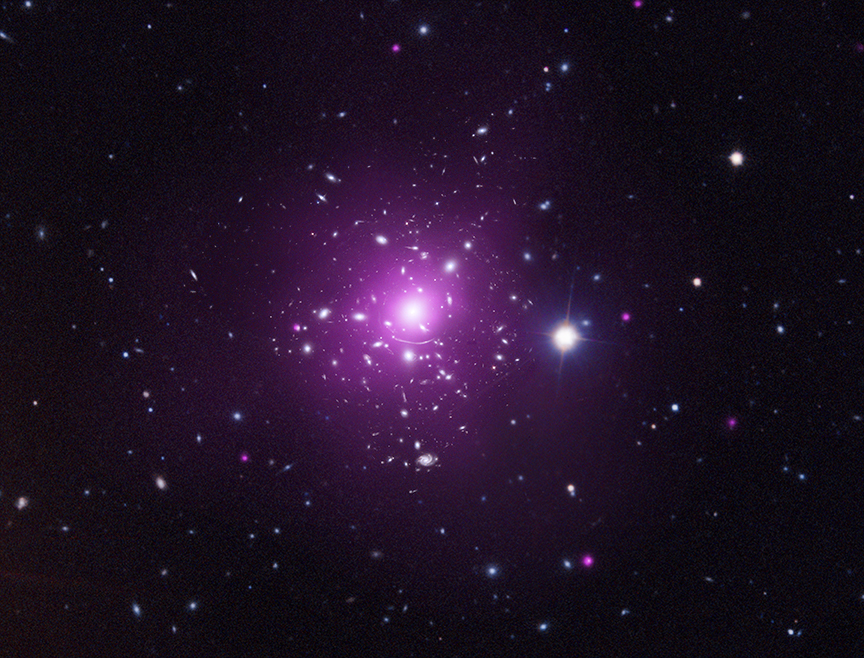
Abell 383
Credit: X-ray: NASA/CXC/Caltech/A.Newman et al/Tel Aviv/A.Morandi & M.Limousin; Optical: NASA/STScI, ESO/VLT, SDSS

Two teams of astronomers have used data from NASA's Chandra X-ray Observatory and other telescopes to map the distribution of dark matter in a galaxy cluster known as Abell 383, which is located about 2.3 billion light years from Earth. Not only were the researchers able to find where the dark matter lies in the two dimensions across the sky, they were also able to determine how the dark matter is distributed along the line of sight.

Dark matter is invisible material that does not emit or absorb any type of light, but is detectable through its gravitational effects. Several lines of evidence indicate that there is about six times as much dark matter as "normal", or baryonic, matter in the Universe. Understanding the nature of this mysterious matter is one of the outstanding problems in astrophysics.

Galaxy clusters are the largest gravitationally-bound structures in the universe, and play an important role in research on dark matter and cosmology, the study of the structure and evolution of the universe. The use of clusters as dark matter and cosmological probes hinges on scientists' ability to use objects such as Abell 383 to accurately determine the three-dimensional structures and masses of clusters.

The recent work on Abell 383 provides one of the most detailed 3-D pictures yet taken of dark matter in a galaxy cluster. Both teams have found that the dark matter is stretched out like a gigantic football, rather than being spherical like a basketball, and that the point of the football is aligned close to the line of sight.

The X-ray data (purple) from Chandra in the composite image show the hot gas, which is by far the dominant type of normal matter in the cluster. Galaxies are shown with the optical data from the Hubble Space Telescope (HST), the Very Large Telescope, and the Sloan Digital Sky Survey, colored in blue and white.

Both teams combined the X-ray observations of the "normal matter" in the cluster with gravitational lensing information determined from optical data. Gravitational lensing - an effect predicted by Albert Einstein - causes the material in the galaxy cluster, both normal and dark matter, to bend and distort the optical light from background galaxies. The distortion is severe in some parts of the image, producing an arc-like appearance for some of the galaxies. In other parts of the image the distortion is subtle and statistical analysis is used to study the distortion effects and probe the dark matter.

A considerable amount of effort has gone into studying the center of galaxy clusters, where the dark matter has the highest concentration and important clues about its behavior might be revealed. Both of the Abell 383 studies reported here continue that effort.

The team of Andrea Morandi from Tel Aviv University in Israel and Marceau Limousin from Université de Provence in France and University of Copenhagen in Denmark concluded that the increased concentration of the dark matter toward the center of the cluster is in agreement with most theoretical simulations. Their lensing data came from HST images.

The team led by Andrew Newman of the California Institute of Technology and Tommaso Treu of University of California, Santa Barbara (UCSB) used lensing data from HST and the Japanese telescope Subaru, but added Keck observations to measure the velocities of stars in the galaxy in the center of the cluster, allowing for a direct estimate of the amount of matter there. They found evidence that the amount of dark matter is not peaked as dramatically toward the center as the standard cold dark matter model predicts. Their paper describes this as being the "most robust case yet" made for such a discrepancy with the theory.

The contrasting conclusions reached by the two teams most likely stem from differences in the data sets and the detailed mathematical modeling used. One important difference is that because the Newman et al. team used velocity information in the central galaxy, they were able to estimate the density of dark matter at distances that approached as close as only 6,500 light years from the center of the cluster. Morandi and Limousin did not use velocity data and their density estimates were unable to approach as close to the cluster's center, reaching to within 80,000 light years.

Another important difference is that Morandi and Limousin used a more detailed model for the 3-D map of dark matter in the cluster. For example, they were able to estimate the orientation of the dark matter "football" in space and show that it is mostly edge-on, although slightly tilted with respect to the line of sight.

As is often the case with cutting-edge and complex results, further work will be needed to resolve the discrepancy between the two teams. In view of the importance of resolving the dark matter mystery, there will undoubtedly be much more research into Abell 383 and other objects like it in the months and years to come.

If the relative lack of dark matter in the center of Abell 383 is confirmed, it may show that improvements need to be made in our understanding of how normal matter behaves in the center of galaxy clusters, or it may show that dark matter particles can interact with each other, contrary to the prevailing model.

The Newman et al. paper was published in the February 20, 2011 issue of the Astrophysical Journal Letter and the Morandi and Limousin paper has been accepted for publication in the Monthly Notices of the Royal Astronomical Society. Other members of the Newman et al. team were Richard Ellis from Caltech, and David Sand from Las Cumbres Global Telescope Network and UCSB.

Fast Facts for Abell 383:

Scale: 7.26 arcmin across (4.84 million light years)
Category: Groups & Clusters of Galaxies
Coordinates: (J2000) RA 02h 48m 06.96s | Dec -03º 29' 31.81"
Constellation: Eridanus
Observation Date: 3 pointings between Sep and Nov 2000
Observation Time: 13 hours 43 min.
Obs. ID: 524, 2320, 2321
Color Code: X-ray (Purple), Optical (White & Blue)
Instrument: ACIS
References: Newman,A. et al. 2011 ApJ 728:L39; arXiv:1101.3553; Morandi, A., Limousin, M. 2011 MNRAS (in press);arXiv:1108.0769
Distance Estimate: 2.3 billion light years (z=0.189)

More aboutAbell 383: Getting a Full Picture of an Elusive Subject

Riding the Wake of a Merging Galaxy Cluster

Posted by carsimulator on Sunday, March 11, 2012

Observations using the OASIS integral field spectrograph on the William Herschel Telescope (WHT) have revealed a long, thin plume of ionised gas stretching out from the brightest cluster galaxy (BCG) of Abell 2146 (z=0.243) (Canning et al. 2012). Extended optical emission-line nebulae are not uncommon in the cores of clusters, but the discovery of this particular structure is unexpected, as the host cluster is in the throes of a major merger event (Russell et al. 2010).

How can a >15kpc long plume survive in the environment of such a turbulent intracluster medium? Chandra X-ray observations of the system show that a merging subcluster has created large shock fronts, each several hundred kiloparsecs across. These surround a dense, relatively cool X-ray core which is being stripped of its material in the collision.

An optical image of the merging cluster Abell 2146 taken with the Subaru telescope. The morphology of the hot X-ray gas is shown as blue contours with the dense X-ray cool core unusually leading the brightest cluster galaxy. The majority of cluster galaxies are ahead of the X-ray gas, as expected in a galaxy cluster merger. The positions of the X-ray shock fronts are shown by the red lines. [ PNG | TIFF ]

A peak of cool, dense X-ray gas is usually observed to coincide with the position of the dominant central galaxy in relaxed galaxy clusters. As it has a short radiative cooling time, material condensing out of the hot atmosphere is in a position to contribute to the growth of the dominant galaxy. In a merging cluster core, however, the situation is very different. During a collision between two clusters, individual galaxies can be regarded as effectively collisionless particles. Along with the dark matter component of the clusters, the galaxies thus lead the baryonic gas, which is slowed by friction after the main collision event. The centroids of the dark matter distribution (observationally traced by the galaxies) thus separates from the main baryonic mass component traced by the hot X-ray gas. Observations of this offset in the 'Bullet' cluster merger have provided some of the strongest evidence for dark matter.

The situation in A2146 is unusual. While many of the member galaxies of the merging subcluster are located ahead of the X-ray peak, the dominant cluster galaxy lags behind. A large offset of 36 kpc is observed between the brightest cluster galaxy and the X-ray cool core. The new OASIS observations reveal a thin plume of ionised gas stretching out from the brightest cluster galaxy to bridge the gap to the X-ray cool core. The shape of the plume is tracked by a tail of cooler X-ray gas, linking the dense X-ray peak to the brightest cluster galaxy. This also means that the optical plume could trace an intermediate stage of gas cooling directly from the hot phase and on to the BCG from the X-ray cool core. Whether or not such a process results in significant star formation - thus contributing to the growth of the massive central galaxy - awaits further observation.

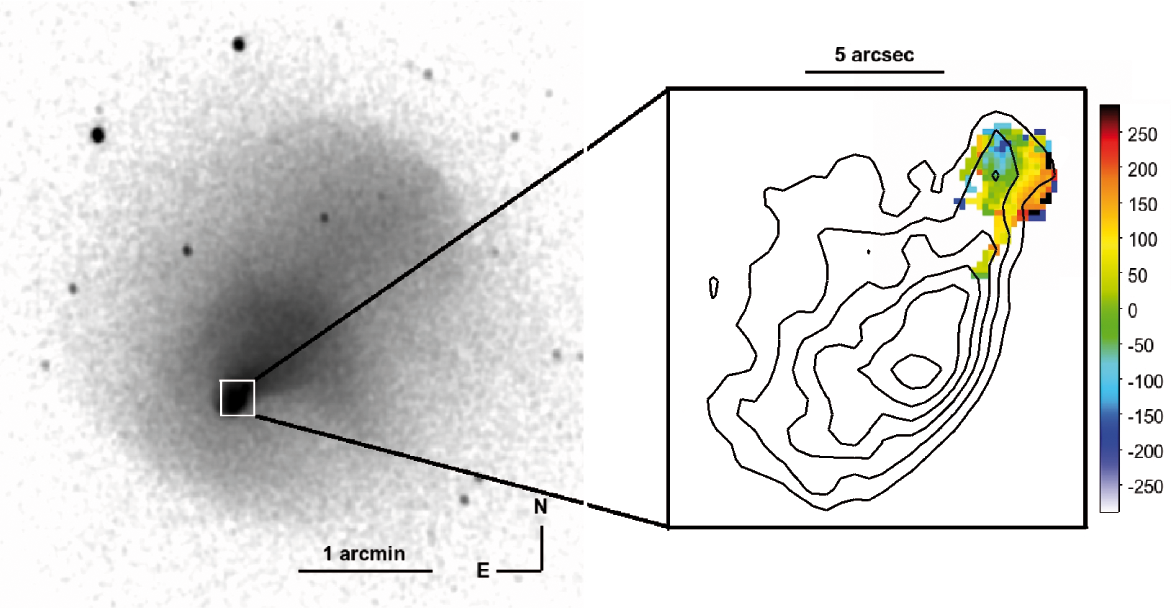
A smoothed Chandra X-ray image of Abell 2146 showing the full gas structure. The insert shows the zoomed in image of the X-ray cool core and the brighest cluster galaxy. Low temperature X-ray gas is stripped from the core and coincides with a thin plume of ionised gas extending onto the galaxy. The plume is likely longer than observed and is truncated by the OASIS field-of-view. The colour of the ionised gas shows it's line-of-sight velocity in km per second; smooth low-velocities are observed in the plume while significant rotaion appears to be ongoing in the core of the galaxy. [ PNG | TIFF ]


References:
R. E. A. Canning, H. R. Russell, N. A. Hatch, A. C. Fabian, A. I. Zabludoff, C. S. Crawford, L. J. King, B. R. McNamara, S. Okamoto and S. I. Raimundo, 2012, "Riding the wake of a merging galaxy cluster", MNRAS, 420, DOI : 10.1111/j.1365-2966.2011.20116.x.
Russell H. R., Sanders J. S., Fabian A. C., Baum S. A., Donahue M., Edge A. C., McNamara B. R., O’Dea C. P., 2010, MNRAS, 406, 1721.

Javier Méndez
Public Relations Officer

More aboutRiding the Wake of a Merging Galaxy Cluster

Dark Matter Core Defies Explanation in Hubble Image

Posted by carsimulator on Friday, March 2, 2012

Merging Galaxy Cluster Abell 520
Credit: NASA, ESA, CFHT, CXO, M.J. Jee (University of California, Davis),
and A. Mahdavi (San Francisco State University)
News Realease Images - Zoomable image

It was the result no one wanted to believe. Astronomers observed what appeared to be a clump of dark matter left behind during a bizarre wreck between massive clusters of galaxies.

The dark matter collected into a "dark core" containing far fewer galaxies than would be expected if the dark matter and galaxies hung together. Most of the galaxies apparently have sailed far away from the collision. This result could present a challenge to basic theories of dark matter, which predict that galaxies should be anchored to the invisible substance, even during the shock of a collision.

The initial observations, made in 2007, were so unusual that astronomers shrugged them off as unreal, due to poor data. However, new results from NASA's Hubble Space Telescope confirm that dark matter and galaxies parted ways in the gigantic merging galaxy cluster called Abell 520, located 2.4 billion light-years away.

Now, astronomers are left with the challenge of trying to explain dark matter's seemingly oddball behavior in this cluster.

"This result is a puzzle," said astronomer James Jee of the University of California, Davis, leader of the Hubble study. "Dark matter is not behaving as predicted, and it's not obviously clear what is going on. Theories of galaxy formation and dark matter must explain what we are seeing."

A paper reporting the team's results has been accepted for publication in The Astrophysical Journal and is available online.

First detected about 80 years ago, dark matter is thought to be the gravitational "glue" that holds galaxies together. The mysterious invisible substance is not made of the same kind of matter that makes up stars, planets, and people. Astronomers know little about dark matter, yet it accounts for most of the universe's mass.

They have deduced dark matter's existence by observing its ghostly gravitational influence on normal matter. It's like hearing the music but not seeing the band.

One way to study dark matter is by analyzing smashups between galaxy clusters, the largest structures in the universe. When galaxy clusters collide, astronomers expect galaxies to tag along with the dark matter, like a dog on a leash. Clouds of intergalactic gas, however, plow into one another, slow down, and lag behind the impact.

That theory was supported by visible-light and X-ray observations of a colossal collision between two galaxy clusters called the Bullet Cluster. The galactic grouping has become a textbook example of how dark matter should behave.

But studies of Abell 520 showed that dark matter's behavior may not be so simple. The original observations found that the system's core was rich in dark matter and hot gas but contained no luminous galaxies, which normally would be seen in the same location as the dark matter. NASA's Chandra X-ray Observatory detected the hot gas. Astronomers used the Canada-France-Hawaii and Subaru telescopes atop Mauna Kea to infer the location of dark matter by measuring how the mysterious substance bends light from more distant background galaxies, an effect called gravitational lensing.

The astronomers then turned Hubble's Wide Field Planetary Camera 2 to help bail them out of this cosmic conundrum. Instead, to their chagrin, the Hubble observations helped confirm the earlier findings. Astronomers used Hubble to map the dark matter in the cluster through the gravitational lensing technique.

"Observations like those of Abell 520 are humbling in the sense that in spite of all the leaps and bounds in our understanding, every now and then, we are stopped cold," explained Arif Babul of the University of Victoria in British Columbia, the team's senior theorist.

Is Abell 520 an oddball, or is the prevailing picture of dark matter flawed? Jee thinks it's too soon to tell.

"We know of maybe six examples of high-speed galaxy cluster collisions where the dark matter has been mapped," Jee said. "But the Bullet Cluster and Abell 520 are the two that show the clearest evidence of recent mergers, and they are inconsistent with each other. No single theory explains the different behavior of dark matter in those two collisions. We need more examples."

The team has proposed a half-dozen explanations for the findings, but each is unsettling for astronomers. "It's pick your poison," said team member Andisheh Mahdavi of San Francisco State University in California, who led the original Abell 520 observations in 2007. One possible explanation for the discrepancy is that Abell 520 was a more complicated interaction than the Bullet Cluster encounter. Abell 520 may have formed from a collision between three galaxy clusters, instead of just two colliding systems in the case of the Bullet Cluster.

Another scenario is that some dark matter may be what astronomers call "sticky." Like two snowballs smashing together, normal matter slams into each other during a collision and slows down. But dark matter blobs are thought to pass through each other during an encounter without slowing down. This scenario proposes that some dark matter interacts with itself and stays behind when galaxy clusters collide.

A third possibility is that the core contained many galaxies, but they were too dim to be seen, even by Hubble. Those galaxies would have to have formed dramatically fewer stars than other normal galaxies. Armed with the Hubble data, the group hopes to create a computer simulation to try to reconstruct the collision, hoping that it yields some answers to dark matter's weird behavior.

CONTACT

Ray Villard
Space Telescope Science Institute, Baltimore, Md.
410-338-4514
villard@stsci.edu

More aboutDark Matter Core Defies Explanation in Hubble Image

Clearest Picture Yet of Dark Matter Points the Way to Better Understanding of Dark Energy

Posted by carsimulator on Monday, January 9, 2012

Teams from Fermilab and Berkeley Lab used galaxies from wide-ranging SDSS Stripe 82, a tiny detail of which is shown here, to plot new maps of dark matter based on the largest direct measurements of cosmic shear to date. (Image credit SDSS)

BATAVIA, Illinois, and BERKELEY, California –Two teams of physicists at the U.S. Department of Energy’s Fermilab and Lawrence Berkeley National Laboratory (Berkeley Lab) have independently made the largest direct measurements of the invisible scaffolding of the universe, building maps of dark matter using new methods that, in turn, will remove key hurdles for understanding dark energy with ground-based telescopes.

The teams’ measurements look for tiny distortions in the images of distant galaxies, called “cosmic shear,” caused by the gravitational influence of massive, invisible dark matter structures in the foreground. Accurately mapping out these dark-matter structures and their evolution over time is likely to be the most sensitive of the few tools available to physicists in their ongoing effort to understand the mysterious space-stretching effects of dark energy.

Both teams depended upon extensive databases of cosmic images collected by the Sloan Digital Sky Survey (SDSS), which were compiled in large part with the help of Berkeley Lab and Fermilab.

“These results are very encouraging for future large sky surveys. The images produced lead to a picture that sees many more galaxies in the universe and sees those that are six time fainter, or further back in time, than is available from single images,” says Huan Lin, a Fermilab physicist and member of the SDSS and the Dark Energy Survey (DES) .

Layering photos of one area of sky taken at various time periods, a process called coaddition, can increase the sensitivity of the images six-fold, by removing errors and enhancing faint light signals. The image on the left shows a single picture of galaxies from SDSS Stripe 82. The image on the right shows the same area after layering, increasing the number of visible, distant galaxies. (Image credit SDSS)

Melanie Simet, a member of the SDSS collaboration from the University of Chicago, will outline the new techniques for improving maps of cosmic shear and explain how these techniques can expand the reach of upcoming international sky survey experiments during a talk at 2 p.m. CST on Monday, January 9, at the American Astronomical Society (AAS) conference in Austin, Texas. In her talk she will demonstrate a unique way to analyze dark matter’s distortion of galaxies to get a better picture of the universe’s past.

Layering photos of one area of sky taken at various time periods, a process called coaddition, can increase the sensitivity of the images six-fold, by removing errors and enhancing faint light signals. The image on the left shows a single picture of galaxies from SDSS Stripe 82. The image on the right shows the same area after layering, increasing the number of visible, distant galaxies. (Image credit SDSS)

Eric Huff, an SDSS member from Berkeley Lab and the University of California at Berkeley, will present a poster describing the full cosmic shear measurement, including the new constraints on dark energy, from 9 a.m. to 2 p.m. CST on Thursday, January 12, at the AAS conference.

Several large astronomical surveys, such as the Dark Energy Survey, the Large Synoptic Survey Telescope, and the HyperSuprimeCam survey, will try to measure cosmic shear in the coming years. Weak lensing distortions are so subtle, however, that the same atmospheric effects that cause stars to twinkle at night pose a formidable challenge for cosmic shear measurements. Until now, no ground-based cosmic-shear measurement has been able to completely and provably separate weak lensing effects from the atmospheric distortions.

“The community has been building towards cosmic shear measurements for a number of years now,” says Huff, an astronomer at Berkeley Lab, “but there’s also been some skepticism as to whether they can be done accurately enough to constrain dark energy. Showing that we can achieve the required accuracy with these pathfinding studies is important for the next generation of large surveys.”

To construct dark matter maps, the Berkeley Lab and Fermilab teams used images of galaxies collected between 2000 and 2009 by SDSS surveys I and II, using the Sloan Telescope at Apache Point Observatory in New Mexico. Berkeley Lab also used updated calibrations from SDSS III, which continues today. The galaxies lie within a continuous ribbon of sky known as SDSS Stripe 82, lying along the celestial equator and encompassing 275 square degrees. The galaxy images were captured in multiple passes over many years.

The two teams layered snapshots of a given area taken at different times, a process called coaddition, to remove errors caused by the atmospheric effects and to enhance very faint signals coming from distant parts of the universe. The teams used different techniques to model and control for the atmospheric variations and to measure the lensing signal, and have performed an exhaustive series of tests to prove that these models work.
Constraints on cosmological parameters from SDSS Stripe 82 cosmic shear at the 1- and 2-sigma level. Also shown are the constraints from WMAP. The innermost region is the combined constraint from both WMAP and Stripe 82. (Image credit SDSS)

Gravity tends to pull matter together into dense concentrations, but dark energy acts as a repulsive force that slows down the collapse. Thus the clumpiness of the dark matter maps provides a measurement of the amount of dark energy in the universe.

When they compared their final results before the AAS meeting, both teams found somewhat less structure than would have been expected from other measurements such as the Wilkinson Microwave Anisotropy Probe (WMAP), but, says Berkeley Lab’s Huff, “the results are not yet different enough from previous experiments to ring any alarm bells.”

Meanwhile, says Fermilab’s Lin, “Our image-correction processes should prove a valuable tool for the next generation of weak-lensing surveys.”

***

This is a joint release of Fermilab and Berkeley Lab. Fermilab’s release is posted at http://www.fnal.gov/pub/presspass/press_releases/2012/Dark-Energy-20120109.html

Fermilab and University of Chicago scientific papers related to these results are accessible online at the following sites:

Berkeley Lab and University of California at Berkeley scientific papers related to these results are accessible online at:

Lawrence Berkeley National Laboratory addresses the world’s most urgent scientific challenges by advancing sustainable energy, protecting human health, creating new materials, and revealing the origin and fate of the universe. Founded in 1931, Berkeley Lab’s scientific expertise has been recognized with 13 Nobel prizes. The University of California manages Berkeley Lab for the U.S. Department of Energy’s Office of Science. For more, visit www.lbl.gov.

Fermilab is a national laboratory supported by the Office of Science of the U.S. Department of Energy, operated under contract by Fermi Research Alliance, LLC. Visit Fermilab’s website at http://www.fnal.gov.

The DOE Office of Science is the single largest supporter of basic research in the physical sciences in the United States, and is working to address some of the most pressing challenges of our time. For more information, please visit http://science.energy.gov.

The National Science Foundation supported this research. For more information, please visit http://www.nsf.gov/.

The Sloan Digital Sky Survey is the most ambitious survey of the sky ever undertaken, involving more than 300 astronomers and engineers at 25 institutions around the world. SDSS-II, which began in 2005 and finished observations in July, 2008, is comprised of three complementary projects.

Funding for the SDSS and SDSS-II has been provided by the Alfred P. Sloan Foundation, the Participating Institutions, the National Science Foundation, the U.S. Department of Energy, the National Aeronautics and Space Administration, the Japanese Monbukagakusho, the Max Planck Society, and the Higher Education Funding Council for England. The SDSS Web Site is http://www.sdss.org/.

Fermilab media contact:
Tona Kunz, Fermilab Office of Communications, 630-840-3351, tkunz@fnal.gov


Science contacts:

Huan Lin, Fermilab physicist, 630-840-8452, hlin@fnal.gov

Eric Huff, Berkeley Lab astronomer, 510-404-0738, emhuff@berkeley.edu

More aboutClearest Picture Yet of Dark Matter Points the Way to Better Understanding of Dark Energy

Astronomers reach new frontiers of dark matter

Posted by carsimulator

For the first time, astronomers have mapped dark matter on the largest scale ever observed. The results, presented by Dr Catherine Heymans of the University of Edinburgh, Scotland, and Associate Professor Ludovic Van Waerbeke of the University of British Columbia, Vancouver, Canada, are being presented today to the American Astronomical Society meeting in Austin, Texas. Their findings reveal a Universe comprised of an intricate cosmic web of dark matter and galaxies that spans more than one billion light years.

An international team of researchers lead by Van Waerbeke and Heymans achieved their results by analysing images of about 10 million galaxies in four different regions of the sky. They studied the distortion of the light emitted from these galaxies, which is bent as it passes massive clumps of dark matter during its journey to Earth.

Their project, known as the Canada-France-Hawaii Telescope Lensing Survey (CFHTLenS), uses data from the Canada-France-Hawaii Telescope Legacy Survey. This accumulated images over five years using the wide field imaging camera MegaCam, a 1 degree by 1 degree field-of-view 340 Megapixel camera on the CFHT in Hawaii.

Galaxies included in the survey are typically six billion light years away. The light captured by the telescope images used in the study was emitted when the Universe was six billion years old - approximately half the age it is today.

The team's result has been suspected for a long time from studies based on computer simulations, but was difficult to verify owing to the invisible nature of dark matter. This is the first direct glimpse at dark matter on large scales showing the cosmic web in all directions.

Professor Ludovic Van Waerbeke, from the University of British Columbia, said: "It is fascinating to be able to 'see' the dark matter using space-time distortion. It gives us privileged access to this mysterious mass in the Universe which cannot be observed otherwise. Knowing how dark matter is distributed is the very first step towards understanding its nature and how it fits within our current knowledge of physics."

Dr Catherine Heymans, a Lecturer in the University of Edinburgh's School of Physics and Astronomy, said: "By analysing light from the distant Universe, we can learn about what it has travelled through on its journey to reach us. We hope that by mapping more dark matter than has been studied before, we are a step closer to understanding this material and its relationship with the galaxies in our Universe."

For Dr Christian Veillet, CFHT Executive Director, this dark matter study illustrates the strong legacy value of the CFTHLS: it is now enabling exciting results obtained by teams from many nations which use the CFHTLS images retrieved from the Canadian Astronomy Data Centre where they are archived and publicly available.

Professor Lance Miller, from Oxford University said: "This result has been achieved through advances in our analysis techniques which we are now applying to data from the Very Large Telescope's (VLT) Survey Telescope in Chile."

Professor Koen Kuijken, from Leiden University, said: "Over the next three years we will image more than 10 times the area mapped by CFHTLenS, bringing us ever closer to our goal of understanding the mysterious dark side of the Universe."

The observations show that dark matter in the Universe is distributed as a network of gigantic dense (white) and empty (dark) regions, where the largest white regions are about the size of several Earth moons on the sky. Credit: Van Waerbeke, Heymans, and CFHTLens collaboration.

This research was supported by the European Research Council, Natural Sciences and Engineering Research Council of Canada, the Canadian Institute for Advanced Research and the Canadian Astronomy Data Centre.

Contacts:

Catriona Kelly, University of Edinburgh, tel 44 131 651 4401; Catriona.Kelly@ed.ac.uk

Brian Lin, University of British Columbia, tel 001 604 822 2234; Brian.Lin@ubc.ca

Jean-Charles Cuillandre, Canada-France-hawaii Telescope, tel 001808 885 7944; cuillandre@cfht.hawaii.edu

More Images

The observations show that dark matter in the Universe is distributed as a network of gigantic dense (light) and empty (dark) regions, where the largest dense regions are about the size of several Earth moons on the sky. Credit: Van Waerbeke, Heymans, and CFHTLens collaboration

The densest regions of the dark matter cosmic web host massive clusters of galaxies
Credit: Van Waerbeke, Heymans, and CFHTLens collaboration

Clusters of galaxies
Credit: CFHTLens
Full Size (2000 x2000): Left, Center and Right

The ubiquitous dark matter cosmic web is seen in all four directions surveyed by the Canada-France-Hawaii Telescope during each season of the year. The central colour inset shows the previous largest COSMOS Dark Matter map (credit: NASA, ESA, P. Simon and T. Schrabback) and the full moon to scale. Credit: Van Waerbeke, Heymans, and CFHTLens collaboration

From left to right, Spring, Summer, Fall, and Winter
Credit: Van Waerbeke, Heymans, and CFHTLens collaboration

More aboutAstronomers reach new frontiers of dark matter