Showing posts with label Neutron Star. Show all posts

SN 1957D in M83: X-Rays Discovered from Young Supernova Remnant

Posted by carsimulator on Monday, July 30, 2012

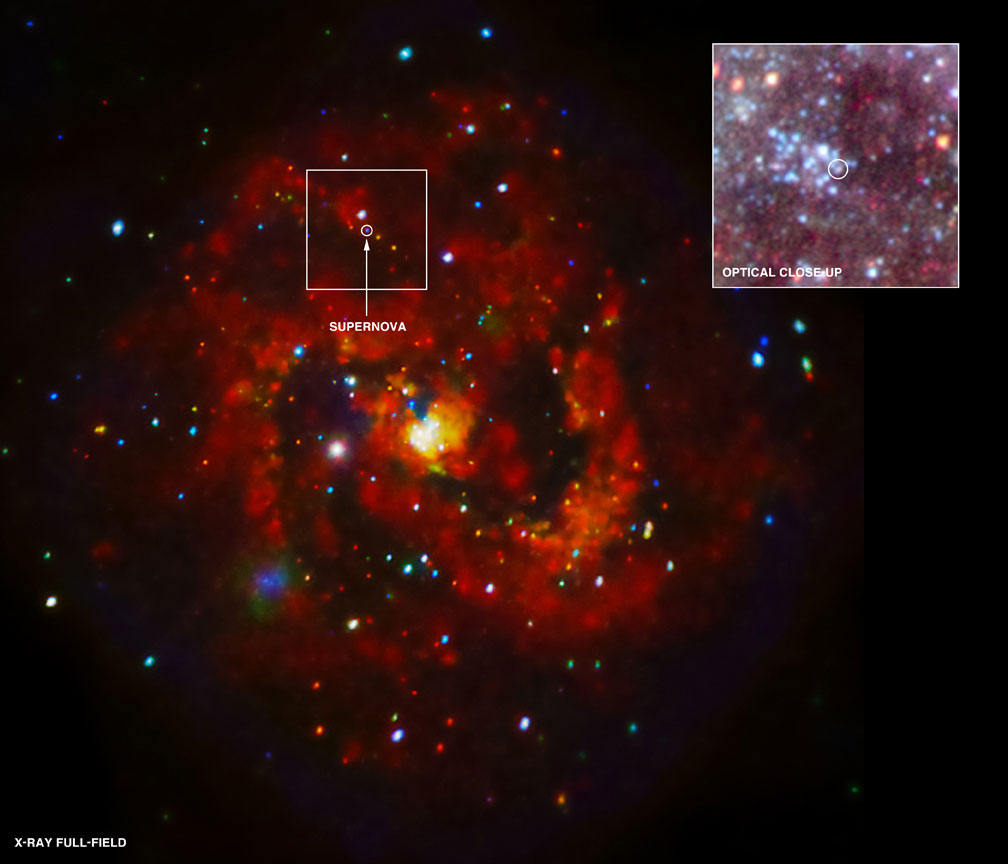
SN 1957D in M83
Credit: X-ray: NASA/CXC/STScI/K.Long et al.,
Optical: NASA/STScI


JPEG (392.3 kb) - Large JPEG (81.5 kb) - Tiff (43.2 MB)
High-Quality Prints - More Images


Over fifty years ago, a supernova was discovered in M83, a spiral galaxy about 15 million light years from Earth. Astronomers have used NASA's Chandra X-ray Observatory to make the first detection of X-rays emitted by the debris from this explosion.

Named SN 1957D because it was the fourth supernova to be discovered in the year of 1957, it is one of only a few located outside of the Milky Way galaxy that is detectable, in both radio and optical wavelengths, decades after its explosion was observed. In 1981, astronomers saw the remnant of the exploded star in radio waves, and then in 1987 they detected the remnant at optical wavelengths, years after the light from the explosion itself became undetectable.

A relatively short observation -- about 14 hours long -- from NASA's Chandra X-ray Observatory in 2000 and 2001 did not detect any X-rays from the remnant of SN 1957D. However, a much longer observation obtained in 2010 and 2011, totaling nearly 8 and 1/2 days of Chandra time, did reveal the presence of X-ray emission. The X-ray brightness in 2000 and 2001 was about the same as or lower than in this deep image.

This new Chandra image of M83 is one of the deepest X-ray observations ever made of a spiral galaxy beyond our own. This full-field view of the spiral galaxy shows the low, medium, and high-energy X-rays observed by Chandra in red, green, and blue respectively. The location of SN 1957D, which is found on the inner edge of the spiral arm just above the galaxy's center, is outlined in the box (or can be seen by mousing over the image.)

The new X-ray data from the remnant of SN 1957D provide important information about the nature of this explosion that astronomers think happened when a massive star ran out of fuel and collapsed. The distribution of X-rays with energy suggests that SN 1957D contains a neutron star, a rapidly spinning, dense star formed when the core of pre-supernova star collapsed. This neutron star, or pulsar, may be producing a cocoon of charged particles moving at close to the speed of light known as a pulsar wind nebula.

If this interpretation is confirmed, the pulsar in SN 1957D is observed at an age of 55 years, one of the youngest pulsars ever seen. The remnant of SN 1979C in the galaxy M100 contains another candidate for the youngest pulsar, but astronomers are still unsure whether there is a black hole or a pulsar at the center of SN 1979C.

An image from the Hubble Space Telescope (in the box labeled "Optical Close-Up") shows that the debris of the explosion that created SN 1957D is located at the edge of a star cluster less than 10 million years old. Many of these stars are estimated to have masses about 17 times that of the Sun. This is just the right mass for a star's evolution to result in a core-collapse supernova as is thought to be the case in SN 1957D.

Multipanel with Optical, H-alpha & X-ray
Credit: Optical: NASA/STScI)

These results will appear in an upcoming issue of The Astrophysical Journal. The researchers involved with this study were Knox Long (Space Telescope Science Institute), William Blair (Johns Hopkins University), Leith Godfrey (Curtain University, Australia), Kip Kuntz (Johns Hopkins), Paul Plucinsky (Harvard-Smithsonian Center for Astrophysics), Roberto Soria (Curtain University), Christopher Stockdale (University of Oklahoma and the Australian Astronomical Observatory), Bradley Whitmore (Space Telescope Science Institute), and Frank Winkler (Middlebury College).

NASA's Marshall Space Flight Center in Huntsville, Ala., manages the Chandra program for NASA's Science Mission Directorate in Washington. The Smithsonian Astrophysical Observatory controls Chandra's science and flight operations from Cambridge, Mass.

Fast Facts for SN 1957D in M83:

Credit: X-ray: NASA/CXC/STScI/K.Long et al., Optical: NASA/STScI
Release Date: July 30, 2012
Scale: 9.5 arcmin on a side (~41,000 light years); Inset image: 1.6 x 1.3 arcsec (~120 x ~100 light years)
Category: Normal Galaxies & Starburst Galaxies
Coordinates: (J2000) RA 13h 37m 00.80s | Dec -29 51 58.60
Constellation:
Hydra
Observation Date: 12 pointings between April 29, 2000 and Dec 28, 2011
Observation Time: 219 hours 49 min.
Obs. ID: 793, 2064, 12420, 12992-12996, 13202, 13241, 13248, 14332, 14342
Instrument:
ACIS
Also Known As: NGC 5236
References: Long, K. et al, 2012, (in press)
arXiv:1207.1555
Color Code: X-ray: (Red, Green, Blue); Optical inset (Red, Green, Blue)

More aboutSN 1957D in M83: X-Rays Discovered from Young Supernova Remnant

IGR J11014-6103: Has the Speediest Pulsar Been Found?

Posted by carsimulator on Thursday, June 28, 2012

IGR J11014-6103
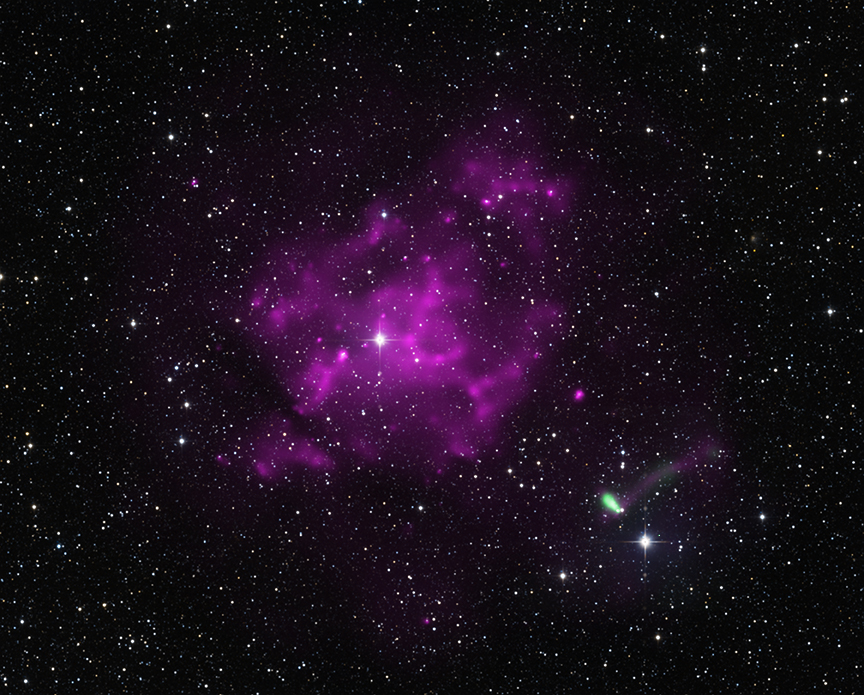
Credit: X-ray: NASA/CXC/UC Berkeley/J.Tomsick et al & ESA/XMM-Newton, Optical: DSS; IR: 2MASS/UMass/IPAC-Caltech/NASA/NSF


Researchers using three different telescopes -- NASA's Chandra X-ray Observatory and ESA's XMM-Newton in space, and the Parkes radio telescope in Australia -- may have found the fastest moving pulsar ever seen.


The evidence for this potentially record-breaking speed comes, in part, from the features highlighted in this composite image. X-ray observations from Chandra (green) and XMM-Newton (purple) have been combined with infrared data from the 2MASS project and optical data from the Digitized Sky Survey (colored red, green and blue, but appearing in the image as white).

The large area of diffuse X-rays seen by XMM-Newton was produced when a massive star exploded as a supernova, leaving behind a debris field, or supernova remnant known as SNR MSH 11-16A. Shocks waves from the supernova have heated surrounding gas to several million degrees Kelvin, causing the remnant to glow brightly in X-rays.

The Chandra image shown in the inset ("Chandra Close-up") reveals a comet-shaped X-ray source well outside the boundary of the supernova remnant. This source consists of a point-like object with a long tail trailing behind it for about 3 light years. The bright star nearby and also the one in SNR MSH11-16A are both likely to be foreground stars unrelated to the supernova remnant.

The point-like X-ray source was discovered by the International Gamma-Ray Astrophysics Laboratory, or INTEGRAL, and is called IGR J11014-6103 (or IGR J11014 for short). It may be a rapidly spinning, super-dense star (known as a "pulsar", a type of neutron star) that was ejected during the explosion. If so, it is racing away from the center of the supernova remnant at millions of miles per hour.

The favored interpretation for the tail of X-ray emission is that a pulsar wind nebula, that is, a "wind" of high-energy particles produced by the pulsar, has been swept behind a bow shock created by the pulsar's high speed. (A similar case was seen in another object known as PSR B1957+20 .

The elongated emission is pointing towards the center of MSH 11-61A where the pulsar would have been formed, supporting the idea that the Chandra image is of a pulsar wind nebula and its bow shock. Another interesting feature of the Chandra image, also seen with XMM-Newton, is the faint X-ray tail extending to the top-right. The cause of this feature is unknown, but similar tails have been seen from other pulsars that also do not line up with the pulsar's direction of motion.

Based on earlier observations, astronomers estimate that the age of MSH 11-61A, as it appears in the image, is approximately 15,000 years, and it lies at a distance of about 30,000 light years away from Earth. Combining these values with the distance that the pulsar has appeared to have traveled from the center of the MSH 11-61A, astronomers estimate that IGR J11014 is moving at a speed between 5.4 million and 6.5 million miles per hour.

The only other neutron star associated with a supernova remnant that may rival this in speed is the candidate found in the supernova remnant known as G350.1-0.3. The speed of the neutron star candidate in this system is estimated to lie between 3 and 6 million miles per hour.

The high speeds estimated for both IGR J11014 and the neutron star candidate in G350.1-0.3 are preliminary and need to be confirmed. If they are confirmed, explaining the high speeds of the neutron star presents a severe challenge to existing models for supernova explosions.

One important caveat in the conclusion that IGR J11014 may be the fastest moving pulsar is that pulsations have not been detected in it during a search with the Commonwealth Scientific and Industrial Research Organization (CSIRO) Parkes radio telescope. This non-detection is not surprising for a pulsar located about 30,000 light years away.

However, there are other pieces of evidence that support the pulsar interpretation. First, the lack of detection of a counterpart to the X-ray source in optical or infrared images supports the idea that it is a pulsar, since such objects are very faint at these wavelengths. Also, there are no apparent differences in the brightness of the source between XMM-Newton observations in 2003 and the Chandra observations in 2011, behavior that is expected if IGR J11014 is a pulsar. Finally, the X-ray spectrum of the source, that is, its signature in energy, is similar to what astronomers expect to see for a pulsar.

These results were published in the May 10, 2012 issue of The Astrophysical Journal Letters. The authors were John Tomsick and Arash Bodaghee (University of California, Berkeley), Jerome Rodriguez and Sylvain Chaty (University of Paris, CEA Saclay), Fernando Camilo (Columbia University), Francesca Fornasini (UC Berkeley), and Farhid Rahoui (Harvard-Smithsonian Center for Astrophysics).

NASA's Marshall Space Flight Center in Huntsville, Ala., manages the Chandra program for NASA's Science Mission Directorate in Washington. The Smithsonian Astrophysical Observatory controls Chandra's science and flight operations from Cambridge, Mass.

Fast Facts for IGR J11014-6103:

Scale: 1 degree across (~576 light years)
Category: Supernovas & Supernova Remnants, Neutron Stars/X-ray Binaries
Coordinates (J2000): RA 11h 01m 22.08s | Dec -61° 03' 25.20"
Constellation: Carina
Observation Date: 6 Sep 2011
Observation Time: 1 hours 23 min.
Obs. ID: 12420
Color Code: X-ray-Chandra: (Green) X-ray-XMM: (Purple); Optical (Red, Green, Blue)
Instrument: ACIS
References: Tomsick, J et al, 2012 ApJ 750:39; arXiv:1204.2836
Distance Estimate: About 30,000 light years

More aboutIGR J11014-6103: Has the Speediest Pulsar Been Found?

The Art of Recycling Pulsars

Posted by carsimulator on Friday, February 3, 2012

Stellar Astrophysics helps to explain the behaviour of fast rotating neutron stars in binary systems


What happens to the spin of rapidly rotating neutron stars called millisecond pulsars when reaching the end of their mass-accretion phase? The formation of millisecond pulsars is the result of stellar cannibalism where matter flows from a donor star to an accreting pulsar in a binary system. During this process the pulsar emits X-rays while being spun up to amazingly high rotational speeds with periods of about 1 to 10 milliseconds. Astrophysicist Thomas Tauris has a joint appointment at both, Argelander-Institut für Astronomie and Max-Planck-Institut für Radioastronomie, based in Bonn, Germany. Through numerical calculations on the base of stellar evolution and accretion torques, he can show that millisecond pulsars loose about half of their rotational energy during the final stages of the mass-transfer process before the pulsar turns on its radio beam. This result is in agreement with current observations and the findings also explain why radio millisecond pulsars appear to be much older than the white dwarf remnants of their companion stars - and perhaps why no sub-millisecond radio pulsars exist at all.

The results are reported in the February 03 issue of the journal "Science".

Figure 1: An artist's impression of an accreting X-ray millisecond pulsar. The flowing material from the companion star forms a disk around the neutron star which is truncated at the edge of the pulsar magnetosphere. Credit: NASA / Goddard Space Flight Center / Dana Berry (Click here for higher resolution)

Millisecond pulsars are strongly magnetized, old neutron stars in binary systems which have been spun up to high rotational frequencies by accumulation of mass and angular momentum from a companion star. Today we know of about 200 such pulsars with spin periods between 1.4-10 milliseconds. These are located in both the Galactic Disk and in Globular Clusters.

Since the first millisecond pulsar was detected in 1982 is has remained a challenge for theorists to explain their spin periods, magnetic fields and ages. As an example, there is the "turn-off" problem, i.e. what happens to the spin of the pulsar when the donor star terminates its mass-transfer process?

"We have now, for the first time, combined detailed numerical stellar evolution models with calculations of the braking torque acting on the spinning pulsar", says Thomas Tauris, the author of the present study. "The result is that the millisecond pulsars loose about half of their rotational energy in the so-called Roche-lobe decoupling phase." This phase is describing the termination of the mass transfer in the binary system. Hence, radio-emitting millisecond pulsars should spin slightly slower than their progenitors, X-ray emitting millisecond pulsars which are still accreting material from their donor star. This is exactly what the observational data seem to suggest. Furthermore, these new findings can help explain why some millisecond pulsars appear to have characteristic ages exceeding the age of the Universe and perhaps why no sub-millisecond radio pulsars exist.

The key feature of the new results is that it has now been demonstrated how the spinning pulsar is able to brake out of its so-called equilibrium spin. At this epoch the mass-transfer rate decreases which causes the magnetospheric radius of the pulsar to expand and thereby expelling the infalling matter like a propeller. This causes the pulsar to loose additional rotational energy and thus slow down its spin rate.

"Actually, without a solution to the "turn-off" problem we would expect the pulsars to even slow down to spin periods of 50-100 milliseconds during the Roche-lobe decoupling phase", concludes Thomas Tauris. "That would be in clear contradiction with observational evidence for the existence of millisecond pulsars."


This work has profited from a recent effort to bridge the Stellar Physics group at the Argelander-Institut für Astronomie at University of Bonn (led by Norbert Langer) with the Fundamental Physics in Radio Astronomy group at the Max-Planck-Institut für Radioastronomie (led by Michael Kramer). The stellar evolution models used for this work were made using a state-of-the-art code developed by Norbert Langer. A significant part of the observational data was supplied by the pulsar group. Michael Kramer and his colleagues are using the 100-m Effelsberg Radio Telescope to participate in several ongoing searches and discoveries of millisecond pulsars.

Thomas Tauris has been working at the Argelander-Institut für Astronomie and the Max-Planck-Institut für Radioastronomie as a visiting research professor since 2010. Some of his recent work on the recycling of millisecond pulsars has been published in the journal "Monthly Notices of the Royal Astronomical Society" in joint publications with Norbert Langer and Michael Kramer. On February 27 they host an international one-day workshop in Bonn on the "Formation and Evolution of Neutron stars".


Original Paper:

Spin-Down of Radio Millisecond Pulsars at Genesis, Thomas M. Tauris, Science Bd. 335, S. 561. DOI 10.1126/science.1216355.


Further Information:

Max Planck Institute for Radio Astronomy (MPIfR).

Argelander-Institut für Astronomie (AIfA), University of Bonn.

Fundamental Physics in Radio Astronomy.

Bonn Stellar Physics Group.

Formation of millisecond pulsars with CO white dwarf companions, Thomas M. Tauris, Norbert Langer, Michael Kramer, Preprint MNRAS.

Formation and Evolution of Neutron Stars, Workshop Bonn Feb 27, 2012.


Parallel Press Releases:

The discovery of deceleration , Max Planck Society News Release, 02 February 2012.

Sternenkreisel entpuppt sich als Vampir , Press Release, University of Bonn, February 03, 2012 (in German).


Contact:

Dr. Thomas M. Tauris,
Argelander-Institut für Astronomie, Univ. of Bonn
& Max-Planck-Institut für Radioastronomie, Bonn.
Fon: +49-73-3660
E-mail: tauris (at) astro.uni-bonn.de

Prof. Dr. Michael Kramer,
Director and Head of Research Group "Fundamental Physics in Radio Astronomy",
Max-Planck-Institut für Radioastronomie, Bonn.
Fon: +49(0)228-525-278
E-mail: mkramer (at) mpifr-bonn.mpg.de

Dr. Norbert Junkes,
Press and Public Outreach,
Max-Planck-Institut für Radioastronomie, Bonn.
Fon: +49-228-525-399
E-mail: njunkes (at) mpifr.de


More aboutThe Art of Recycling Pulsars

G350.1-0.3: Remnant of an Explosion With a Powerful Kick?

Posted by carsimulator on Wednesday, February 1, 2012

G350.1+0.3


Vital clues about the devastating ends to the lives of massive stars can be found by studying the aftermath of their explosions. In its more than twelve years of science operations, NASA's Chandra X-ray Observatory has studied many of these supernova remnants sprinkled across the Galaxy.

The latest example of this important investigation is Chandra's new image of the supernova remnant known as G350.1+0.3. This stellar debris field is located some 14,700 light years from the Earth toward the center of the Milky Way .

Evidence from Chandra and from ESA's XMM-Newton telescope suggest that a compact object within G350.1+0.3 may be the dense core of the star that exploded. The position of this likely neutron star, seen by mousing over the image above, is well away from the center of the X-ray emission (mouse-over for this position). If the supernova explosion occurred near the center of the X-ray emission then the neutron star must have received a powerful kick in the supernova explosion.

Data from Chandra and other telescopes suggest this supernova remnant, as it appears in the image, is between 600 and 1,200 years old. If the estimated location of the explosion is correct, this means that the neutron star has been moving at a speed of at least 3 million miles per hour since the explosion This is comparable to the exceptionally high speed derived for the neutron star in Puppis A and provides new evidence that extremely powerful "kicks" can be imparted to neutron stars from supernova explosions.

Another intriguing aspect of G350.1+0.3 is its unusual shape. While many supernova remnants are nearly circular, G350.1+0.3 is strikingly asymmetrical as seen in the Chandra data in this image (gold). Infrared data from NASA's Spitzer Space Telescope (light blue) also trace the morphology found by Chandra. Astronomers think that this bizarre shape is due to the stellar debris field expanding into a nearby cloud of cold molecular gas.

The age of 600-1,200 years puts the explosion that created G350.1+0.3 in the same time frame as other famous supernovas that formed the Crab and SN 1006 supernova remnants. However, it is unlikely that anyone on Earth would have seen the explosion because of the obscuring gas and dust that lies along our line of sight to the remnant.

These results appeared in the April 10, 2011 issue of The Astrophysical Journal. The scientists on this paper were Igor Lovchinsky and Patrick Slane (Harvard-Smithsonian Center for Astrophysics), Bryan Gaensler (University of Sydney, Australia), Jack Hughes (Rutgers University), Jasmina Lazendic (Monash University Clayton, Australia), Joseph Gelfand (New York University, Abu Dhabi), and Crystal Brogan (National Radio Astronomy Observatory).

Fast Facts for G350.1-0.3:

Scale: 5.2 arcmin across (about 22 light years)
Category: Supernovas & Supernova Remnants, Neutron Stars/X-ray Binaries
Coordinates: (J2000) RA 17h 21m 03.00s | Dec -37° 26' 50.00"
Constellation: Scorpius
Observation Date: 5/24/2009
Observation Time: 23 hours 3 min.
Obs. ID: 10102
Color Code: X-ray (Gold); Infrared 24 micron (Cyan); Infrared 8 micron (Purple); Infrared: 3.6 micron (Green)
Instrument: ACIS
References: Lovchinsky, I. et al, 2011, ApJ, 731, 70
Distance Estimate: 14,700 light years

More aboutG350.1-0.3: Remnant of an Explosion With a Powerful Kick?

Potential New NASA Mission Would Reveal the Hearts of Undead Stars

Posted by carsimulator on Wednesday, November 9, 2011

This is an artist's concept of a pulsar (blue-white disk in center) pulling in matter from a nearby star (red disk at upper right). The stellar material forms a disk around the pulsar (multicolored ring) before falling on to the surface at the magnetic poles. The pulsar's intense magnetic field is represented by faint blue outlines surrounding the pulsar. Credit: NASA. Full-resolution copy

This is an artist's concept of the NICER instrument on board the International Space Station. NICER is the cube in the foreground on the left. The circular objects protruding from the cube are telescopes that focus X-rays from the pulsar on to the detector. Credit: NASA.Full-resolution copy

Neutron stars have been called the zombies of the cosmos, shining on even though they're technically dead, and occasionally feeding on a neighboring star if it gets too close.

They are born when a massive star runs out of fuel and collapses under its own gravity, crushing the matter in its core and blasting away its outer layers in a supernova explosion that can outshine a billion suns.

The core, compressed by gravity to inconceivable density – one teaspoon would weigh about a billion tons on Earth – lives on as a neutron star. Although the nuclear fusion fires that sustained its parent star are extinguished, it still shines with heat left over from its explosive formation, and from radiation generated by its magnetic field, which became intensely concentrated as the core collapsed, and can be over a trillion times stronger than Earth's.

Although its parent star could easily have been more than a million miles across, a neutron star is only about the size of a city. However, its intense gravity makes it the ultimate trash compactor, capable of packing in an astonishing amount of matter, more than 1.4 times the content of the Sun, or at least 460,000 Earths.

"A neutron star is right at the threshold of matter as it can exist – if it gets any denser, it becomes a black hole," says Dr. Zaven Arzoumanian of NASA's Goddard Space Flight Center in Greenbelt, Md.

Arzoumanian is Deputy Principal Investigator on a proposed mission called the Neutron Star Interior Composition Explorer (NICER) that would unveil the dark heart of a neutron star. "We have no way of creating neutron star interiors on Earth, so what happens to matter under such incredible pressure is a mystery – there are many theories about how it behaves. The closest we come to simulating these conditions is in particle accelerators that smash atoms together at almost the speed of light. However, these collisions are not an exact substitute – they only last a split second, and they generate temperatures that are much higher than what's inside neutron stars."

If NASA approves it for construction, the mission will be launched by the summer of 2016 and attached robotically to the International Space Station. In September 2011, NASA selected NICER for study as a potential Explorer Mission of Opportunity. The mission will receive $250,000 to conduct an 11-month implementation concept study. Five Mission of Opportunity proposals were selected from 20 submissions. Following the detailed studies, NASA plans to select for development one or more of the five Mission of Opportunity proposals in February 2013.

NICER's array of 56 telescopes will collect X-rays generated both from hotspots on a neutron star's surface and from its powerful magnetic field. There are two hotspots on a neutron star at opposite sides, one at each magnetic pole, the place where the star's intense magnetic field emerges from the surface. Here, particles trapped in the magnetic field rain down and generate X-rays when they strike the surface. X-rays are an energetic form of light invisible to human eyes but detectable by special instruments. As the hotspots rotate into our line of sight, they produce a pulse of light, like a lighthouse beam, giving rise to the stars' alternate name, pulsars.

Many pulsars flash several times per second, because of the rapid rotation they inherit as they are born. All stars rotate, and as the parent star's core shrinks, it spins faster, like a twirling ice skater pulling in her arms. A neutron star's powerful gravity can also pull in gas from a neighboring star if it orbits too closely. This infalling gas can spin up a neutron star to even higher speeds; some rotate hundreds of times per second.

The key to understanding how matter behaves inside a neutron star is pinning down the correct Equation Of State (EOS) that most accurately describes how matter responds to increasing pressure. Currently, there are many suggested EOSs, each proposing that matter can be compressed by different amounts inside neutron stars. Suppose you held two balls of the same size, but one was made of foam and the other was made of wood. You could squeeze the foam ball down to a smaller size than the wooden one. In the same way, an EOS that says matter is highly compressible will predict a smaller neutron star for a given mass than an EOS that says matter is less compressible.

So if researchers know a neutron star's mass, all they need to do is find out how big it is to get the correct EOS and unlock the secret of what matter does under extreme gravity. "The problem is that neutron stars are small, and much too far away to allow their sizes to be measured directly," says NICER Principal Investigator Dr. Keith Gendreau of NASA Goddard. "However, NICER will be the first mission that has enough sensitivity and time-resolution to figure out a neutron star's size indirectly. The key is to precisely measure how much the brightness of the X-rays changes as the neutron star rotates."

This change in brightness with time is called a star's light curve, and it appears as a wavy line on a graph.

Because neutron stars pack so much mass into such a tiny volume, they generate strong gravity that actually bends space (and distorts time) in accordance with Einstein's theory of General Relativity. This warping of space enables researchers to determine a neutron star's mass if it has a nearby companion, either another neutron star or a white dwarf, a lower-density object that is the core remnant of a less-massive star. Neutron stars with these companions are actually fairly common.

The warping of space produces effects like an orbital shift called precession, which makes the orbit move like a hula-hoop around a dancer. Also, as the neutron star and its companion move around each other, they create ripples in space called gravitational waves. These waves carry away orbital energy, so the neutron star and its companion gradually move closer together and their orbit shrinks. NICER will measure these effects over time, and the greater these effects, the more mass the neutron star has.

Warped space also will let the NICER team figure out a neutron star's size. Suppose we have a neutron star lined up so that you can only see one hotspot, the one on the near side that faces us. As it rotates into view, the brightness increases until the hotspot is pointed directly at us, then the brightness decreases as it rotates away.

This alignment makes the star's brightness highly variable – it's quite bright when the hotspot is pointed at us, and very dim when the hotspot is on the far side out of our view. The drastic change in brightness produces a light curve with large waves, with deep troughs when the star is dim.

However, since light must follow the contours of space, warped space bends light. The distorted space around the neutron star bends its light so much that you can see parts of the far side, including the other hotspot. With the second hotspot visible, at least part of the time, you have bright light more often, so the brightness doesn't change as much. This makes a light curve that appears smoother, with smaller waves.

If a woman wearing stiletto heels walks on a trampoline, she will warp the surface more than if she wears snowshoes. In the same way, the more compact a neutron star is, the more it will bend space and light. This will allow us to see the far-side hotspot more often, which will make its X-ray brightness less variable, and the star will produce a smoother light curve.

The team has models that produce unique light curves for the various sizes predicted by different EOSs. By choosing the light curve that best matches the observed one, they will get the correct EOS and solve the riddle of matter on the edge of oblivion.

Bill Steigerwald
NASA's Goddard Space Flight Center, Greenbelt, Md.

More aboutPotential New NASA Mission Would Reveal the Hearts of Undead Stars

Crab Pulsar Dazzles Astronomers with its Gamma-Ray Beams

Posted by carsimulator on Thursday, October 6, 2011

An artist's conception of the pulsar at the center of the Crab Nebula, with a Hubble Space Telescope photo of the nebula in the background. Researchers using the Veritas telescope array have discovered pulses of high-energy gamma rays coming from this object. Credit: David A. Aguilar / NASA / ESA. High Resolution Image (jpg) - Low Resolution Image (jpg)

This artist's conception shows the Crab Nebula pulsar, which astronomers discovered to be sending out pulses of gamma rays with energies exceeding 100 billion electron-volts (100 GeV). A pulsar is a spinning neutron star - the collapsed core of a massive star that exploded as a supernova. Credit: David A. Aguilar (CfA). High Resolution Image (jpg) - Low Resolution Image (jpg)

An artist’s rendering of the VERITAS array detecting gamma-ray pulses from the Crab Nebula. Credit: José Francisco Salgado based on images by M. SubbaRao, S. Criswell, B. Humensky, and J.F. Salgado. Low Resolution Image (jpg)

Cambridge, MA - A thousand years ago, a brilliant beacon of light blazed in the sky, shining brightly enough to be seen even in daytime for almost a month. Native American and Chinese observers recorded the eye-catching event. We now know that they witnessed an exploding star, which left behind a gaseous remnant known as the Crab Nebula.

The same object that dazzled skygazers in 1054 C.E. continues to dazzle astronomers today by pumping out radiation at higher energies than anyone expected. Researchers have detected pulses of gamma rays with energies exceeding 100 billion electron-volts (100 GeV) -- a million times more energetic than medical X-rays and 100 billion times more than visible light.

"If you asked theorists a year ago whether we would see gamma-ray pulses this energetic, almost all of them would have said, 'No.' There's just no theory that can account for what we've found," said corresponding author Martin Schroedter of the Harvard-Smithsonian Center for Astrophysics (CfA).

The gamma rays come from an extreme object at the Crab Nebula's center known as a pulsar. A pulsar is a spinning neutron star -- the collapsed core of a massive star. Although only a few miles across, a neutron star is so dense that it weighs more than the Sun.

Rotating about 30 times a second, the Crab pulsar generates beams of radiation from its spinning magnetic field. The beams sweep around like a lighthouse beacon because they're not aligned with the star's rotation axis. So although the beams are steady, they're detected on Earth as rapid pulses of radiation.

The discovery was reported by an international team of scientists in a paper in the October 7 issue of Science. Corresponding author Nepomuk Otte, a postdoctoral researcher at the University of California, Santa Cruz, said that some researchers had told him he was crazy to even look for pulsar emission in this energy realm.

"It turns out that being persistent and stubborn helps," Otte said. "These results put new constraints on the mechanism for how the gamma-ray emission is generated."

Some possible scenarios to explain the data have been put forward, but it will take more data, or even a next-generation observatory, to really understand the mechanisms behind these gamma-ray pulses.

The gamma-ray pulses were detected by the Very Energetic Radiation Imaging Telescope Array System (VERITAS) -- the most powerful very-high-energy gamma-ray observatory in the Northern Hemisphere. VERITAS is located at the Smithsonian's Whipple Observatory, just south of Tucson, Ariz.

Astronomers observe very-high-energy gamma rays with ground-based Cherenkov telescopes. These gamma rays, coming from cosmic "particle accelerators," are absorbed in Earth's atmosphere, where they create a short-lived shower of subatomic particles. The Cherenkov telescopes detect the faint, extremely short flashes of blue light that these particles emit (named Cherenkov light) using extremely sensitive cameras. The images can be used to infer the arrival direction and initial energy of the gamma rays.

This technique is used by gamma-ray observatories throughout the world, and was pioneered under the direction of CfA's Trevor Weekes using the 10-meter Cherenkov telescope at Whipple Observatory. The Whipple 10-meter telescope was used to detect the first Galactic and extragalactic sources of very-high-energy gamma rays.

VERITAS continues the tradition of Whipple's 10-meter telescope. It is comprised of an array of four 12-meter-diameter Cherenkov telescopes. VERITAS began full-scale observations in September 2007. The telescopes are used to study the remnants of exploded stars, distant galaxies, powerful gamma-ray bursts, and to search for evidence of mysterious dark matter particles.

VERITAS is funded by the U.S. Department of Energy Office of Science, the U.S. National Science Foundation, the Smithsonian Institution, the Natural Sciences and Engineering Research Council of Canada, the Science Foundation Ireland and the STFC of the U.K.

Headquartered in Cambridge, Mass., the Harvard-Smithsonian Center for Astrophysics (CfA) is a joint collaboration between the Smithsonian Astrophysical Observatory and the Harvard College Observatory. CfA scientists, organized into six research divisions, study the origin, evolution and ultimate fate of the universe.

For more information, contact:

David A. Aguilar
Director of Public Affairs
Harvard-Smithsonian Center for Astrophysics
617-495-7462
daguilar@cfa.harvard.edu

Christine Pulliam
Public Affairs Specialist
Harvard-Smithsonian Center for Astrophysics
617-495-7463
cpulliam@cfa.harvard.edu

More aboutCrab Pulsar Dazzles Astronomers with its Gamma-Ray Beams