Showing posts with label supergiant star. Show all posts

Cygnus-X: the cool swan glowing in flight

Posted by carsimulator on Thursday, May 10, 2012

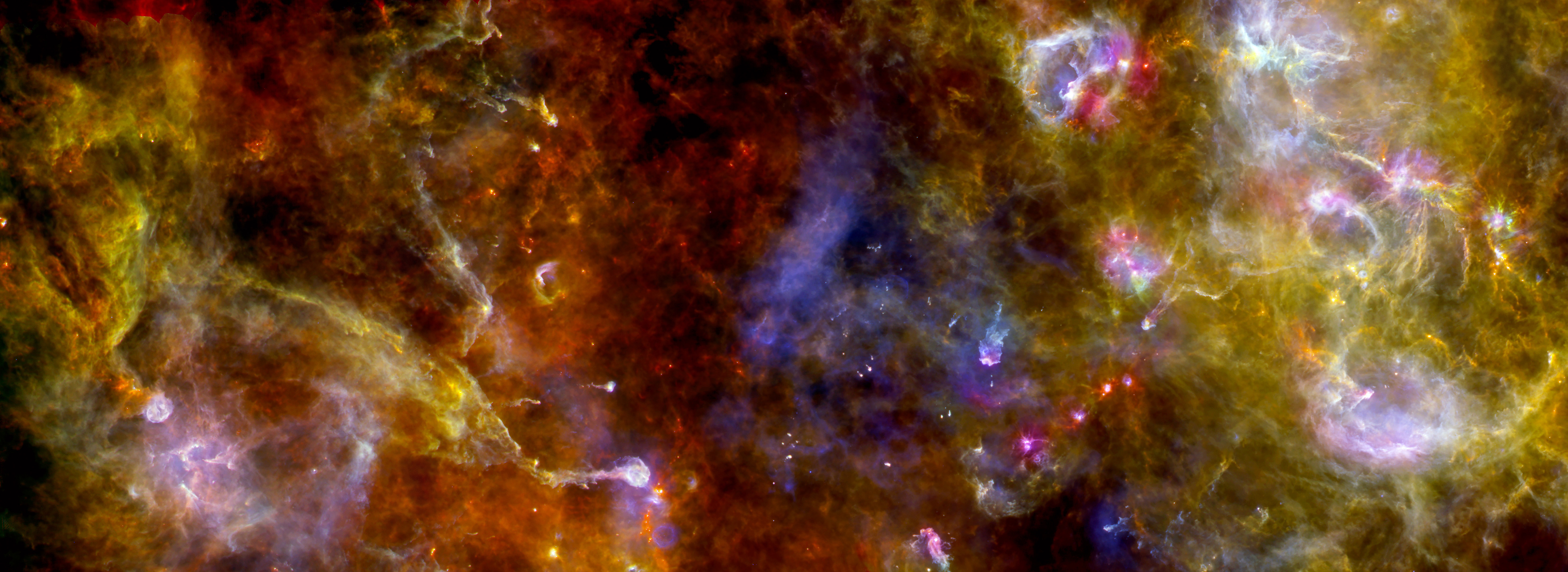
This new view of the Cygnus-X star-formation region by Herschel highlights chaotic networks of dust and gas that point to sites of massive star formation.

The image combines data acquired with the PACS instrument at 70 micron (corresponding to the blue channel) and 160 micron (corresponding to the green channel) and with the SPIRE instrument at 250 micron (corresponding to the red channel). The observations were made on 24 May 2010 and 18 December 2010. North is to the lower-right and east to the upper-right.

Credits: ESA/PACS/SPIRE/Martin Hennemann & Frédérique Motte, Laboratoire AIM Paris-Saclay, CEA/Irfu – CNRS/INSU – Univ. Paris Diderot, France. HI-RES JPEG (Size: 2381 kb)

An annotated version of Herschel’s view of Cygnus-X highlighting numerous dense sites of new star formation in the right-hand complex, and the swan-like structure in the left-hand portion of the scene. Powerful radiation and winds from thousands of stars in the OB2 complex undetected at Herschel’s long wavelengths have partly cleared and heated surrounding material, visible as the diffuse blue glow in the centre of the image. A supergiant star identified as G79.29+0.46 has likely ejected the ring of material seen at the bottom of the image.

Credits: ESA/PACS/SPIRE/Martin Hennemann & Frédérique Motte, Laboratoire AIM Paris-Saclay, CEA/Irfu – CNRS/INSU – Univ. Paris Diderot, France. HI-RES JPEG (Size:
7952 kb)

Chaotic networks of dust and gas signpost the next generations of massive stars in this stunning new image of the Cygnus-X star-nursery captured by ESA’s Herschel space observatory.

Cygnus-X is an extremely active region of massive-star birth some 4500 light-years from Earth in the constellation of Cygnus, the Swan.

Using Herschel’s far-infrared eyes, astronomers can seek out regions where dust has been gently heated by stars, pointing them to dense clumps of gas where new generations of stars are forming.

Bright white areas highlight zones where large stars have recently formed out of turbulent clouds, especially evident in the chaotic network of filaments seen in the right-hand portion of the image.

Here, dense knots of gas and dust mark intersections where filaments meet and collapse to form new stars, and where bubble-like structures are carved by their immense radiation.

In the centre of the image, fierce radiation and powerful stellar winds from stars undetected at Herschel’s wavelengths have partly cleared and heated interstellar material, which then glows blue in this representation.

The left-hand part of the scene is dominated by a pillar of gas whose shape resembles that of the neck of a swan.

Below and to the right, a shell of gas and dust has likely been ejected from a supergiant star at its centre, but which is not seen directly in this image.

Strings of compact red objects scattered throughout the scene map the cold seeds of future generations of stars.

The image highlights the unique capabilities of Herschel to probe the birth of large stars and their influence on the surrounding interstellar material with a level of detail at far-infrared wavelengths that has never before been available.

For further information, please contact:

Markus Bauer
ESA Science and Robotic Exploration Communication Officer
Tel: +31 71 565 6799
Mob: +31 61 594 3 954
Email: markus.bauer@esa.int

Göran Pilbratt
ESA Herschel Project Scientist
Research and Scientific Support Department
Science and Robotic Exploration Directorate
ESA, The Netherlands
Tel: +31 71 565 3621
Email: gpilbratt@rssd.esa.int

More about → Cygnus-X: the cool swan glowing in flight

NOAO: The Lives of Stars, or Astronomers as Paparazzi

Posted by carsimulator on Monday, April 16, 2012

Fig. 1: The yellow and red supergiants in the Large Magellanic Cloud are marked on an images of the LMC, taken to reveal the glowing interstellar gas around very hot stars. (LMC Image available from the NOAO Image Gallery) Image Credit: C. Smith, S. Points, the MCELS Team and NOAO/AURA/NSF

Fig 2: The yellow and red supergiants in M33
Image taken as part of the NOAO Local Group Galaxies Survey (P. Massey).

Stars live for a long time, with even the most massive stars having lifetimes measured in millions of years. But, for a mere few thousand years towards the end of their lives, some massive stars go through what astronomers call the yellow supergiant phase. This is remarkably short in astronomical terms, and, as a result, stars in this phase are incredibly rare. In a recent study, astronomers from Lowell Observatory have acted as “stellar paparazzi”, managing to identify hundreds of these rare yellow supergiants, and their more long-lived descendants, the red supergiants in two neighboring galaxies. The Lowell astronomers use these newly identified populations to provide a stringent observational test for the theoretical models which describe how these stars change from blue, to yellow and then to red. These constraints are vital because the behavior of the models in this phase can influence many theoretical predictions, including something as “basic” as what types of stars explode as supernova.

Nearby red supergiant stars include such well-known stars as Betelgeuse, Antares, and Mu Cephei, and yellow supergiant stars include names like Canopus and rho Cassiopeiae, although these stars were not included in the study.

As described in two recent papers the group from Lowell Observatory, using NOAO facilities in Chile and the Multiple Mirror Telescope in Arizona, have observed a relatively complete set of the red and yellow supergiants in the nearby galaxies of the Large Magellanic Cloud (LMC) and M33. The location of the supergiants in the LMC are shown in Figure 1; those in M33 are shown in fig. 2. The astronomers compared their observations with computer models of stars derived by a group at Geneva Observatory, Switzerland, and find excellent agreement between their observed sample and theory in predicting the stellar lifetimes and general stellar properties during a critical period near the end of the stars’ lifetimes. This is in contrast to studies from three years ago by the same teams that showed large discrepancies between yellow supergiant populations and a previous version of the Geneva evolutionary models.

These two studies were led by two young researchers at Lowell Observatory, Kathryn Neugent (lead for the LMC study) and Maria Drout (lead for the M33 study), and both involve an international collaboration with Dr. Georges Meynet (Geneva Observatory), one of the world’s experts in stellar evolution theory. Both women retain the status of researcher at Lowell, while pursuing other concerns: Ms Neugent has recently joined the staff of MITRE in Colorado Springs as a cyber security analysist, and Ms Drout is completing her first year in the PhD program at Harvard. Phil Massey, a staff astronomer at Lowell Observatory, helped with both studies, and Brian Skiff, another researcher at Lowell Observatory, helped with the LMC study.

To astronomers, the HR diagram (a plot of the intrinsic luminosity versus temperature of all stars) is key to understanding the evolution, or lifetime, of stars. For most of their lives, stars, fueled by hydrogen in their cores, are constant in brightness and temperature, and this phase, termed the main sequence, is well understood. But there have been problems with understanding how the temperature and luminosity of a star rapidly changes as the core of the star is exhausted at the end of the stellar life. Understanding the late stages of stellar evolution is important for other questions, too. Yellow supergiants may be the progenitors of core-collapse supernovae, and understanding supernovae completely has important implications for cosmology.

Interpreting the HR diagram depends on mathematical models of a star’s interior, which indicate how stars of different masses change with age. These models, based on knowledge of the physics of nuclear reaction rates, predict how a star of a given mass will change in temperature and luminosity over its lifetime, but models require careful comparison with actual observations. Suppose curious aliens visited earth and, from a quick schoolyard survey, noted that human weight and height increase with age. The aliens might propose a model for human growth in which weight and height increase smoothly with age, but this model would not allow for adolescent growth spurts or middle age. If they compared their model with further measurements of fast sprouting teenagers, they would be puzzled. This is akin to the problem astronomers have faced in understanding the red and yellow supergiants. Previous evolutional models predicted far too many yellow supergiants—in other words, theoretical yellow supergiants seem to live much longer than the real stars in nature. This may resonate with those familiar with star names: it’s easy to come up with examples of red supergiants like Betelgeuse, but more difficult to think of examples of yellow supergiants whose lifetimes are measured in only a few tens of thousand years.

The Lowell group studied the supergiants in nearby galaxies, rather than our own Milky Way, to avoid the problems of identifying and characterizing stars at different distances. First, they selected stars based on their colors and angular motion across the sky. For the LMC study, they obtained spectra of almost 2,000 stars by making use of Hydra, a spectrograph on the Blanco 4-m telescope on Cerro Tololo (in northern Chile) that allows many stars to be observed at the same time. They obtained a similar number of spectra of the M33 stars using Hectospec on the 6.5-meter MMT telescope located on Mt Hopkins (in southern Arizona). The spectra provide a star’s radial velocity: motion towards or away from us. This is key to deciding which stars are actually foreground red and yellow stars in our own Milky Way galaxy, masquerading as red supergiants in these other galaxies. The work by the Lowell astronomers was supported by the National Science Foundation.

The observational data in the paper on the LMC were taken at NOAO’s Cerro Tololo Inter-American Observatory by K. Neugent, P. Massey, and B. Skiff, all from Lowell Observatory. A second paper on M33, by M. Drout and P. Massey, makes use of data collected through time granted by NOAO at the MMT Observatory. Both papers rely on mathematical models by G. Meynet, Geneva University. The published version of the LMC paper is available at http://lanl.arxiv.org/abs/1202.4225, the preprint of the M33 paper accepted for publication is available at http://lanl.arxiv.org/abs/1203.0247 .

NOAO, which manages CTIO, is operated by the Association of Universities for Research in Astronomy Inc. (AURA) under a cooperative agreement with the National Science Foundation.

***

Science Contact

Maria R. Drout
Center for Astrophysics
Harvard University
60 Garden Street, M-S 10
Cambridge, MA 02138
Email: mdrout@cfa.harvard.edu

More about → NOAO: The Lives of Stars, or Astronomers as Paparazzi

Neutron star bites off more than it can chew

Posted by carsimulator on Tuesday, June 28, 2011

HI-RES GIF (Size: 10 261 kb)
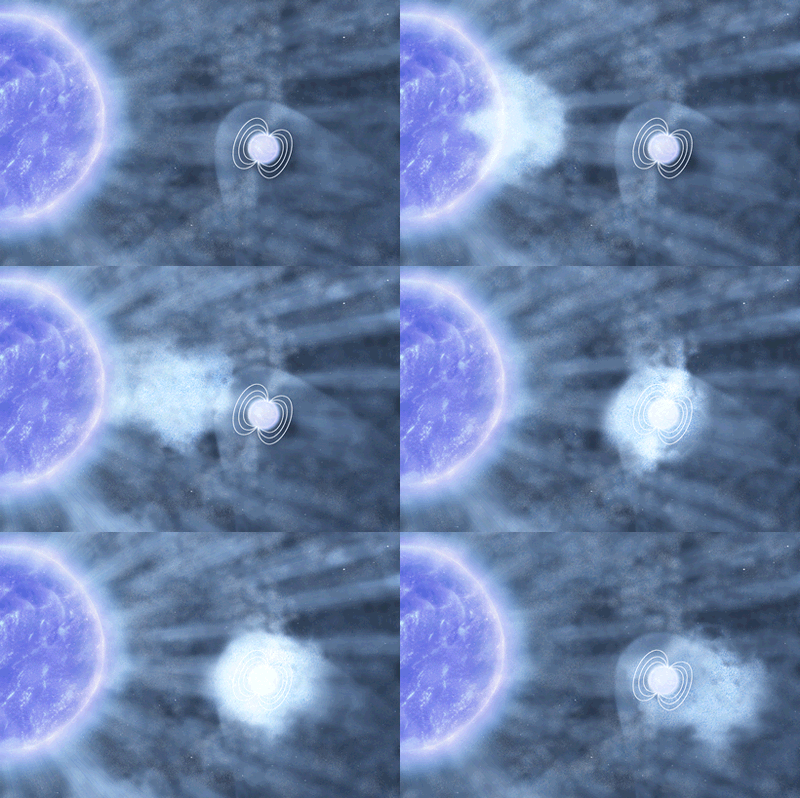
This animated sequence of images illustrates the partial ingestion of a clump of matter by the neutron star hosted in the Supergiant Fast X-Ray Transient, IGR J18410-0535.

The ingestion of the clump material produced a dramatic increase in the X-rays released by the neutron star, which was detected with XMM-Newton. The peak in the X-ray luminosity corresponds to the period when the accretion rate was at its maximum.

Credits: ESA/AOES Medialab
ESA’s XMM-Newton space observatory has watched a faint star flare up at X-ray wavelengths to almost 10 000 times its normal brightness. Astronomers believe the outburst was caused by the star trying to eat a giant clump of matter.

The flare took place on a neutron star, the collapsed heart of a once much larger star. Now about 10 km in diameter, the neutron star is so dense that it generates a strong gravitational field.

The clump of matter was much larger than the neutron star and came from its enormous blue supergiant companion star.

“This was a huge bullet of gas that the star shot out, and it hit the neutron star allowing us to see it,” says Enrico Bozzo, ISDC Data Centre for Astrophysics, University of Geneva, Switzerland, and team leader of this research.

The flare lasted four hours and the X-rays came from the gas in the clump as it was heated to millions of degrees while being pulled into the neutron star’s intense gravity field. In fact, the clump was so big that not much of it hit the neutron star. Yet, if the neutron star had not been in its path, this clump would probably have disappeared into space without trace.

XMM-Newton caught the flare during a scheduled 12.5-hour observation of the system, which is known only by its catalogue number IGR J18410-0535, but the astronomers were unaware of their catch immediately.

The telescope works through a sequence of observations carefully planned to make the best use of the space observatory’s time, then sends the data to Earth.

It was about ten days after the observation that Dr Bozzo and his colleagues received the data and quickly realised they had something special. Not only were they pointing in the right direction to see the flare, but the observation had lasted long enough for them to see it from beginning to end.

“I don’t know if there is any way to measure luck, but we were extremely lucky,” says Dr Bozzo. He estimates that an X-ray flare of this magnitude can be expected a few times a year at the most for this particular star system.

The duration of the flare allowed them to estimate the size of the clump. It was much larger than the star, probably 16 million km across, or about 100 billion times the volume of the Moon. Yet, according to the estimate made from the flare’s brightness, the clump contained only one-thousandth of our natural satellite’s mass.

These figures will help astronomers understand the behaviour of the blue supergiant and the way it emits matter into space. All stars expel atoms into space, creating a stellar wind. The X-ray flare shows that this particular blue supergiant does it in a clumpy fashion, and the estimated size and mass of the cloud allow constraints to be placed on the process.

“This remarkable result highlights XMM-Newton's unique capabilities,” comments Norbert Schartel, XMM-Newton Project Scientist. “Its observations indicate that these flares can be linked to the neutron star attempting to ingest a giant clump of matter.”


Contact for further information


Markus Bauer

ESA Science and Robotic Exploration Communication Officer
Email: markus.bauer@esa.int
Tel: +31 71 565 6799
Mob: +31 61 594 3 954

Enrico Bozzo
ISDC Data Centre for Astrophysics
University of Geneva, Switzerland
Tel: +41 22 37 92158
Email: enrico.bozzo@unige.ch

Norbert Schartel
ESA XMM-Newton Project Scientist
Tel: +34 91 8131 184
Email: norbert.schartel@esa.int

Notes to editors

IGR J18410-0535 belongs to the class of star called Supergiant Fast X-Ray Transients, which were discovered by ESA’s INTEGRAL spacecraft in 2005.

Bozzo, E., et al., “XMM-Newton observations of IGR J18410-0535: the ingestion of a clump by a supergiant fast X-ray transient”, will be published in a forthcoming edition of Astronomy and Astrophysics.

More about → Neutron star bites off more than it can chew