Showing posts with label Supernova Remnant. Show all posts

SN 1957D in M83: X-Rays Discovered from Young Supernova Remnant

Posted by carsimulator on Monday, July 30, 2012

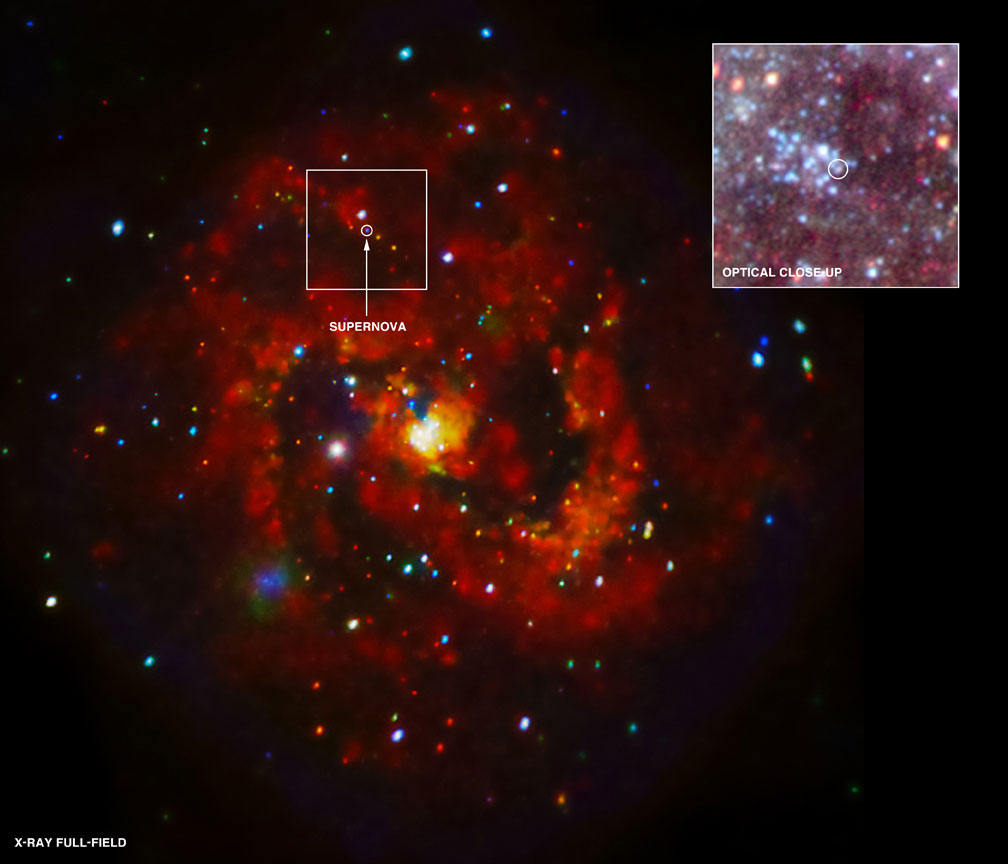
SN 1957D in M83
Credit: X-ray: NASA/CXC/STScI/K.Long et al.,
Optical: NASA/STScI


JPEG (392.3 kb) - Large JPEG (81.5 kb) - Tiff (43.2 MB)
High-Quality Prints - More Images


Over fifty years ago, a supernova was discovered in M83, a spiral galaxy about 15 million light years from Earth. Astronomers have used NASA's Chandra X-ray Observatory to make the first detection of X-rays emitted by the debris from this explosion.

Named SN 1957D because it was the fourth supernova to be discovered in the year of 1957, it is one of only a few located outside of the Milky Way galaxy that is detectable, in both radio and optical wavelengths, decades after its explosion was observed. In 1981, astronomers saw the remnant of the exploded star in radio waves, and then in 1987 they detected the remnant at optical wavelengths, years after the light from the explosion itself became undetectable.

A relatively short observation -- about 14 hours long -- from NASA's Chandra X-ray Observatory in 2000 and 2001 did not detect any X-rays from the remnant of SN 1957D. However, a much longer observation obtained in 2010 and 2011, totaling nearly 8 and 1/2 days of Chandra time, did reveal the presence of X-ray emission. The X-ray brightness in 2000 and 2001 was about the same as or lower than in this deep image.

This new Chandra image of M83 is one of the deepest X-ray observations ever made of a spiral galaxy beyond our own. This full-field view of the spiral galaxy shows the low, medium, and high-energy X-rays observed by Chandra in red, green, and blue respectively. The location of SN 1957D, which is found on the inner edge of the spiral arm just above the galaxy's center, is outlined in the box (or can be seen by mousing over the image.)

The new X-ray data from the remnant of SN 1957D provide important information about the nature of this explosion that astronomers think happened when a massive star ran out of fuel and collapsed. The distribution of X-rays with energy suggests that SN 1957D contains a neutron star, a rapidly spinning, dense star formed when the core of pre-supernova star collapsed. This neutron star, or pulsar, may be producing a cocoon of charged particles moving at close to the speed of light known as a pulsar wind nebula.

If this interpretation is confirmed, the pulsar in SN 1957D is observed at an age of 55 years, one of the youngest pulsars ever seen. The remnant of SN 1979C in the galaxy M100 contains another candidate for the youngest pulsar, but astronomers are still unsure whether there is a black hole or a pulsar at the center of SN 1979C.

An image from the Hubble Space Telescope (in the box labeled "Optical Close-Up") shows that the debris of the explosion that created SN 1957D is located at the edge of a star cluster less than 10 million years old. Many of these stars are estimated to have masses about 17 times that of the Sun. This is just the right mass for a star's evolution to result in a core-collapse supernova as is thought to be the case in SN 1957D.

Multipanel with Optical, H-alpha & X-ray
Credit: Optical: NASA/STScI)

These results will appear in an upcoming issue of The Astrophysical Journal. The researchers involved with this study were Knox Long (Space Telescope Science Institute), William Blair (Johns Hopkins University), Leith Godfrey (Curtain University, Australia), Kip Kuntz (Johns Hopkins), Paul Plucinsky (Harvard-Smithsonian Center for Astrophysics), Roberto Soria (Curtain University), Christopher Stockdale (University of Oklahoma and the Australian Astronomical Observatory), Bradley Whitmore (Space Telescope Science Institute), and Frank Winkler (Middlebury College).

NASA's Marshall Space Flight Center in Huntsville, Ala., manages the Chandra program for NASA's Science Mission Directorate in Washington. The Smithsonian Astrophysical Observatory controls Chandra's science and flight operations from Cambridge, Mass.

Fast Facts for SN 1957D in M83:

Credit: X-ray: NASA/CXC/STScI/K.Long et al., Optical: NASA/STScI
Release Date: July 30, 2012
Scale: 9.5 arcmin on a side (~41,000 light years); Inset image: 1.6 x 1.3 arcsec (~120 x ~100 light years)
Category: Normal Galaxies & Starburst Galaxies
Coordinates: (J2000) RA 13h 37m 00.80s | Dec -29 51 58.60
Constellation:
Hydra
Observation Date: 12 pointings between April 29, 2000 and Dec 28, 2011
Observation Time: 219 hours 49 min.
Obs. ID: 793, 2064, 12420, 12992-12996, 13202, 13241, 13248, 14332, 14342
Instrument:
ACIS
Also Known As: NGC 5236
References: Long, K. et al, 2012, (in press)
arXiv:1207.1555
Color Code: X-ray: (Red, Green, Blue); Optical inset (Red, Green, Blue)

More aboutSN 1957D in M83: X-Rays Discovered from Young Supernova Remnant

IGR J11014-6103: Has the Speediest Pulsar Been Found?

Posted by carsimulator on Thursday, June 28, 2012

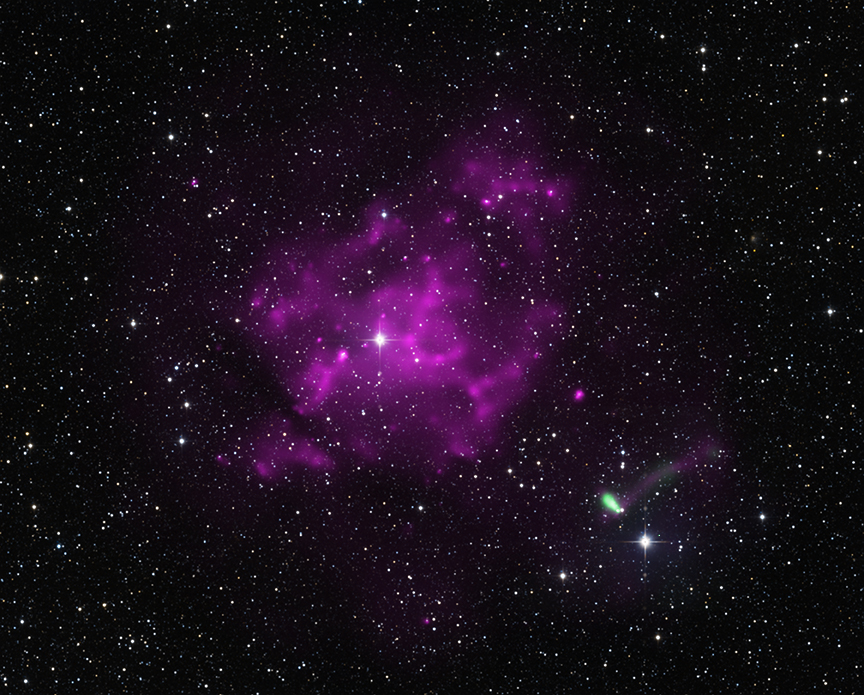
IGR J11014-6103
Credit: X-ray: NASA/CXC/UC Berkeley/J.Tomsick et al & ESA/XMM-Newton, Optical: DSS; IR: 2MASS/UMass/IPAC-Caltech/NASA/NSF


Researchers using three different telescopes -- NASA's Chandra X-ray Observatory and ESA's XMM-Newton in space, and the Parkes radio telescope in Australia -- may have found the fastest moving pulsar ever seen.


The evidence for this potentially record-breaking speed comes, in part, from the features highlighted in this composite image. X-ray observations from Chandra (green) and XMM-Newton (purple) have been combined with infrared data from the 2MASS project and optical data from the Digitized Sky Survey (colored red, green and blue, but appearing in the image as white).

The large area of diffuse X-rays seen by XMM-Newton was produced when a massive star exploded as a supernova, leaving behind a debris field, or supernova remnant known as SNR MSH 11-16A. Shocks waves from the supernova have heated surrounding gas to several million degrees Kelvin, causing the remnant to glow brightly in X-rays.

The Chandra image shown in the inset ("Chandra Close-up") reveals a comet-shaped X-ray source well outside the boundary of the supernova remnant. This source consists of a point-like object with a long tail trailing behind it for about 3 light years. The bright star nearby and also the one in SNR MSH11-16A are both likely to be foreground stars unrelated to the supernova remnant.

The point-like X-ray source was discovered by the International Gamma-Ray Astrophysics Laboratory, or INTEGRAL, and is called IGR J11014-6103 (or IGR J11014 for short). It may be a rapidly spinning, super-dense star (known as a "pulsar", a type of neutron star) that was ejected during the explosion. If so, it is racing away from the center of the supernova remnant at millions of miles per hour.

The favored interpretation for the tail of X-ray emission is that a pulsar wind nebula, that is, a "wind" of high-energy particles produced by the pulsar, has been swept behind a bow shock created by the pulsar's high speed. (A similar case was seen in another object known as PSR B1957+20 .

The elongated emission is pointing towards the center of MSH 11-61A where the pulsar would have been formed, supporting the idea that the Chandra image is of a pulsar wind nebula and its bow shock. Another interesting feature of the Chandra image, also seen with XMM-Newton, is the faint X-ray tail extending to the top-right. The cause of this feature is unknown, but similar tails have been seen from other pulsars that also do not line up with the pulsar's direction of motion.

Based on earlier observations, astronomers estimate that the age of MSH 11-61A, as it appears in the image, is approximately 15,000 years, and it lies at a distance of about 30,000 light years away from Earth. Combining these values with the distance that the pulsar has appeared to have traveled from the center of the MSH 11-61A, astronomers estimate that IGR J11014 is moving at a speed between 5.4 million and 6.5 million miles per hour.

The only other neutron star associated with a supernova remnant that may rival this in speed is the candidate found in the supernova remnant known as G350.1-0.3. The speed of the neutron star candidate in this system is estimated to lie between 3 and 6 million miles per hour.

The high speeds estimated for both IGR J11014 and the neutron star candidate in G350.1-0.3 are preliminary and need to be confirmed. If they are confirmed, explaining the high speeds of the neutron star presents a severe challenge to existing models for supernova explosions.

One important caveat in the conclusion that IGR J11014 may be the fastest moving pulsar is that pulsations have not been detected in it during a search with the Commonwealth Scientific and Industrial Research Organization (CSIRO) Parkes radio telescope. This non-detection is not surprising for a pulsar located about 30,000 light years away.

However, there are other pieces of evidence that support the pulsar interpretation. First, the lack of detection of a counterpart to the X-ray source in optical or infrared images supports the idea that it is a pulsar, since such objects are very faint at these wavelengths. Also, there are no apparent differences in the brightness of the source between XMM-Newton observations in 2003 and the Chandra observations in 2011, behavior that is expected if IGR J11014 is a pulsar. Finally, the X-ray spectrum of the source, that is, its signature in energy, is similar to what astronomers expect to see for a pulsar.

These results were published in the May 10, 2012 issue of The Astrophysical Journal Letters. The authors were John Tomsick and Arash Bodaghee (University of California, Berkeley), Jerome Rodriguez and Sylvain Chaty (University of Paris, CEA Saclay), Fernando Camilo (Columbia University), Francesca Fornasini (UC Berkeley), and Farhid Rahoui (Harvard-Smithsonian Center for Astrophysics).

NASA's Marshall Space Flight Center in Huntsville, Ala., manages the Chandra program for NASA's Science Mission Directorate in Washington. The Smithsonian Astrophysical Observatory controls Chandra's science and flight operations from Cambridge, Mass.

Fast Facts for IGR J11014-6103:

Scale: 1 degree across (~576 light years)
Category: Supernovas & Supernova Remnants, Neutron Stars/X-ray Binaries
Coordinates (J2000): RA 11h 01m 22.08s | Dec -61° 03' 25.20"
Constellation: Carina
Observation Date: 6 Sep 2011
Observation Time: 1 hours 23 min.
Obs. ID: 12420
Color Code: X-ray-Chandra: (Green) X-ray-XMM: (Purple); Optical (Red, Green, Blue)
Instrument: ACIS
References: Tomsick, J et al, 2012 ApJ 750:39; arXiv:1204.2836
Distance Estimate: About 30,000 light years

More aboutIGR J11014-6103: Has the Speediest Pulsar Been Found?

One Supernova Type, Two Different Sources

Posted by carsimulator on Monday, May 7, 2012

The Tycho supernova remnant is the result of a Type Ia supernova explosion. The explosion was observed by Danish astronomer Tycho Brahe in 1572. More than 400 years later, the ejecta from that explosion has expanded to fill a bubble 55 light-years across. In this image, low-energy X-rays (red) show expanding debris from the supernova explosion and high energy X-rays (blue) show the blast wave - a shell of extremely energetic electrons. Credit: X-ray: NASA/CXC/Rutgers/K.Eriksen et al.; Optical: DSS. Low Resolution Image (jpg)

Cambridge, MA - The exploding stars known as Type Ia supernovae serve an important role in measuring the universe, and were used to discover the existence of dark energy. They're bright enough to see across large distances, and similar enough to act as a "standard candle" - an object of known luminosity. The 2011 Nobel Prize in Physics was awarded for the discovery of the accelerating universe using Type Ia supernovae. However, an embarrassing fact is that astronomers still don't know what star systems make Type Ia supernovae.

Two very different models explain the possible origin of Type Ia supernovae, and different studies support each model. New evidence shows that both models are correct - some of these supernovae are created one way and some the other.

"Previous studies have produced conflicting results. The conflict disappears if both types of explosion are happening," explained Smithsonian astronomer and Clay Fellow Ryan Foley (Harvard-Smithsonian Center for Astrophysics).

Type Ia supernovae are known to originate from white dwarfs - the dense cores of dead stars. White dwarfs are also called degenerate stars because they're supported by quantum degeneracy pressure.

In the single-degenerate model for a supernova, a white dwarf gathers material from a companion star until it reaches a tipping point where a runaway nuclear reaction begins and the star explodes. In the double-degenerate model, two white dwarfs merge and explode. Single-degenerate systems should have gas from the companion star around the supernova, while the double-degenerate systems will lack that gas.

"Just like mineral water can be with or without gas, so can supernovae," said Robert Kirshner, Clowes Professor of Astronomy at Harvard University and a co-author on the study.

Foley and his colleagues studied 23 Type Ia supernovae to look for signatures of gas around the supernovae, which should be present only in single-degenerate systems. They found that the more powerful explosions tended to come from "gassy" systems, or systems with outflows of gas. However, only a fraction of supernovae show evidence for outflows. The remainder seem to come from double-degenerate systems.

"There are definitely two kinds of environments - with and without outflows of gas. Both are found around Type Ia supernovae," Foley said.

This finding has important implications for measurements of dark energy and the expanding universe. If two different mechanisms are at work in Type Ia supernovae, then the two types must be considered separately when calculating cosmic distances and expansion rates.

"It's like measuring the universe with a mix of yardsticks and meter sticks - you'll get about the same answer, but not quite. To get an accurate answer, you need to separate the yardsticks from the meter sticks," Foley explained.

This study raises an interesting question - if two different mechanisms create Type Ia supernovae, why are they homogeneous enough to serve as standard candles?

"How can supernovae coming from different systems look so similar? I don't have the answer for that," said Foley.

The paper describing this research will appear in the Astrophysical Journal and is available online.

Headquartered in Cambridge, Mass., the Harvard-Smithsonian Center for Astrophysics (CfA) is a joint collaboration between the Smithsonian Astrophysical Observatory and the Harvard College Observatory. CfA scientists, organized into six research divisions, study the origin, evolution and ultimate fate of the universe.

For more information, contact:

David A. Aguilar
Director of Public Affairs
Harvard-Smithsonian Center for Astrophysics
617-495-7462
daguilar@cfa.harvard.edu

Christine Pulliam
Public Affairs Specialist
Harvard-Smithsonian Center for Astrophysics
617-495-7463
cpulliam@cfa.harvard.edu

More aboutOne Supernova Type, Two Different Sources

Cassiopeia A: A Star Explodes and Turns Inside Out

Posted by carsimulator on Thursday, March 29, 2012

Credit Illustration: NASA/CXC/M.Weiss;
X-ray: NASA/CXC/GSFC/U.Hwang & J.Laming

JPEG (425 kb) - Tiff (35.7 MB) - More Images


A new X-ray study of the remains of an exploded star indicates that the supernova that disrupted the massive star may have turned it inside out in the process. Using very long observations of Cassiopeia A (or Cas A), a team of scientists has mapped the distribution of elements in the supernova remnant in unprecedented detail. This information shows where the different layers of the pre-supernova star are located three hundred years after the explosion, and provides insight into the nature of the supernova.

An artist's illustration on the left shows a simplified picture of the inner layers of the star that formed Cas A just before it exploded, with the predominant concentrations of different elements represented by different colors: iron in the core (blue), overlaid by sulfur and silicon (green), then magnesium, neon and oxygen (red). The image from NASA's Chandra X-ray Observatory on the right uses the same color scheme to show the distribution of iron, sulfur and magnesium in the supernova remnant. The data show that the distributions of sulfur and silicon are similar, as are the distributions of magnesium and neon. Oxygen, which according to theoretical models is the most abundant element in the remnant, is difficult to detect because the X-ray emission characteristic of oxygen ions is strongly absorbed by gas in along the line of sight to Cas A, and because almost all the oxygen ions have had all their electrons stripped away.

A comparison of the illustration and the Chandra element map shows clearly that most of the iron, which according to theoretical models of the pre-supernova was originally on the inside of the star, is now located near the outer edges of the remnant. Surprisingly, there is no evidence from X-ray (Chandra) or infrared (Spitzer Space Telescope) observations for iron near the center of the remnant, where it was formed. Also, much of the silicon and sulfur, as well as the magnesium, is now found toward the outer edges of the still-expanding debris. The distribution of the elements indicates that a strong instability in the explosion process somehow turned the star inside out.

This latest work, which builds on earlier Chandra observations, represents the most detailed study ever made of X-ray emitting debris in Cas A, or any other supernova remnant resulting from the explosion of a massive star. It is based on a million seconds of Chandra observing time. Tallying up what they see in the Chandra data, astronomers estimate that the total amount of X-ray emitting debris has a mass just over three times that of the Sun. This debris was found to contain about 0.13 times the mass of the Sun in iron, 0.03 in sulfur and only 0.01 in magnesium.

The researchers found clumps of almost pure iron, indicating that this material must have been produced by nuclear reactions near the center of the pre-supernova star, where the neutron star was formed. That such pure iron should exist was anticipated because another signature of this type of nuclear reaction is the formation of the radioactive nucleus titanium-44, or Ti-44. Emission from Ti-44, which is unstable with a half-life of 63 years, has been detected in Cas A with several high-energy observatories including the Compton Gamma Ray Observatory, BeppoSAX, and the International Gamma-Ray Astrophysics Laboratory (INTEGRAL).

These results appeared in the February 20th issue of The Astrophysical Journal in a paper by Una Hwang of Goddard Space Flight Center and Johns Hopkins University, and (John) Martin Laming of the Naval Research Laboratory.

Fast Facts for Cassiopeia A:

Credit Illustration: NASA/CXC/M.Weiss; X-ray: NASA/CXC/GSFC/U.Hwang & J.Laming
Scale Image is 8.4 arcmin across (about 27 light years)
Category: Supernovas & Supernova Remnants
Coordinates: (J2000) RA 23h 23m 26.7s | Dec +58° 49' 03.00"
Constellation: Cassiopeia
Observation Dates: 9 pointings between Feb 8 and May 5, 2004
Observation Time: 272 hours 13 min (11 days 8 hours 13 min)
Obs. IDs: 4634-4639, 5196, 5319-5320
Instrument: ACIS
Also Known As: Cas A
References: Hwang, U. et al, 2012, ApJ, 746, 130; arXiv:1111.7316
Distance Estimate: About 11,000 light years

More aboutCassiopeia A: A Star Explodes and Turns Inside Out

G350.1-0.3: Remnant of an Explosion With a Powerful Kick?

Posted by carsimulator on Wednesday, February 1, 2012

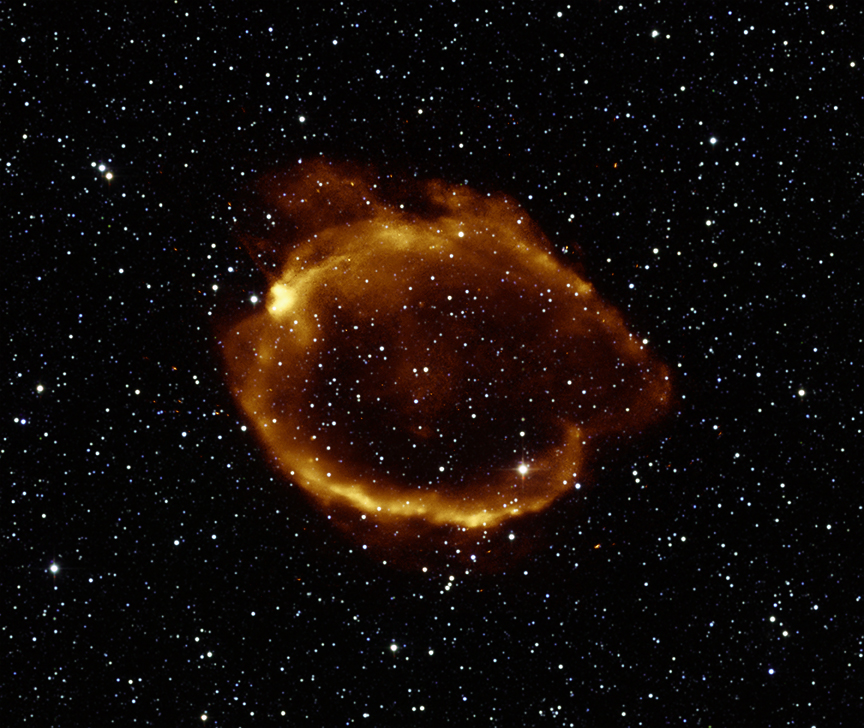
G350.1+0.3


Vital clues about the devastating ends to the lives of massive stars can be found by studying the aftermath of their explosions. In its more than twelve years of science operations, NASA's Chandra X-ray Observatory has studied many of these supernova remnants sprinkled across the Galaxy.

The latest example of this important investigation is Chandra's new image of the supernova remnant known as G350.1+0.3. This stellar debris field is located some 14,700 light years from the Earth toward the center of the Milky Way .

Evidence from Chandra and from ESA's XMM-Newton telescope suggest that a compact object within G350.1+0.3 may be the dense core of the star that exploded. The position of this likely neutron star, seen by mousing over the image above, is well away from the center of the X-ray emission (mouse-over for this position). If the supernova explosion occurred near the center of the X-ray emission then the neutron star must have received a powerful kick in the supernova explosion.

Data from Chandra and other telescopes suggest this supernova remnant, as it appears in the image, is between 600 and 1,200 years old. If the estimated location of the explosion is correct, this means that the neutron star has been moving at a speed of at least 3 million miles per hour since the explosion This is comparable to the exceptionally high speed derived for the neutron star in Puppis A and provides new evidence that extremely powerful "kicks" can be imparted to neutron stars from supernova explosions.

Another intriguing aspect of G350.1+0.3 is its unusual shape. While many supernova remnants are nearly circular, G350.1+0.3 is strikingly asymmetrical as seen in the Chandra data in this image (gold). Infrared data from NASA's Spitzer Space Telescope (light blue) also trace the morphology found by Chandra. Astronomers think that this bizarre shape is due to the stellar debris field expanding into a nearby cloud of cold molecular gas.

The age of 600-1,200 years puts the explosion that created G350.1+0.3 in the same time frame as other famous supernovas that formed the Crab and SN 1006 supernova remnants. However, it is unlikely that anyone on Earth would have seen the explosion because of the obscuring gas and dust that lies along our line of sight to the remnant.

These results appeared in the April 10, 2011 issue of The Astrophysical Journal. The scientists on this paper were Igor Lovchinsky and Patrick Slane (Harvard-Smithsonian Center for Astrophysics), Bryan Gaensler (University of Sydney, Australia), Jack Hughes (Rutgers University), Jasmina Lazendic (Monash University Clayton, Australia), Joseph Gelfand (New York University, Abu Dhabi), and Crystal Brogan (National Radio Astronomy Observatory).

Fast Facts for G350.1-0.3:

Scale: 5.2 arcmin across (about 22 light years)
Category: Supernovas & Supernova Remnants, Neutron Stars/X-ray Binaries
Coordinates: (J2000) RA 17h 21m 03.00s | Dec -37° 26' 50.00"
Constellation: Scorpius
Observation Date: 5/24/2009
Observation Time: 23 hours 3 min.
Obs. ID: 10102
Color Code: X-ray (Gold); Infrared 24 micron (Cyan); Infrared 8 micron (Purple); Infrared: 3.6 micron (Green)
Instrument: ACIS
References: Lovchinsky, I. et al, 2011, ApJ, 731, 70
Distance Estimate: 14,700 light years

More aboutG350.1-0.3: Remnant of an Explosion With a Powerful Kick?

Hubble Solves Mystery on Source of Supernova in Nearby Galaxy

Posted by carsimulator on Wednesday, January 11, 2012

SNR 0509-67.5
Science Credit: NASA, ESA, and B. Schaefer and A. Pagnotta (Louisiana State University, Baton Rouge)
Image Credit: NASA, ESA, CXC, SAO, the Hubble Heritage Team (STScI/AURA), and J. Hughes (Rutgers University)

Using NASA's Hubble Space Telescope, astronomers have solved a longstanding mystery on the type of star, or so-called progenitor, that caused a supernova in a nearby galaxy. The finding yields new observational data for pinpointing one of several scenarios that could trigger such outbursts.

Based on previous observations from ground-based telescopes, astronomers knew that a kind of supernova called a Type Ia created a remnant named SNR 0509-67.5, which lies 170,000 light-years away in the Large Magellanic Cloud galaxy.

The type of system that leads to this kind of supernova explosion has long been a high importance problem with various proposed solutions but no decisive answer. All these solutions involve a white dwarf star that somehow increases in mass to the highest limit. Astronomers failed to find any companion star near the center of the remnant, and this rules out all but one solution, so the only remaining possibility is that this one Type Ia supernova came from a pair of white dwarfs in close orbit.

"We know that Hubble has the sensitivity necessary to detect the faintest white dwarf remnants that could have caused such explosions," said lead investigator Bradley Schaefer of Louisiana State University (LSU) in Baton Rouge. "The logic here is the same as the famous quote from Sherlock Holmes: 'When you have eliminated the impossible, whatever remains, however improbable, must be the truth.'"

The cause of SNR 0509-67.5 can best be explained by two tightly orbiting white dwarf stars spiraling closer and closer until they collided and exploded.

These results are being reported today at the meeting of the American Astronomical Society in Austin, Texas. A paper on the results will be published in the January 12 issue of the science journal Nature.

For four decades the search for Type Ia supernovae stellar progenitors has been a key question in astrophysics. The problem has taken on special importance over the last decade with Type Ia supernovae being the premier tools for measuring the accelerating universe.

Type Ia supernovae are tremendous explosions of energy in which the light produced is often brighter than a whole galaxy of stars. The problem has been to identify the type of star system that pushes the white dwarf's mass over the edge and triggers this type of explosion. Many possibilities have been suggested, but most require that a companion star near the exploding white dwarf be left behind after the explosion.

Therefore, a possible way to distinguish between the various progenitor models has been to look deep in the center of an old supernova remnant to search for the ex-companion star.

In 2010, Schaefer and Ashley Pagnotta of LSU were preparing a proposal to look for any faint ex-companion stars in the center of four supernova remnants in the Large Magellanic Cloud when they discovered that the Hubble Space Telescope had already taken the desired image of one of their target remnants, SNR 0509-67.5, for the Hubble Heritage program, which collects images of especially photogenic astronomical targets.

In analyzing the central region they found it to be completely empty of stars down to the limit of the faintest objects that Hubble can detect in the photos. Schaefer reports that the best explanation left is the so-called "double degenerate model" in which two white dwarfs collide.

There are no recorded observations of the star exploding. However, researchers at the Space Telescope Science Institute in Baltimore, Md., have identified light from the supernova that was reflected off of interstellar dust, delaying its arrival at Earth by 400 years. This delay, called a light echo, of the supernova explosion also allowed the astronomers to measure the spectral signature of the light from the explosion. By virtue of the color signature, astronomers were able to deduce it was a Type Ia supernova.

Because the remnant appears as a nice symmetric shell or bubble, the geometric center can be accurately determined. These properties make SNR 0509-67.5 an ideal target to search for ex-companions. The young age also means that any surviving stars have not moved far from the site of the explosion.

The team plans to look at other supernova remnants in the Large Magellanic Cloud to further test their observations.

CONTACT

Ray Villard / Cheryl Gundy
Space Telescope Science Institute, Baltimore, Md.
410-338-4514 / 410-338-4707
villard@stsci.edu / gundy@stsci.edu

Trent Perrotta
NASA Headquarters, Washington, DC
202-358-0321
trent.j.perrotto@nasa.gov

Ashley Pagnotta / Bradley Schaefer
Louisiana State University, Baton Rouge, La.
281-686-1370 / 225-578-0015
pagnotta@phys.lsu.edu / schaefer@lsu.edu

More aboutHubble Solves Mystery on Source of Supernova in Nearby Galaxy

NASA's Fermi Shows That Tycho's Star Shines in Gamma Rays

Posted by carsimulator on Tuesday, December 13, 2011

Gamma-rays detected by Fermi's LAT show that the remnant of Tycho's supernova shines in the highest-energy form of light. This portrait of the shattered star includes gamma rays (magenta), X-rays (yellow, green, and blue), infrared (red) and optical data. (Credit: Gamma ray, NASA/DOE/Fermi LAT Collaboration; X-ray, NASA/CXC/SAO; Infrared, NASA/JPL-Caltech; Optical, MPIA, Calar Alto, O. Krause et al. and DSS). Larger image

In early November 1572, observers on Earth witnessed the appearance of a "new star" in the constellation Cassiopeia, an event now recognized as the brightest naked-eye supernova in more than 400 years. It's often called "Tycho's supernova" after the great Danish astronomer Tycho Brahe, who gained renown for his extensive study of the object. Now, years of data collected by NASA's Fermi Gamma-Ray Space Telescope reveal that the shattered star's remains shine in high-energy gamma rays.

The detection gives astronomers another clue in understanding the origin of cosmic rays, subatomic particles -- mainly protons -- that move through space at nearly the speed of light. Exactly where and how these particles attain such incredible energies has been a long-standing mystery because charged particles speeding through the galaxy are easily deflected by interstellar magnetic fields. This makes it impossible to track cosmic rays back to their sources.

"Fortunately, high-energy gamma rays are produced when cosmic rays strike interstellar gas and starlight. These gamma rays come to Fermi straight from their sources," said Francesco Giordano at the University of Bari and the National Institute of Nuclear Physics in Italy. He is the lead author of a paper describing the findings in the Dec. 7 edition of The Astrophysical Journal Letters.

Better understanding the origins of cosmic rays is one of Fermi's key goals. Its Large Area Telescope (LAT) scans the entire sky every three hours, gradually building up an ever-deeper view of the gamma-ray sky. Because gamma rays are the most energetic and penetrating form of light, they serve as signposts for the particle acceleration that gives rise to cosmic rays.

"This detection gives us another piece of evidence supporting the notion that supernova remnants can accelerate cosmic rays," said co-author Stefan Funk, an astrophysicist at the Kavli Institute for Particle Astrophysics and Cosmology (KIPAC), jointly located at SLAC National Accelerator Laboratory and Stanford University, Calif.

In 1949, physicist Enrico Fermi -- the satellite's namesake -- suggested that the highest-energy cosmic rays were accelerated in the magnetic fields of interstellar gas clouds. In the decades that followed, astronomers showed that supernova remnants may be the galaxy's best candidate sites for this process.


The gamma-ray emission from Tycho's supernova remnant can be explained by pion production. A proton traveling close to the speed of light strikes a slower-moving proton. Their interaction creates an unstable particle -- a pion -- with only 14 percent of the proton's mass. In 10 millionths of a billionth of a second, the pion decays into a pair of gamma rays. (Credit: NASA's Goddard Space Flight Center) . Download animation


When a star explodes, it is transformed into a supernova remnant, a rapidly expanding shell of hot gas bounded by the blast's shockwave. Scientists expect that magnetic fields on either side of the shock front can trap particles between them in what amounts to a subatomic pingpong game.

"A supernova remnant's magnetic fields are very weak relative to Earth's, but they extend across a vast region, ultimately spanning thousands of light-years. They have a major influence on the course of charged particles," said co-author Melitta Naumann-Godo at Paris Diderot University and the Atomic Energy Commission in Saclay, France, who led the study with Giordano.

As they shuttle back and forth across the supernova shock, the charged particles gain energy with each traverse. Eventually they break out of their magnetic confinement, escaping the supernova remnant and freely roaming the galaxy.

The LAT's ongoing sky survey provides additional evidence favoring this scenario. Many younger remnants, like Tycho's, tend to produce more high-energy gamma rays than older remnants. "The gamma-ray energies reflect the energies of the accelerated particles that produce them, and we expect more cosmic rays to be accelerated to higher energies in younger objects because the shockwaves and their tangled magnetic fields are stronger," Funk added. By contrast, older remnants with weaker shockwaves cannot retain the highest-energy particles, and the LAT does not detect gamma rays with corresponding energies.

The supernova of 1572 was one of the great watersheds in the history of astronomy. The star blazed forth at a time when the starry sky was regarded as a fixed and unchanging part of the universe. Tycho's candid account of his own discovery of the strange star gives a sense of how radical an event it was.

Tycho's map shows the supernova's position (largest symbol, at top) relative to the stars that form the constellation Cassiopeia. (Credit: Gerstein Science Information Centre, Univ. of Toronto). Larger image

The supernova first appeared around Nov. 6, but poor weather kept it from Tycho until Nov. 11, when he noticed it during a walk before dinner. "When I had satisfied myself that no star of that kind had ever shone forth before, I was led into such perplexity by the unbelievability of the thing that I began to doubt the faith of my own eyes, and so, turning to the servants who were accompanying me, I asked them whether they too could see a certain extremely bright star…. They immediately replied with one voice that they saw it completely and that it was extremely bright," he recalled.

The supernova remained visible for 15 months and exhibited no movement in the heavens, indicating that it was located far beyond the sun, moon and planets. Modern astronomers estimate that the remnant lies between 9,000 and 11,000 light-years away.

After more than two and a half years of scanning the sky, LAT data clearly show that an unresolved region of GeV (billion electron volt) gamma-ray emission is associated with the remnant of Tycho's supernova. (For comparison, the energy of visible light is between about 2 and 3 electron volts.)

Keith Bechtol, a KIPAC graduate student who is also based at SLAC, was one of the first researchers to notice the potential link. "We knew that Tycho's supernova remnant could be an important find for Fermi because this object has been so extensively studied in other parts of the electromagnetic spectrum. We thought it might be one of our best opportunities to identify a spectral signature indicating the presence of cosmic-ray protons," he said.

The science team's model of the emission is based on LAT observations, along with higher-energy TeV (trillion electron volt) gamma rays mapped by ground-based facilities and radio and X-ray data. The researchers conclude that a process called pion production best explains the emission. First, a proton traveling close to the speed of light strikes a slower-moving proton. This interaction creates an unstable particle -- a pion -- with only 14 percent of the proton's mass. In just 10 millionths of a billionth of a second, the pion decays into a pair of gamma rays.

If this interpretation is correct, then somewhere within the remnant, protons are being accelerated to near the speed of light, and then interacting with slower particles to produce gamma rays, the most extreme form of light. With such unbelievable goings-on in what's left of his "unbelievable" star, it's easy to imagine that Tycho Brahe himself might be pleased.

Related Links:

NASA's Fermi Closes on Source of Cosmic Rays

NASA'S Chandra Finds New Evidence on Origin of Supernovas

A New View of Tycho's Supernova Remnant

Reproduction of Tycho's book on the 1572 supernova


Francis Reddy
NASA's Goddard Space Flight Center, Greenbelt, Md.

More aboutNASA's Fermi Shows That Tycho's Star Shines in Gamma Rays

4,000-Year-Old Supernova Fireballs Observed in the Jellyfish Nebula

Posted by carsimulator on Thursday, December 1, 2011

IC 443 - Jellyfish Nebula

Studies of two supernova remnants using the Japan-U.S. Suzaku observatory revealed never-before-seen embers of the high-temperature fireballs that immediately followed the explosions. Even after thousands of years, gas within these stellar wrecks retain the imprint of temperatures 10,000 times hotter than the sun's surface. "Suzaku sees the Jellyfish's hot heart," said Midori Ozawa of Koyoto University.

"This is the first evidence of a new type of supernova remnant -- one that was heated right after the explosion," said Hiroya Yamaguchi at the Institute of Physical and Chemical Research in Japan.

A supernova remnant usually cools quickly due to rapid expansion following the explosion. Then, as it sweeps up tenuous interstellar gas over thousands of years, the remnant gradually heats up again.

Capitalizing on the sensitivity of the Suzaku satellite, a team led by Yamaguchi and Midori Ozawa, of Kyoto University, detected unusual features in the X-ray spectrum of IC 443, better known to amateur astronomers as the Jellyfish Nebula.

The remnant, which lies some 5,000 light-years away in the constellation Gemini, formed about 4,000 years ago. The X-ray emission forms a roughly circular patch in the northern part of the visible nebulosity.

Suzaku's X-ray Imaging Spectrometers (XISs) separate X-rays by energy in much the same way as a prism separates light into a rainbow of colors. This allows astronomers to tease out the types of processes responsible for the radiation.

Some of the X-ray emission in the Jellyfish Nebula arises as fast-moving free electrons sweep near the nuclei of atoms. Their mutual attraction deflects the electrons, which then emit X-rays as they change course. The electrons have energies corresponding to a temperature of about 12 million degrees Fahrenheit (7 million degrees Celsius).

Several bumps in the Suzaku spectrum were more puzzling. "These structures indicate the presence of a large amount of silicon and sulfur atoms from which all electrons have been stripped away," Yamaguchi said. These "naked" nuclei produce X-rays as they recapture their lost electrons.

But removing all electrons from a silicon atom requires temperatures higher than about 30 million degrees F (17 million C); hotter still for sulfur atoms. "These ions cannot form in the present-day remnant," Yamaguchi explained. "Instead, we're seeing ions created by the enormous temperatures that immediately followed the supernova."

The team suggests that the supernova occurred in a relatively dense environment, perhaps in a cocoon of the star's own making. As a massive star ages, it sheds material in the form of an outflow called a stellar wind and creates a cocoon of gas and dust. When the star explodes, the blast wave traverses the dense cocoon and heats it to temperatures as high as 100 million degrees F (55 million C), or 10,000 times hotter than the sun's surface.

Eventually, the shock wave breaks out into true interstellar space, where the gas density can be as low as a single atom per cubic centimeter -- about the volume of a sugar cube. Once in this low-density environment, the young supernova remnant rapidly expands.

The expansion cools the electrons, but it also thins the remnant's gas so much that collisions between particles become rare events. Because an atom may take thousands of years to recapture an electron, the Jellyfish Nebula's hottest ions remain even today, the astronomers reported in the Nov. 1 issue of The Astrophysical Journal.

The team has already identified another fossil fireball in the supernova remnant known as W49B, which lies 35,000 light-years away in the constellation Aquila. In the Nov. 20 edition of The Astrophysical Journal, Ozawa, Yamaguchi and colleagues report X-ray emission from iron atoms that are almost completely stripped of electrons. Forming these ions requires temperatures in excess of 55 million degrees F (30 million C)-- nearly twice the observed temperature of the remnant's electrons.

Launched on July 10, 2005, Suzaku was developed at the Japanese Institute of Space and Astronautical Science (ISAS), which is part of the Japan Aerospace Exploration Agency (JAXA), in collaboration with NASA and other Japanese and U.S. institutions.

The Daily Galaxy via NASA's Goddard Space Flight Center

More about4,000-Year-Old Supernova Fireballs Observed in the Jellyfish Nebula

NASA Telescopes Help Solve Ancient Supernova Mystery

Posted by carsimulator on Monday, October 24, 2011

This image combines data from four different space telescopes to create a multi-wavelength view of all that remains of the oldest documented example of a supernova, called RCW 86. Full image and caption

Infrared images from NASA's Spitzer Space Telescope and Wide-field Infrared Survey Explorer (WISE) are combined in this image of RCW 86, the dusty remains of the oldest documented example of an exploding star, or supernova. It shows light from both the remnant itself and unrelated background light from our Milky Way galaxy.

PASADENA, Calif. -- A mystery that began nearly 2,000 years ago, when Chinese astronomers witnessed what would turn out to be an exploding star in the sky, has been solved. New infrared observations from NASA's Spitzer Space Telescope and Wide-field Infrared Survey Explorer, or WISE, reveal how the first supernova ever recorded occurred and how its shattered remains ultimately spread out to great distances.

The findings show that the stellar explosion took place in a hollowed-out cavity, allowing material expelled by the star to travel much faster and farther than it would have otherwise.

"This supernova remnant got really big, really fast," said Brian J. Williams, an astronomer at North Carolina State University in Raleigh. Williams is lead author of a new study detailing the findings online in the Astrophysical Journal. "It's two to three times bigger than we would expect for a supernova that was witnessed exploding nearly 2,000 years ago. Now, we've been able to finally pinpoint the cause."

A new image of the supernova, known as RCW 86, is online at http://go.nasa.gov/pnv6Oy .

In 185 A.D., Chinese astronomers noted a "guest star" that mysteriously appeared in the sky and stayed for about 8 months. By the 1960s, scientists had determined that the mysterious object was the first documented supernova. Later, they pinpointed RCW 86 as a supernova remnant located about 8,000 light-years away. But a puzzle persisted. The star's spherical remains are larger than expected. If they could be seen in the sky today in infrared light, they'd take up more space than our full moon.

The solution arrived through new infrared observations made with Spitzer and WISE, and previous data from NASA's Chandra X-ray Observatory and the European Space Agency's XMM-Newton Observatory.

The findings reveal that the event is a "Type Ia" supernova, created by the relatively peaceful death of a star like our sun, which then shrank into a dense star called a white dwarf. The white dwarf is thought to have later blown up in a supernova after siphoning matter, or fuel, from a nearby star.

"A white dwarf is like a smoking cinder from a burnt-out fire," Williams said. "If you pour gasoline on it, it will explode."

The observations also show for the first time that a white dwarf can create a cavity around it before blowing up in a Type Ia event. A cavity would explain why the remains of RCW 86 are so big. When the explosion occurred, the ejected material would have traveled unimpeded by gas and dust and spread out quickly.

Spitzer and WISE allowed the team to measure the temperature of the dust making up the RCW 86 remnant at about minus 325 degrees Fahrenheit, or minus 200 degrees Celsius. They then calculated how much gas must be present within the remnant to heat the dust to those temperatures. The results point to a low-density environment for much of the life of the remnant, essentially a cavity.

Scientists initially suspected that RCW 86 was the result of a core-collapse supernova, the most powerful type of stellar blast. They had seen hints of a cavity around the remnant, and, at that time, such cavities were only associated with core-collapse supernovae. In those events, massive stars blow material away from them before they blow up, carving out holes around them.

But other evidence argued against a core-collapse supernova. X-ray data from Chandra and XMM-Newton indicated that the object consisted of high amounts of iron, a telltale sign of a Type Ia blast. Together with the infrared observations, a picture of a Type Ia explosion into a cavity emerged.

"Modern astronomers unveiled one secret of a two-millennia-old cosmic mystery only to reveal another," said Bill Danchi, Spitzer and WISE program scientist at NASA Headquarters in Washington. "Now, with multiple observatories extending our senses in space, we can fully appreciate the remarkable physics behind this star's death throes, yet still be as in awe of the cosmos as the ancient astronomers."

NASA's Jet Propulsion Laboratory, Pasadena, Calif., manages the Spitzer Space Telescope mission for NASA's Science Mission Directorate, Washington. Science operations are conducted at the Spitzer Science Center at the California Institute of Technology in Pasadena. Caltech manages JPL for NASA. For more information about Spitzer, visit http://spitzer.caltech.edu/ and http://www.nasa.gov/spitzer .

JPL manages, and operated, WISE for NASA's Science Mission Directorate. The spacecraft was put into hibernation mode after it scanned the entire sky twice, completing its main objectives. Edward Wright is the principal investigator and is at UCLA. The mission was selected competitively under NASA's Explorers Program managed by the agency's Goddard Space Flight Center in Greenbelt, Md. The science instrument was built by the Space Dynamics Laboratory in Logan. The spacecraft was built by Ball Aerospace & Technologies Corp. in Boulder, Colo. Science operations and data processing take place at the Infrared Processing and Analysis Center at Caltech. Caltech manages JPL for NASA. More information is online at http://www.nasa.gov/wise and http://wise.astro.ucla.edu and http://www.jpl.nasa.gov/wise .

Whitney Clavin 818-354-4673
Jet Propulsion Laboratory, Pasadena, Calif.
whitney.clavin@jpl.nasa.gov

Trent J. Perrotto 202-358-0321
NASA Headquarters, Washington
trent.j.perrotto@nasa.gov


More aboutNASA Telescopes Help Solve Ancient Supernova Mystery

G299.2-2.9: A Middle-Aged Supernova Remnant

Posted by carsimulator on Wednesday, October 12, 2011

G299.2-2.9
Credit: X-ray: NASA/CXC/U.Texas/S.Park et al, ROSAT;
I
nfrared: 2MASS/UMass/IPAC-Caltech/NASA/NSF


JPEG (577.4 kb) - Tiff (8.7 MB) - PS (17.6 MB)

Download Desktop - Image with Scalebar - More Images

Zoom-In (flash) - View on the Sky (WWT)

G299.2-2.9 is an intriguing supernova remnant found about 16,000 light years away in the Milky Way galaxy . Evidence points to G299.2-2.9 being the remains of a Type Ia supernova, where a white dwarf has grown sufficiently massive to cause a thermonuclear explosion. Because it is older than most supernova remnants caused by these explosions, at an age of about 4500 years, G299.2-2.9 provides astronomers with an excellent opportunity to study how these objects evolve over time. It also provides a probe of the Type Ia supernova explosion that produced this structure.

This composite image shows G299.2-2.9 in X-ray light from Chandra, along with data from the ROSAT satellite (orange), that has been overlaid on an infrared image from the Two Micron All-Sky Survey (2MASS). The faint X-ray emission from the inner region reveals relatively large amounts of iron and silicon, as expected for a remnant of a Type Ia supernova. The outer shell of the remnant is complex, with at least a double shell structure. Typically, such a complex outer shell is associated with a star that has exploded into space where gas and dust are not uniformly distributed.

Since most theories to explain Type Ia supernovas assume they go off in a uniform environment, detailed studies of this complicated outer shell should help astronomers improve their understanding of the environments where these explosions occur. It is very important to understand the details of Type Ia explosions because astronomers use them as cosmic mile markers to measure the accelerated expansion of the universe and study dark energy. The discovery of this accelerated expansion in the late 1990s led to the recent award of the Nobel Prize in Physics.

Fast Facts for G299.2-2.9:

Scale: Image is about 24 arcmin across (about 114 light years)
Category: Supernovas & Supernova Remnants
Coordinates (J2000): RA 12h 15m 33.80s | Dec -65° 26' 33.90"
Constellation: Musca
Observation Date: 10 pointings between April 9, 2005 and Nov 13, 2010
Observation Time: 186 hours 7 min (7 days 18 hours 7 min).
Obs. ID: 5517, 11098-11101, 13157-13160, 13187
Color Code: X-ray (Gold), Infrared (Red, Green, Blue)
Instrument: ACIS
Distance Estimate: 16,000 light years

More aboutG299.2-2.9: A Middle-Aged Supernova Remnant

New Supernova Remnant Lights Up

Posted by carsimulator on Wednesday, June 8, 2011

This HST image of SN 1987A shows the brightening ring of supernova debris. The closest supernova explosion seen in almost 400 years, it is located in the Large Magellanic Cloud. Credit: Pete Challis (CfA). High Resolution Image (jpg)

Cambridge, MA - In 1987, light from an exploding star in a neighboring galaxy, the Large Magellanic Cloud, reached Earth. Named Supernova 1987A, it was the closest supernova explosion witnessed in almost 400 years, allowing astronomers to study it in unprecedented detail as it evolves.

Today a team of astronomers announced that the supernova debris, which has faded over the years, is brightening. This shows that a different power source has begun to light the debris, and marks the transition from a supernova to a supernova remnant.

"Supernova 1987A has become the youngest supernova remnant visible to us," said Robert Kirshner of the Harvard-Smithsonian Center for Astrophysics (CfA).

Kirshner leads a long-term study of SN 1987A with NASA's Hubble Space Telescope. Since its launch in 1990, Hubble has provided a continuous record of the changes in SN 1987A.

As shown in the accompanying image, SN 1987A is surrounded by a ring of material that blew off the progenitor star thousands of years before it exploded. The ring is about one light-year (6 trillion miles) across. Inside that ring, the "guts" of the star are rushing outward in an expanding debris cloud.

Most of a supernova's light comes from radioactive decay of elements created in the explosion. As a result, it fades over time. However, the debris from SN 1987A has begun to brighten, suggesting that a new power source is lighting it.

"It’s only possible to see this brightening because SN 1987A is so close and Hubble has such sharp vision," Kirshner said.

A supernova remnant consists of material ejected from an exploding star, as well as the interstellar material it sweeps up. The debris of SN 1987A is beginning to impact the surrounding ring, creating powerful shock waves that generate X-rays observed with NASA's Chandra X-ray Observatory. Those X-rays are illuminating the supernova debris and shock heating is making it glow. The same process powers well-known supernova remnants in our galaxy like Cassiopeia A.

Because it's so young, the remnant of SN 1987A still shows the history of the last few thousand years of the star's life recorded in the knots and whorls of gas. By studying it further, astronomers may decode that history.

"Young supernova remnants have personality," Kirshner agreed.

Eventually, that history will be lost when the bulk of the expanding stellar debris hits the surrounding ring and shreds it. Until then, SN 1987A continues to offer an unprecedented opportunity to watch a cosmic object change over the course of a human lifetime. Few other objects in the sky evolve on such short time-scales.

This research appears in a paper in the June 9, 2011 issue of Nature. The first author is Josefin Larsson (University of Stockholm).

Headquartered in Cambridge, Mass., the Harvard-Smithsonian Center for Astrophysics (CfA) is a joint collaboration between the Smithsonian Astrophysical Observatory and the Harvard College Observatory. CfA scientists, organized into six research divisions, study the origin, evolution and ultimate fate of the universe.

For more information, contact:

David A. Aguilar
Director of Public Affairs
Harvard-Smithsonian Center for Astrophysics
617-495-7462
daguilar@cfa.harvard.edu

Christine Pulliam
Public Affairs Specialist
Harvard-Smithsonian Center for Astrophysics
617-495-7463
cpulliam@cfa.harvard.edu

More aboutNew Supernova Remnant Lights Up