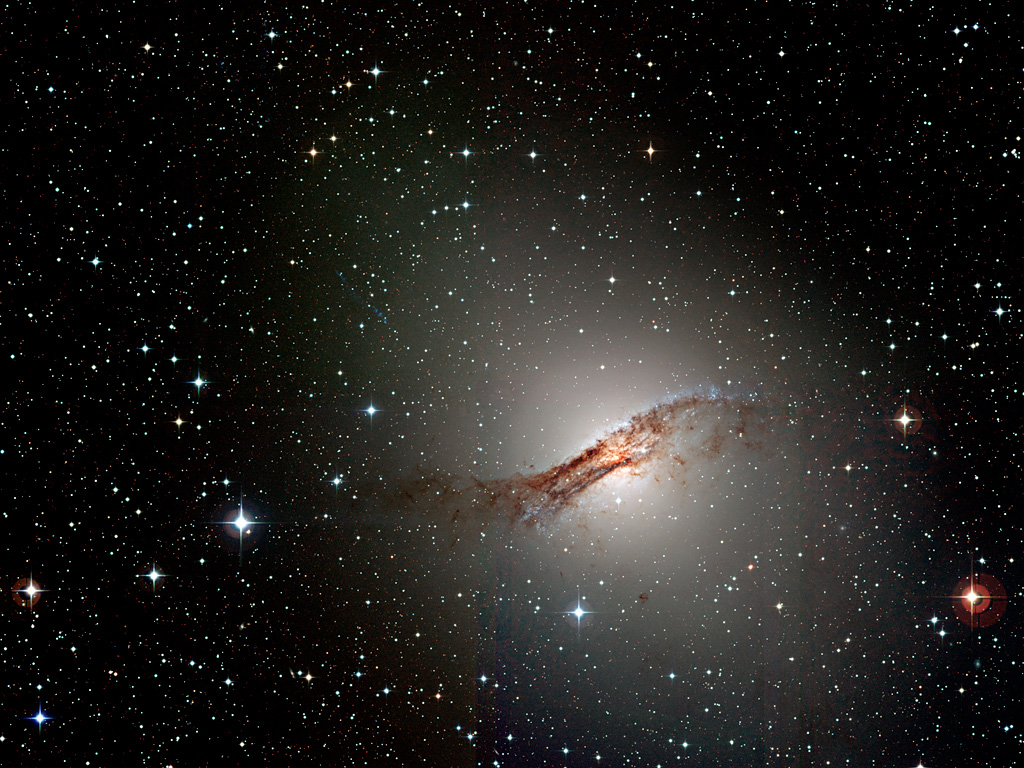
Centaurus A
ESA/Herschel/PACS/SPIRE/VNGS ;
ESA/XMM-Newton/EPIC
ESA/Herschel/PACS/SPIRE/VNGS ;
ESA/XMM-Newton/EPIC
Observations by the two of the European Space Agency's space observatories have provided a multi-wavelength view of the mysterious galaxy Centaurus A. The new images, from the Herschel Space Observatory and the XMM-Newton x-ray satellite, are revealing further hints about its cannibalistic past and energetic processes going on in its core.
At a distance of around 12 million light years, Centaurus A is the closest large elliptical galaxy to our own Milky Way. It has been marked as unusual since shortly after its discovery in the 19th century due to a thick lane of dust across its centre – an unusual feature for an elliptical galaxy. But it wasn't until a century later that the galaxy’s true nature was revealed.
Emanating from its core are two massive jets of material streaming from a massive black hole in the heart of Centaurus A. When observed by radio telescopes, the jets stretch for up to a million light years, though the Herschel and XMM-Newton results focus on the inner regions.
“Centaurus A is the closest example of a galaxy to us with massive jets from its central black hole,” explained Prof Christine Wilson of McMaster University, Canada, who is leading the study of Centaurus A with Herschel. “Observations with Herschel, XMM-Newton and telescopes at many other wavelengths allow us to study their effects on the galaxy and its surroundings.”

 Centaurus A as seen in far-infrared light by Herschel, showing the twisted disc in the centre, the jets from the black hole, and two clumps of dust. Image credit: ESA/Herschel/SPIRE/PACS
Strong radio emission is caused by electrons travelling at close to the speed of light through strong magnetic fields, and is so bright that the jets are even visible in the far-infrared images from the Herschel Space Observatory. As well as the jets, the images from this infrared observatory also show a twisted disc of dust near the galaxy’s centre.
This odd shape is strong evidence that Centaurus A underwent a cosmic collision with another galaxy in the distant past. The colliding galaxy was ripped apart to form the warped disc, and the formation of young stars heats the dust to cause the infrared glow seen by Herschel.
Such collisions often result in shells and rings of gas and dust, and Centaurus A is no exception. Herschel observations have now confirmed the presence of two clumps of dust that seem to be lined up with the two lobes of the jets.
“The apparent alignment of two clumps with the two jets now seems to be a cosmic coincidence, and it appears that the dust originated from one of the colliding galaxies.” explained Dr Robbie Auld, of Cardiff University. “Unlike most dust Herschel sees, which is heated by nearby star formation, the dust in these clumps is being heated by old stars in Centaurus A itself, up to 50,000 light years away.”
This odd shape is strong evidence that Centaurus A underwent a cosmic collision with another galaxy in the distant past. The colliding galaxy was ripped apart to form the warped disc, and the formation of young stars heats the dust to cause the infrared glow seen by Herschel.
Such collisions often result in shells and rings of gas and dust, and Centaurus A is no exception. Herschel observations have now confirmed the presence of two clumps of dust that seem to be lined up with the two lobes of the jets.
“The apparent alignment of two clumps with the two jets now seems to be a cosmic coincidence, and it appears that the dust originated from one of the colliding galaxies.” explained Dr Robbie Auld, of Cardiff University. “Unlike most dust Herschel sees, which is heated by nearby star formation, the dust in these clumps is being heated by old stars in Centaurus A itself, up to 50,000 light years away.”
 Centaurus A as seen in x-rays by XMM-Newton, showing the jets from the black hole and the super-heated gas. Image credit: ESA/XMM-Newton/EPIC
In x-rays the effect of the two jets of material is clearly visible. Showing the presence of extremely hot gas, the images from the XMM-Newton x-ray satellite clearly show the axis of the one of the jets. While the other jet itself is not seen in by XMM-Newton, the gas it is ploughing into is shocked and heated to very high temperatures, creating a bright x-ray glow.
“XMM-Newton is the observatory most suited to detecting extended weak X-ray emission, often allowing us to see halos around galaxies for the first time,” notes Norbert Schartel, XMM-Newton Project Scientist.
In the centre of the galaxy, the massive black hole is also having an effect on its immediate surroundings. The material around it glows brightly in x-rays, but there Herschel has identified an apparent deficit of dust within a few thousand light years of the black hole.
“This could be due to intense x-rays destroying the tiny dust grains, or due to the way the warped ring of dust is affecting star formation” said Prof Wilson. “Either way, Centaurus A is the ideal place to study the extreme processes that occur near super-massive black holes"
 Centaurus A at visible, far-infrared and x-ray wavelengths. Image credit:ESA/Herschel/SPIRE/PACS/VNGS (far-infrared) ; ESA/XMM-Newton/EPIC (x-ray) ; ESO (visible). Click view