Showing posts with label Type Ia supernova. Show all posts

Supernova progenitor found?

Posted by carsimulator on Friday, August 3, 2012

An optical / infrared / X-ray composite image of the remnant of Tycho's star, a type Ia supernova seen in 1572. Courtesy of Astronomy Picture of the Day. Credit: NASA / CXC / SAO / JPL-Caltech / MPIA / Calar Alto / O. Krause et al. Click for here a large version of this image

Type Ia supernovae are violent stellar explosions. Observations of their brightness are used to determine distances in the universe and have shown scientists that the cosmos is expanding at an accelerating rate. But there is still too little known about the specifics of the processes by which these supernovae form. New research, led by Stella Kafka of the Carnegie Institution for Science in the United States, identifies a star system, prior to explosion, which will possibly become a type Ia supernova. The work will appear in the journal Monthly Notices of the Royal Astronomical Society.

The widely accepted theory is that type Ia supernovae are thermonuclear explosions of a white dwarf star that's part of a binary system—two stars that are physically close and orbit around a common centre of mass. The white dwarf has mass gradually donated to it by its companion. When the white dwarf mass eventually reaches 1.4 times that of the sun, it explodes to produce a type Ia supernova. The crucial questions are: What is the nature of the donor star and how does this white dwarf increase its mass. Also, how would that process affect the properties of the explosion?

With these questions in mind, scientists have been searching for candidate systems that could become type Ia supernovae. There are thousands of possibilities in the candidate pool, none of which have yet been observed to produce an explosion. Recent studies, some of which involved scientists at Carnegie observatories, have identified sodium gas associated with type Ia supernovae. This gas might be ejected from the binary's donor star and linger around the system to be detected after the white dwarf explodes. This provides a clue to the progenitor. Even so, Kafka still compared the search to "looking for a needle in a stellar haystack."

Using data from the DuPont telescope of the Las Campanas observatory in Chile, Kafka and her team—Kent Honeycutt of Indiana University and Bob Williams of the Space Telescope Science Institute— looked at these gas signatures and were able to identify a binary star called QU Carinae as a possible supernova progenitor. It contains a white dwarf, which is accumulating mass from a giant star, and sodium has been detected around the system.

This star belongs to a small category of binaries that are very bright and in which the white dwarf accretes material from its companion at very high rates. Sodium should be produced in the atmosphere of the mass-donor giant star, and it can be ejected from the system via a stellar wind. If the white dwarf of this binary explodes into a supernova, the sodium would be detected with the same sort of signature as those found in other type Ia supernovae.

"We are really excited to have identified such a system," Kafka said. "Understanding these systems, the nature of the two stars, the manner in which mass is exchanged, and their long-term evolution will give us a comprehensive picture on how binaries can create one of the most important explosions in the universe."


Science contact

Stella Kafka
Tel: +1 202 478 8864

skafka@dtm.ciw.edu


Media contacts

Natasha T. Metzler
Science Writer
Carnegie Institution for Science
Tel: +1 202 939 1142

nmetzler@carnegiescience.edu

Robert Massey
Royal Astronomical Society
Mob: +44 (0)794 124 8035

rm@ras.org.uk


Image

A composite X-ray / optical / infrared image of the remnant of Tycho's star, a type Ia supernova seen in 1572, is available athttp://apod.nasa.gov/apod/ap090317.html

Further information

The new work appears in the paper "QU Carinae: Supernova Ia in the making?" S. Kafka, K. Honeycutt, B. Williams, Monthly Notices of the Royal Astronomical Society, in press. A preprint of the paper can be seen at http://arxiv.org/abs/1206.6798


Notes for editors

This work was funded, in part, by the NASA Astrobiology Institute.

The Carnegie Institution for Science (
carnegiescience.edu) is a private, non-profit organization headquartered in Washington, D.C., with six research departments throughout the U.S. Since its founding in 1902, the Carnegie Institution has been a pioneering force in basic scientific research. Carnegie scientists are leaders in plant biology, developmental biology, astronomy, materials science, global ecology, and Earth and planetary science.

The Royal Astronomical Society (RAS,
www.ras.org.uk), founded in 1820, encourages and promotes the study of astronomy, solar-system science, geophysics and closely related branches of science. The RAS organizes scientific meetings, publishes international research and review journals, recognizes outstanding achievements by the award of medals and prizes, maintains an extensive library, supports education through grants and outreach activities and represents UK astronomy nationally and internationally. Its more than 3500 members (Fellows), a third based overseas, include scientific researchers in universities, observatories and laboratories as well as historians of astronomy and others.

Follow the RAS on Twitter via @royalastrosoc

More about → Supernova progenitor found?

One Supernova Type, Two Different Sources

Posted by carsimulator on Monday, May 7, 2012

The Tycho supernova remnant is the result of a Type Ia supernova explosion. The explosion was observed by Danish astronomer Tycho Brahe in 1572. More than 400 years later, the ejecta from that explosion has expanded to fill a bubble 55 light-years across. In this image, low-energy X-rays (red) show expanding debris from the supernova explosion and high energy X-rays (blue) show the blast wave - a shell of extremely energetic electrons. Credit: X-ray: NASA/CXC/Rutgers/K.Eriksen et al.; Optical: DSS. Low Resolution Image (jpg)

Cambridge, MA - The exploding stars known as Type Ia supernovae serve an important role in measuring the universe, and were used to discover the existence of dark energy. They're bright enough to see across large distances, and similar enough to act as a "standard candle" - an object of known luminosity. The 2011 Nobel Prize in Physics was awarded for the discovery of the accelerating universe using Type Ia supernovae. However, an embarrassing fact is that astronomers still don't know what star systems make Type Ia supernovae.

Two very different models explain the possible origin of Type Ia supernovae, and different studies support each model. New evidence shows that both models are correct - some of these supernovae are created one way and some the other.

"Previous studies have produced conflicting results. The conflict disappears if both types of explosion are happening," explained Smithsonian astronomer and Clay Fellow Ryan Foley (Harvard-Smithsonian Center for Astrophysics).

Type Ia supernovae are known to originate from white dwarfs - the dense cores of dead stars. White dwarfs are also called degenerate stars because they're supported by quantum degeneracy pressure.

In the single-degenerate model for a supernova, a white dwarf gathers material from a companion star until it reaches a tipping point where a runaway nuclear reaction begins and the star explodes. In the double-degenerate model, two white dwarfs merge and explode. Single-degenerate systems should have gas from the companion star around the supernova, while the double-degenerate systems will lack that gas.

"Just like mineral water can be with or without gas, so can supernovae," said Robert Kirshner, Clowes Professor of Astronomy at Harvard University and a co-author on the study.

Foley and his colleagues studied 23 Type Ia supernovae to look for signatures of gas around the supernovae, which should be present only in single-degenerate systems. They found that the more powerful explosions tended to come from "gassy" systems, or systems with outflows of gas. However, only a fraction of supernovae show evidence for outflows. The remainder seem to come from double-degenerate systems.

"There are definitely two kinds of environments - with and without outflows of gas. Both are found around Type Ia supernovae," Foley said.

This finding has important implications for measurements of dark energy and the expanding universe. If two different mechanisms are at work in Type Ia supernovae, then the two types must be considered separately when calculating cosmic distances and expansion rates.

"It's like measuring the universe with a mix of yardsticks and meter sticks - you'll get about the same answer, but not quite. To get an accurate answer, you need to separate the yardsticks from the meter sticks," Foley explained.

This study raises an interesting question - if two different mechanisms create Type Ia supernovae, why are they homogeneous enough to serve as standard candles?

"How can supernovae coming from different systems look so similar? I don't have the answer for that," said Foley.

The paper describing this research will appear in the Astrophysical Journal and is available online.

Headquartered in Cambridge, Mass., the Harvard-Smithsonian Center for Astrophysics (CfA) is a joint collaboration between the Smithsonian Astrophysical Observatory and the Harvard College Observatory. CfA scientists, organized into six research divisions, study the origin, evolution and ultimate fate of the universe.

For more information, contact:

David A. Aguilar
Director of Public Affairs
Harvard-Smithsonian Center for Astrophysics
617-495-7462
daguilar@cfa.harvard.edu

Christine Pulliam
Public Affairs Specialist
Harvard-Smithsonian Center for Astrophysics
617-495-7463
cpulliam@cfa.harvard.edu

More about → One Supernova Type, Two Different Sources

Explosive Stars with Good Table Manners

Posted by carsimulator on Tuesday, March 20, 2012

These images from Swift's Ultraviolet/Optical Telescope (UVOT) show the nearby spiral galaxy M101 before and after the appearance of SN 2011fe (circled, right), which was discovered on Aug. 24, 2011. At a distance of 21 million light-years, it was the nearest Type Ia supernova since 1986. Left: View constructed from images taken in March and April 2007. Right: The supernova was so bright that most UVOT exposures were short, so this view includes imagery from August through November 2011 to better show the galaxy. Credit: NASA/Swift/Peter Brown, Univ. of Utah. High Resolution Image (jpg) - Low Resolution Image (jpg)

Cambridge, MA - An exploding star known as a Type Ia supernova plays a key role in our understanding of the universe. Studies of Type Ia supernovae led to the discovery of dark energy, which garnered the 2011 Nobel Prize in Physics. Yet the cause of this variety of exploding star remains elusive.

All evidence points to a white dwarf that feeds off its companions star, gaining mass, growing unstable, and ultimately detonating. But does that white dwarf draw material from a Sun-like star, an evolved red giant star, or from a second white dwarf? Or is something more exotic going on? Clues can be collected by searching for "cosmic crumbs" left over from the white dwarf's last meal.

In two comprehensive studies of SN 2011fe - the closest Type Ia supernova in the past two decades - there is new evidence that indicates that the white dwarf progenitor was a particularly picky eater, leading scientists to conclude that the companion star was not likely to be a Sun-like star or an evolved giant.

"It's hard to understand how a white dwarf could eat itself to death while showing such good table manners," said Alicia Soderberg of the Harvard-Smithsonian Center for Astrophysics (CfA).

Soderberg and her colleagues examined SN 2011fe with a suite of instruments in wavelengths ranging from X-rays to radio. They saw no sign of stellar material recently devoured by the white dwarf. Instead, the explosion occurred in a remarkably clean environment.

"This white dwarf was a tidy eater," said Laura Chomiuk of the CfA, lead author of one of the two papers.

Additional studies using NASA's Swift satellite, which examined a large number of more distant Type Ia supernovae, appear to rule out giant stars as companions for the white-dwarf progenitors. Those results were described in a NASA press release.

Taken together, these studies suggest that Type Ia supernovae likely originate from a more exotic scenario, possibly the explosive merger of two white dwarfs.

"This is an exciting time in Type Ia supernova research since it brings us closer to solving one of the longest-standing mysteries in the life cycles of stars," said Raffaella Margutti of the CfA, lead author of the second paper.

The two papers on SN 2011fe are available online at http://arxiv.org/abs/1201.0994 and http://arxiv.org/abs/1202.0741.

Headquartered in Cambridge, Mass., the Harvard-Smithsonian Center for Astrophysics (CfA) is a joint collaboration between the Smithsonian Astrophysical Observatory and the Harvard College Observatory. CfA scientists, organized into six research divisions, study the origin, evolution and ultimate fate of the universe.

For more information, contact:

David A. Aguilar
Director of Public Affairs
Harvard-Smithsonian Center for Astrophysics
617-495-7462
daguilar@cfa.harvard.edu

Christine Pulliam
Public Affairs Specialist
Harvard-Smithsonian Center for Astrophysics
617-495-7463
cpulliam@cfa.harvard.edu

More about → Explosive Stars with Good Table Manners

Hubble Solves Mystery on Source of Supernova in Nearby Galaxy

Posted by carsimulator on Wednesday, January 11, 2012

SNR 0509-67.5
Science Credit: NASA, ESA, and B. Schaefer and A. Pagnotta (Louisiana State University, Baton Rouge)
Image Credit: NASA, ESA, CXC, SAO, the Hubble Heritage Team (STScI/AURA), and J. Hughes (Rutgers University)

Using NASA's Hubble Space Telescope, astronomers have solved a longstanding mystery on the type of star, or so-called progenitor, that caused a supernova in a nearby galaxy. The finding yields new observational data for pinpointing one of several scenarios that could trigger such outbursts.

Based on previous observations from ground-based telescopes, astronomers knew that a kind of supernova called a Type Ia created a remnant named SNR 0509-67.5, which lies 170,000 light-years away in the Large Magellanic Cloud galaxy.

The type of system that leads to this kind of supernova explosion has long been a high importance problem with various proposed solutions but no decisive answer. All these solutions involve a white dwarf star that somehow increases in mass to the highest limit. Astronomers failed to find any companion star near the center of the remnant, and this rules out all but one solution, so the only remaining possibility is that this one Type Ia supernova came from a pair of white dwarfs in close orbit.

"We know that Hubble has the sensitivity necessary to detect the faintest white dwarf remnants that could have caused such explosions," said lead investigator Bradley Schaefer of Louisiana State University (LSU) in Baton Rouge. "The logic here is the same as the famous quote from Sherlock Holmes: 'When you have eliminated the impossible, whatever remains, however improbable, must be the truth.'"

The cause of SNR 0509-67.5 can best be explained by two tightly orbiting white dwarf stars spiraling closer and closer until they collided and exploded.

These results are being reported today at the meeting of the American Astronomical Society in Austin, Texas. A paper on the results will be published in the January 12 issue of the science journal Nature.

For four decades the search for Type Ia supernovae stellar progenitors has been a key question in astrophysics. The problem has taken on special importance over the last decade with Type Ia supernovae being the premier tools for measuring the accelerating universe.

Type Ia supernovae are tremendous explosions of energy in which the light produced is often brighter than a whole galaxy of stars. The problem has been to identify the type of star system that pushes the white dwarf's mass over the edge and triggers this type of explosion. Many possibilities have been suggested, but most require that a companion star near the exploding white dwarf be left behind after the explosion.

Therefore, a possible way to distinguish between the various progenitor models has been to look deep in the center of an old supernova remnant to search for the ex-companion star.

In 2010, Schaefer and Ashley Pagnotta of LSU were preparing a proposal to look for any faint ex-companion stars in the center of four supernova remnants in the Large Magellanic Cloud when they discovered that the Hubble Space Telescope had already taken the desired image of one of their target remnants, SNR 0509-67.5, for the Hubble Heritage program, which collects images of especially photogenic astronomical targets.

In analyzing the central region they found it to be completely empty of stars down to the limit of the faintest objects that Hubble can detect in the photos. Schaefer reports that the best explanation left is the so-called "double degenerate model" in which two white dwarfs collide.

There are no recorded observations of the star exploding. However, researchers at the Space Telescope Science Institute in Baltimore, Md., have identified light from the supernova that was reflected off of interstellar dust, delaying its arrival at Earth by 400 years. This delay, called a light echo, of the supernova explosion also allowed the astronomers to measure the spectral signature of the light from the explosion. By virtue of the color signature, astronomers were able to deduce it was a Type Ia supernova.

Because the remnant appears as a nice symmetric shell or bubble, the geometric center can be accurately determined. These properties make SNR 0509-67.5 an ideal target to search for ex-companions. The young age also means that any surviving stars have not moved far from the site of the explosion.

The team plans to look at other supernova remnants in the Large Magellanic Cloud to further test their observations.

CONTACT

Ray Villard / Cheryl Gundy
Space Telescope Science Institute, Baltimore, Md.
410-338-4514 / 410-338-4707
villard@stsci.edu / gundy@stsci.edu

Trent Perrotta
NASA Headquarters, Washington, DC
202-358-0321
trent.j.perrotto@nasa.gov

Ashley Pagnotta / Bradley Schaefer
Louisiana State University, Baton Rouge, La.
281-686-1370 / 225-578-0015
pagnotta@phys.lsu.edu / schaefer@lsu.edu

More about → Hubble Solves Mystery on Source of Supernova in Nearby Galaxy

NASA's Hubble Breaks New Ground with Distant Supernova Discovery

Posted by carsimulator

SN Primo - HUDF
Credit: NASA, ESA, A. Riess (Space Telescope Science Institute and The Johns Hopkins University), and S. Rodney (The Johns Hopkins University)

NASA's Hubble Space Telescope has looked deep into the distant universe and detected the feeble glow from a star that exploded more than 9 billion years ago.

This isn't just any dying star. It belongs to a special class called Type Ia supernovae, which are bright beacons used as distance markers for studying the expansion rate of the universe. Type Ia supernovae most likely arise when white dwarf stars — the burned-out cores of normal stars — siphon too much material from their companion stars and explode.

The stellar explosion, given the nickname SN Primo, will help astronomers place better constraints on the nature of dark energy — a mysterious repulsive force that is causing the universe to fly apart ever faster.

SN Primo is the farthest Type Ia supernova whose distance has been confirmed through spectroscopic observations. Spectroscopy is the "gold standard" for measuring supernova distances. A spectrum splits the light from a supernova into its constituent colors. By analyzing those colors, astronomers can confirm its distance by measuring how much the supernova's light has been stretched, or reddened, into near-infrared wavelengths due to the expansion of the universe.

The sighting is the first result from a three-year Hubble program to survey faraway Type Ia supernovae, opening a new distance realm for searching for this special class of stellar explosion. The remote supernovae will help astronomers determine whether the exploding stars remain dependable cosmic yardsticks across vast distances of space in an epoch when the cosmos was only one-third its current age of 13.7 billion years.

Called the CANDELS+CLASH Supernova Project, the census is using the sharpness and versatility of Hubble's Wide Field Camera 3 (WFC3) to help astronomers search for supernovae in near-infrared light and verify their distance with spectroscopy. WFC3 is looking in regions targeted by two large Hubble programs called the Cosmic Assembly Near-infrared Deep Extragalactic Legacy Survey (CANDELS) and the Cluster Lensing and Supernova Survey with Hubble (CLASH).

"In our search for supernovae, we had gone as far as we could go in optical light," said the project's lead investigator, Adam Riess of the Space Telescope Science Institute and The Johns Hopkins University in Baltimore, Md. "But it's only the beginning of what we can do in infrared light. This discovery demonstrates that we can use the Wide Field Camera 3 to search for supernovae in the distant universe."

The new results are being presented today at the American Astronomical Society meeting in Austin, Texas. A paper describing the study has been accepted for publication in The Astrophysical Journal.

The supernova team's search technique involved taking multiple near-infrared images over several months, looking for a supernova's faint glow. Once the team spotted the stellar blast in October 2010, they used WFC3's spectrograph to verify SN Primo's distance and to decode its light, finding the unique signature of a Type Ia supernova. The team then re- imaged SN Primo periodically for eight months, measuring the slow dimming of its light.

By taking the census, the astronomers hope to determine the frequency of Type Ia supernovae during the early universe and glean insights into the mechanisms that detonated them.

"If we look into the early universe and measure a drop in the number of supernovae, then it could be that it takes a long time to make a Type Ia supernova," said Steve Rodney of The Johns Hopkins University, the science paper's first author. "Like corn kernels in a pan waiting for the oil to heat up, the stars haven't had enough time at that epoch to evolve to the point of explosion. However, if supernovae form very quickly, like microwave popcorn, then they will be immediately visible, and we'll find many of them, even when the universe was very young. But each supernova is unique. It's possible that there are multiple ways to make a supernova."

If astronomers discover that Type Ia supernovae begin to depart from how they expect them to look, they might be able to gauge those changes and make the measurements of dark energy more precise, Riess explained. Riess and two other astronomers shared the 2011 Nobel Prize in Physics for discovering dark energy 13 years ago, using Type Ia supernovae to plot the universe's expansion rate.

After extending the frontier for supernova discoveries with Hubble, a full scrutiny of this new territory will have to wait for the James Webb Space Telescope (JWST). Scheduled to launch later this decade, JWST will probe exploding stars at much farther distances than Hubble can reach.

JWST will be able to see farther into the infrared than Hubble does. This capability will push back the frontier by probing more than 11 billion years back in time, when the universe was only 2 billion years old.

CONTACT

Donna Weaver / Ray Villard

Space Telescope Science Institute, Baltimore, Md.

410-338-4514

dweaver@stsci.edu / villard@stsci.edu

Steve Rodney
The Johns Hopkins University, Baltimore, Md.
4
10-516-0446

steve.rodney@gmail.com

Adam Riess
Space Telescope Science Institute and The Johns Hopkins University, Baltimore, Md.
410-516-4474
ariess@stsci.edu

More about → NASA's Hubble Breaks New Ground with Distant Supernova Discovery

Closest Type Ia Supernova in Decades Solves a Cosmic Mystery

Posted by carsimulator on Wednesday, December 14, 2011

Early close-ups of a Type Ia supernova allow Berkeley Lab scientists and their colleagues to picture its progenitor and infer how it exploded

The Palomar Transient Factory caught SN 2011fe in the Pinwheel Galaxy in the vicinity of the Big Dipper on 24 August, 2011. Found just hours after it exploded and only 21 million light years away, the discovery triggered the closest-ever look at a young Type Ia supernova. (Image by B. J. Fulton, Las Cumbres Observatory Global Telescope Network. Click here for better resolution.)

Type Ia supernovae (SN Ia’s) are the extraordinarily bright and remarkably similar “standard candles” astronomers use to measure cosmic growth, a technique that in 1998 led to the discovery of dark energy – and 13 years later to a Nobel Prize, “for the discovery of the accelerating expansion of the universe.” The light from thousands of SN Ia’s has been studied, but until now their physics – how they detonate and what the star systems that produce them actually look like before they explode – has been educated guesswork.

Peter Nugent of the U.S. Department of Energy’s Lawrence Berkeley National Laboratory (Berkeley Lab) heads the Computational Cosmology Center in the Lab’s Computational Research Division and also leads the Lab’s collaboration in the multi-institutional Palomar Transient Factory (PTF). On August 24 of this year, searching data as it poured into DOE’s National Energy Research Scientific Computing Center (NERSC) from an automated telescope on Palomar Mountain in California, Nugent spotted a remarkable object. It was shortly confirmed as a Type Ia supernova in the Pinwheel Galaxy, some 21 million light-years distant. That’s unusually close by cosmic standards, and the nearest SN Ia since 1986; it was subsequently given the official name SN 2011fe.

Nugent says, “We caught the supernova just 11 hours after it exploded, so soon that we were later able to calculate the actual moment of the explosion to within 20 minutes. Our early observations confirmed some assumptions about the physics of Type Ia supernovae, and we ruled out a number of possible models. But with this close-up look, we also found things nobody had dreamed of.”

“When we saw SN2011fe, I fell off my chair,” says PTF team member Mansi Kasliwal of the Carnegie Institution for Science and the California Institute of Technology. “Its brightness was too faint to be a supernova and too bright to be nova. Only follow-up observations in the next few hours revealed that this was actually an exceptionally young Type Ia supernova.”

Because they could closely study the supernova during its first few days, the team was able to gather the first direct evidence for what at least one SN Ia looked like before it exploded, and what happened next. Their results are reported in the 15 December, 2011, issue of the journal Nature.

Confirming a carbon-oxygen white dwarf

Scientists long ago developed models of Type Ia supernovae based on their evolving brightness and spectra. The models assume the progenitor is a binary system – about half of all stars are in binary systems – in which a very dense, very small white-dwarf star made of carbon and oxygen orbits a companion, from which it sweeps up additional matter. There’s a specific limit to how massive the white dwarf can grow, equal to about 1.4 times the mass of our sun, before it can no longer support itself against gravitational collapse.

“As it approaches the limit, conditions are met in the center so that the white dwarf detonates in a colossal thermonuclear explosion, which converts the carbon and oxygen to heavier elements including nickel,” says Nugent. “A shock wave rips through it and ejects the material in a bright expanding photosphere. Much of the brightness comes from the heat of the radioactive nickel as it decays to cobalt. Light also comes from ejecta being heated by the shock wave, and if this runs into the companion star it can be reheated, adding to the luminosity.”

By examining how SN 2011fe’s brightness evolved – its so-called early-time light curve – and the features of its early-time spectra, members of the PTF team were able to constrain how big the exploding star was, when it exploded, what might have happened during the explosion, and what kind of binary star system was involved.

The first observations of SN 2011fe were carried out at the Liverpool Telescope at La Palma in the Canary Islands, followed within hours by the Shane Telescope at Lick Observatory in California and the Keck I Telescope on Mauna Kea in Hawaii. These were shortly followed by NASA’s orbiting Swift Observatory.

Says Nugent, “We made an absurdly conservative assumption that the earliest luminosity was due entirely to the explosion itself and would increase over time in proportion to the size of the expanding fireball, which set an upper limit on the radius of the progenitor.”

Daniel Kasen, an assistant professor of astronomy and physics at the University of California at Berkeley and a faculty scientist in Berkeley Lab’s Nuclear Science Division, explains that “it only takes a few seconds for the shock wave to tear apart the star, but the debris heated in the explosion will continue to glow for several hours. The bigger the star, the brighter this afterglow. Because we caught this supernova so early, and with such sensitive observations, we were able to directly constrain the size of the progenitor.”

“Sure enough, it could only have been a white dwarf,” says Nugent. “The spectra gave us the carbon and oxygen, so we knew we had the first direct evidence that a Type Ia supernova does indeed start with a carbon-oxygen white dwarf.”

The expected and the unexpected

“The early-time light curve also constrained the radius of the binary system,” says Nugent, “so we got rid of a whole bunch of models,” ranging from old red giant stars to other white dwarfs in a so-called “double-degenerate” system.

Kasen explains that “if there was a giant companion star orbiting nearby, we should have seen some fireworks when the debris from the supernova crashed into it.” A red giant would have made the supernova brighter by several orders of magnitude early on. “Because we didn’t observe any bright flashes like that, we determined that the companion star could not have been much bigger than our sun.”

Nor was there much chance the companion was another white dwarf in a double-degenerate system, unless it had somehow avoided being torn apart and littering the surroundings with debris. A shock wave plowing through that kind of rubble would have produced a burst of early light the observers couldn’t have missed. So unless the companion was positioned almost exactly between the exploding star and the observers on Earth, closer to it than a 10th the diameter of our sun – an unlikely set of circumstances – the white dwarf’s companion had to be a main-sequence star.

While these observations pointed to a “normal” SN Ia, the way the white dwarf exploded held surprises. Typical of what would be expected, early spectra obtained by the Lick three-meter telescope showed many intermediate-mass elements spewing out of the expanding fireball, including ionized oxygen, magnesium, silicon, calcium, and iron, traveling 16,000 kilometers a second – more than five percent of the speed of light. Yet some oxygen was traveling much faster, at over 20,000 kilometers a second.

“The high-velocity oxygen shows that the oxygen wasn’t evenly distributed when the white dwarf blew up,” Nugent says, “indicating unusual clumpiness in the way it was dispersed.” But more interesting, he says, is that “whatever the mechanism of the explosion, it showed a tremendous amount of mixing, with some radioactive nickel mixed all the way to the photosphere. So the brightness followed the expanding surface almost exactly. This is not something any of us would have expected.”

PTF team member Mark Sullivan of the University of Oxford says, “Understanding how these giant explosions create and mix materials is important because supernovae are where we get most of the elements that make up the Earth and even our own bodies – for instance, these supernovae are a major source of iron in the universe. So we are all made of bits of exploding stars.”

“It is rare that you have eureka moments in science, but it happened four times on this supernova,” says Andy Howell, coleader of PTF’s SN Ia team: “The super-early discovery; the crazy first spectrum; when we figured out it had to be a white dwarf; and then, the Holy Grail, when we figured out details of the second star.”

Howell adds, “We’re like Captain Ahab … except our white whale is a white dwarf. We’re obsessed with proving they cause supernovae, but the evidence has been eluding us for decades.” This time, he says, “We got our whale … and we lived.”

“This first close SN Ia in the era of modern instrumentation will undoubtedly become the best-studied thermonuclear supernova in history,” the PTF team notes in their Nature paper, and “will form the new foundation upon which our knowledge of more distant Type Ia supernovae is built.”

Two decades after the Berkeley-Lab-based Supernova Cosmology Project, led by 2011 Nobel Prize-winner in Physics Saul Perlmutter, proved that Type Ia supernovae could be used to measure the expansion history of the universe, Berkeley Lab astrophysicists and computer scientists have finally gotten a close-up look at what these remarkable cosmic mileposts really look like.
###

“Supernova 2011fe from an exploding carbon-oxygen white dwarf star,” by Peter E. Nugent, Mark Sullivan, S. Bradley Cenko, Rollin C. Thomas, Daniel Kasen, D. Andrew Howell, David Bersier, Joshua S. Bloom, S. R. Kulkarni, Michael T. Kandrashoff, Alexei V. Filippenko, Jeffrey M. Silverman, Geoffrey W. Marcy, Andrew W. Howard, Howard T. Isaacson, Kate Maguire, Nao Suzuki, James E. Tarlton, Yen-Chen Pan, Lars Bildsten, Benjamin J. Fulton, Jerod T. Parrent, David Sand, Philipp Podsiadlowski, Federica B. Bianco, Benjamin Dilday, Melissa L. Graham, Joe Lyman, Phil James, Mansi M. Kasliwal, Nicholas M. Law, Robert M. Quimby, Isobel M. Hook, Emma S. Walker, Paolo Mazzali, Elena Pian, Eran O. Ofek, Avishay Gal-Yam and Dovi Poznanski, appears in the 15 December, 2011, issue of Nature. Berkeley Lab authors in addition to Peter Nugent include Rollin Thomas, Daniel Kasen, Nao Suzuki, and Dovi Poznanski.

The Palomar Transient Factory is an international collaboration of scientists and engineers from the California Institute of Technology, DOE’s National Energy Research Scientific Computing Center at Lawrence Berkeley National Laboratory, NASA’s Infrared Processing and Analysis Center, the University of California at Berkeley, Las Cumbres Observatory Global Telescope Network, the University of Oxford, Columbia University, the Weizmann Institute of Science in Israel, and Pennsylvania State University. The Principal Investigator of the PTF is Caltech’s Professor S. R. Kulkarni. The High Performance Wireless Research and Education Network (HPWREN) of the University of California at San Diego’s Applied Network Research provides Palomar Observatory’s high-speed data connection. Visit the PTF website at http://www.astro.caltech.edu/ptf/

The National Energy Research Scientific Computing Center (NERSC), located at Lawrence Berkeley National Laboratory, is the primary high-performance computing facility for scientific research sponsored by the U.S. Department of Energy’s Office of Science. Visit their website at http://www.nersc.gov/

DOE’s Office of Science is the single largest supporter of basic research in the physical sciences in the Unites States, and is working to address some of the most pressing challenges of our time. For more information, please visit the Office of Science website at http://science.energy.gov/

Lawrence Berkeley National Laboratory addresses the world’s most urgent scientific challenges by advancing sustainable energy, protecting human health, creating new materials, and revealing the origin and fate of the universe. Founded in 1931, Berkeley Lab’s scientific expertise has been recognized with 13 Nobel prizes. The University of California manages Berkeley Lab for DOE’s Office of Science. For more, visit http://www.lbl.gov

More about → Closest Type Ia Supernova in Decades Solves a Cosmic Mystery

NASA Telescopes Help Solve Ancient Supernova Mystery

Posted by carsimulator on Monday, October 24, 2011

This image combines data from four different space telescopes to create a multi-wavelength view of all that remains of the oldest documented example of a supernova, called RCW 86. Full image and caption

Infrared images from NASA's Spitzer Space Telescope and Wide-field Infrared Survey Explorer (WISE) are combined in this image of RCW 86, the dusty remains of the oldest documented example of an exploding star, or supernova. It shows light from both the remnant itself and unrelated background light from our Milky Way galaxy.

PASADENA, Calif. -- A mystery that began nearly 2,000 years ago, when Chinese astronomers witnessed what would turn out to be an exploding star in the sky, has been solved. New infrared observations from NASA's Spitzer Space Telescope and Wide-field Infrared Survey Explorer, or WISE, reveal how the first supernova ever recorded occurred and how its shattered remains ultimately spread out to great distances.

The findings show that the stellar explosion took place in a hollowed-out cavity, allowing material expelled by the star to travel much faster and farther than it would have otherwise.

"This supernova remnant got really big, really fast," said Brian J. Williams, an astronomer at North Carolina State University in Raleigh. Williams is lead author of a new study detailing the findings online in the Astrophysical Journal. "It's two to three times bigger than we would expect for a supernova that was witnessed exploding nearly 2,000 years ago. Now, we've been able to finally pinpoint the cause."

A new image of the supernova, known as RCW 86, is online at http://go.nasa.gov/pnv6Oy .

In 185 A.D., Chinese astronomers noted a "guest star" that mysteriously appeared in the sky and stayed for about 8 months. By the 1960s, scientists had determined that the mysterious object was the first documented supernova. Later, they pinpointed RCW 86 as a supernova remnant located about 8,000 light-years away. But a puzzle persisted. The star's spherical remains are larger than expected. If they could be seen in the sky today in infrared light, they'd take up more space than our full moon.

The solution arrived through new infrared observations made with Spitzer and WISE, and previous data from NASA's Chandra X-ray Observatory and the European Space Agency's XMM-Newton Observatory.

The findings reveal that the event is a "Type Ia" supernova, created by the relatively peaceful death of a star like our sun, which then shrank into a dense star called a white dwarf. The white dwarf is thought to have later blown up in a supernova after siphoning matter, or fuel, from a nearby star.

"A white dwarf is like a smoking cinder from a burnt-out fire," Williams said. "If you pour gasoline on it, it will explode."

The observations also show for the first time that a white dwarf can create a cavity around it before blowing up in a Type Ia event. A cavity would explain why the remains of RCW 86 are so big. When the explosion occurred, the ejected material would have traveled unimpeded by gas and dust and spread out quickly.

Spitzer and WISE allowed the team to measure the temperature of the dust making up the RCW 86 remnant at about minus 325 degrees Fahrenheit, or minus 200 degrees Celsius. They then calculated how much gas must be present within the remnant to heat the dust to those temperatures. The results point to a low-density environment for much of the life of the remnant, essentially a cavity.

Scientists initially suspected that RCW 86 was the result of a core-collapse supernova, the most powerful type of stellar blast. They had seen hints of a cavity around the remnant, and, at that time, such cavities were only associated with core-collapse supernovae. In those events, massive stars blow material away from them before they blow up, carving out holes around them.

But other evidence argued against a core-collapse supernova. X-ray data from Chandra and XMM-Newton indicated that the object consisted of high amounts of iron, a telltale sign of a Type Ia blast. Together with the infrared observations, a picture of a Type Ia explosion into a cavity emerged.

"Modern astronomers unveiled one secret of a two-millennia-old cosmic mystery only to reveal another," said Bill Danchi, Spitzer and WISE program scientist at NASA Headquarters in Washington. "Now, with multiple observatories extending our senses in space, we can fully appreciate the remarkable physics behind this star's death throes, yet still be as in awe of the cosmos as the ancient astronomers."

NASA's Jet Propulsion Laboratory, Pasadena, Calif., manages the Spitzer Space Telescope mission for NASA's Science Mission Directorate, Washington. Science operations are conducted at the Spitzer Science Center at the California Institute of Technology in Pasadena. Caltech manages JPL for NASA. For more information about Spitzer, visit http://spitzer.caltech.edu/ and http://www.nasa.gov/spitzer .

JPL manages, and operated, WISE for NASA's Science Mission Directorate. The spacecraft was put into hibernation mode after it scanned the entire sky twice, completing its main objectives. Edward Wright is the principal investigator and is at UCLA. The mission was selected competitively under NASA's Explorers Program managed by the agency's Goddard Space Flight Center in Greenbelt, Md. The science instrument was built by the Space Dynamics Laboratory in Logan. The spacecraft was built by Ball Aerospace & Technologies Corp. in Boulder, Colo. Science operations and data processing take place at the Infrared Processing and Analysis Center at Caltech. Caltech manages JPL for NASA. More information is online at http://www.nasa.gov/wise and http://wise.astro.ucla.edu and http://www.jpl.nasa.gov/wise .

Whitney Clavin 818-354-4673
Jet Propulsion Laboratory, Pasadena, Calif.
whitney.clavin@jpl.nasa.gov

Trent J. Perrotto 202-358-0321
NASA Headquarters, Washington
trent.j.perrotto@nasa.gov


More about → NASA Telescopes Help Solve Ancient Supernova Mystery

G299.2-2.9: A Middle-Aged Supernova Remnant

Posted by carsimulator on Wednesday, October 12, 2011

G299.2-2.9
Credit: X-ray: NASA/CXC/U.Texas/S.Park et al, ROSAT;
I
nfrared: 2MASS/UMass/IPAC-Caltech/NASA/NSF


JPEG (577.4 kb) - Tiff (8.7 MB) - PS (17.6 MB)

Download Desktop - Image with Scalebar - More Images

Zoom-In (flash) - View on the Sky (WWT)

G299.2-2.9 is an intriguing supernova remnant found about 16,000 light years away in the Milky Way galaxy . Evidence points to G299.2-2.9 being the remains of a Type Ia supernova, where a white dwarf has grown sufficiently massive to cause a thermonuclear explosion. Because it is older than most supernova remnants caused by these explosions, at an age of about 4500 years, G299.2-2.9 provides astronomers with an excellent opportunity to study how these objects evolve over time. It also provides a probe of the Type Ia supernova explosion that produced this structure.

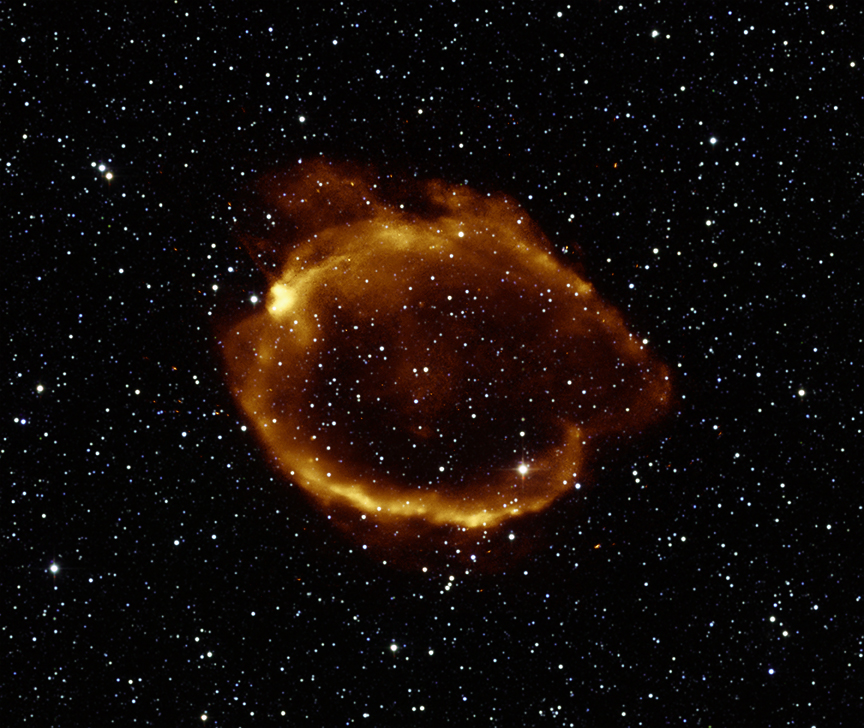
This composite image shows G299.2-2.9 in X-ray light from Chandra, along with data from the ROSAT satellite (orange), that has been overlaid on an infrared image from the Two Micron All-Sky Survey (2MASS). The faint X-ray emission from the inner region reveals relatively large amounts of iron and silicon, as expected for a remnant of a Type Ia supernova. The outer shell of the remnant is complex, with at least a double shell structure. Typically, such a complex outer shell is associated with a star that has exploded into space where gas and dust are not uniformly distributed.

Since most theories to explain Type Ia supernovas assume they go off in a uniform environment, detailed studies of this complicated outer shell should help astronomers improve their understanding of the environments where these explosions occur. It is very important to understand the details of Type Ia explosions because astronomers use them as cosmic mile markers to measure the accelerated expansion of the universe and study dark energy. The discovery of this accelerated expansion in the late 1990s led to the recent award of the Nobel Prize in Physics.

Fast Facts for G299.2-2.9:

Scale: Image is about 24 arcmin across (about 114 light years)
Category: Supernovas & Supernova Remnants
Coordinates (J2000): RA 12h 15m 33.80s | Dec -65° 26' 33.90"
Constellation: Musca
Observation Date: 10 pointings between April 9, 2005 and Nov 13, 2010
Observation Time: 186 hours 7 min (7 days 18 hours 7 min).
Obs. ID: 5517, 11098-11101, 13157-13160, 13187
Color Code: X-ray (Gold), Infrared (Red, Green, Blue)
Instrument: ACIS
Distance Estimate: 16,000 light years

More about → G299.2-2.9: A Middle-Aged Supernova Remnant

Our Galaxy Might Hold Thousands of Ticking "Time Bombs"

Posted by carsimulator on Tuesday, September 6, 2011

New research shows that some old stars known as white dwarfs might be held up by their rapid spins, and when they slow down, they explode as Type Ia supernovae. Thousands of these "time bombs" could be scattered throughout our Galaxy. In this artist's conception, a supernova explosion is about to obliterate an orbiting Saturn-like planet. Credit: David A. Aguilar (CfA). High Resolution Image (jpg)

Cambridge, MA - In the Hollywood blockbuster "Speed," a bomb on a bus is rigged to blow up if the bus slows down below 50 miles per hour. The premise - slow down and you explode - makes for a great action movie plot, and also happens to have a cosmic equivalent.

New research shows that some old stars might be held up by their rapid spins, and when they slow down, they explode as supernovae. Thousands of these "time bombs" could be scattered throughout our Galaxy.

"We haven't found one of these 'time bomb' stars yet in the Milky Way, but this research suggests that we've been looking for the wrong signs. Our work points to a new way of searching for supernova precursors," said astrophysicist Rosanne Di Stefano of the Harvard-Smithsonian Center for Astrophysics (CfA).

The specific type of stellar explosion Di Stefano and her colleagues studied is called a Type Ia supernova. It occurs when an old, compact star known as a white dwarf destabilizes.

A white dwarf is a stellar remnant that has ceased nuclear fusion. It typically can weigh up to 1.4 times as much as our Sun - a figure called the Chandrasekhar mass after the astronomer who first calculated it. Any heavier, and gravity overwhelms the forces supporting the white dwarf, compacting it and igniting runaway nuclear fusion that blows the star apart.

There are two possible ways for a white dwarf to exceed the Chandrasekhar mass and explode as a Type Ia supernova. It can accrete gas from a donor star, or two white dwarfs can collide. Most astronomers favor the first scenario as the more likely explanation. But we would expect to see certain signs if the theory is correct, and we don't for most Type Ia supernovae.

For example, we should detect small amounts of hydrogen and helium gas near the explosion, but we don't. That gas would come from matter that wasn't accreted by the white dwarf, or from the disruption of the companion star in the explosion. Astronomers also have looked for the donor star after the supernova faded from sight, without success.

Di Stefano and her colleagues suggest that white dwarf spin might solve this puzzle. A spin-up/spin-down process would introduce a long delay between the time of accretion and the explosion. As a white dwarf gains mass, it also gains angular momentum, which speeds up its spin. If the white dwarf rotates fast enough, its spin can help support it, allowing it to cross the 1.4-solar-mass barrier and become a super-Chandrasekhar-mass star.

Once accretion stops, the white dwarf will gradually slow down. Eventually, the spin isn't enough to counteract gravity, leading to a Type Ia supernova.

"Our work is new because we show that spin-up and spin-down of the white dwarf have important consequences. Astronomers therefore must take angular momentum of accreting white dwarfs seriously, even though it's very difficult science," explained Di Stefano.

The spin-down process could produce a time delay of up to a billion years between the end of accretion and the supernova explosion. This would allow the companion star to age and evolve into a second white dwarf, and any surrounding material to dissipate.

In our Galaxy, scientists estimate that there are three Type Ia supernovae every thousand years. If a typical super-Chandrasekhar-mass white dwarf takes millions of years to spin down and explode, then calculations suggest that there should be dozens of pre-explosion systems within a few thousand light-years of Earth.

Those supernova precursors will be difficult to detect. However, upcoming wide-field surveys conducted at facilities like Pan-STARRS and the Large Synoptic Survey Telescope should be able to spot them.

"We don't know of any super-Chandrasekhar-mass white dwarfs in the Milky Way yet, but we're looking forward to hunting them out," said co-author Rasmus Voss of Radboud University Nijmegen, The Netherlands.

This research appears in a paper in the Sept. 1 issue of The Astrophysical Journal Letters and is available online. Authors are Di Stefano (CfA), Voss (Radboud University Nijmegen, The Netherlands), and J.S.W. Claeys (Universiteit Utrecht, The Netherlands).

Headquartered in Cambridge, Mass., the Harvard-Smithsonian Center for Astrophysics (CfA) is a joint collaboration between the Smithsonian Astrophysical Observatory and the Harvard College Observatory. CfA scientists, organized into six research divisions, study the origin, evolution and ultimate fate of the universe.

For more information, contact:

David A. Aguilar
Director of Public Affairs
Harvard-Smithsonian Center for Astrophysics
617-495-7462
daguilar@cfa.harvard.edu

Christine Pulliam
Public Affairs Specialist
Harvard-Smithsonian Center for Astrophysics
617-495-7463
cpulliam@cfa.harvard.edu

More about → Our Galaxy Might Hold Thousands of Ticking "Time Bombs"

Berkeley Scientists Discover an “Instant Cosmic Classic” Supernova

Posted by carsimulator on Thursday, August 25, 2011

Supercomputing, fast networks key

to early discovery of explosion


A supernova discovered yesterday is closer to Earth — approximately 21 million light-years away — than any other of its kind in a generation. Astronomers believe they caught the supernova within hours of its explosion, a rare feat made possible with a specialized survey telescope and state-of-the-art computational tools.


The finding of such a supernova so early and so close has energized the astronomical community as they are scrambling to observe it with as many telescopes as possible, including the Hubble Space Telescope.


Joshua Bloom, assistant professor of astronomy at the University of California, Berkeley, called it “the supernova of a generation.” Astronomers at Lawrence Berkeley National Laboratory (Berkeley Lab) and UC Berkeley, who made the discovery predict that it will be a target for research for the next decade, making it one of the most-studied supernova in history.


These images show Type Ia supernova PTF 11kly, the youngest ever detected—over the past three nights. The left image taken on August 22 shows the event before it exploded supernova, approximately 1 million times fainter than the human eye can detect. The center image taken on August 23 shows the supernova at about 10,000 times fainter than the human eye can detect. The right image taken on August 24 shows that the event is 6 times brighter than the previous day. In two weeks time it should be visible with a good pair of binoculars.


The supernova, dubbed PTF 11kly, occurred in the Pinwheel Galaxy, located in the “Big Dipper,” otherwise known as the Ursa Major constellation. It was discovered by the Palomar Transient Factory (PTF) survey, which is designed to observe and uncover astronomical events as they happen.


“We caught this supernova very soon after explosion. PTF 11kly is getting brighter by the minute. It’s already 20 times brighter than it was yesterday,” said Peter Nugent, the senior scientist at Berkeley Lab who first spotted the supernova. Nugent is also an adjunct professor of astronomy at UC Berkeley. “Observing A supernova discovered yesterday is closer to Earth — approximately 21 million light-years away — than any other of its kind in a generation. Astronomers believe they caught the supernova within hours of its explosion, a rare feat made possible with a specialized survey telescope and state-of-the-art computational tools.


The finding of such a supernova so early and so close has energized the astronomical community as they are scrambling to observe it with as many telescopes as possible, including the Hubble Space Telescope.


Joshua Bloom, assistant professor of astronomy at the University of California, Berkeley, called it “the supernova of a generation.” Astronomers at Lawrence Berkeley National Laboratory (Berkeley Lab) and UC Berkeley, who made the discovery predict that it will be a target for research for the next decade, making it one of the most-studied supernova in history. unfold should be a wild ride. It is an instant cosmic classic.”


He credits supercomputers at the National Energy Research Scientific Computing Center (NERSC), a Department of Energy supercomputing center at Berkeley Lab, as well as high-speed networks with uncovering this rare event in the nick of time.


The PTF survey uses a robotic telescope mounted on the 48-inch Samuel Oschin Telescope at Palomar Observatory in Southern California to scan the sky nightly. As soon as the observations are taken, the data travels more than 400 miles to NERSC via the National Science Foundation’s High Performance Wireless Research and Education Network and DOE’s Energy Sciences Network (ESnet). At NERSC, computers running machine learning algorithms in the Real-time Transient Detection Pipeline scan through the data and identify events to follow up on. Within hours of identifying PTF 11kly, this automated system sent the coordinates to telescopes around the world for follow-up observations.


Three hours after the automated PTF pipeline identified this supernova candidate, telescopes in the Canary Islands (Spain) had captured unique “light signatures,” or spectra, of the event. Twelve hours later, his team had observed the event with a suite of telescopes including the Lick Observatory (California), and Keck Observatory (Hawaii) had determined the supernova belongs to a special category, called Type Ia. Nugent notes that this is the earliest spectrum ever taken of a Type Ia supernova.


“Type Ia supernova are the kind we use to measure the expansion of the Universe. Seeing one explode so close by allows us to study these events in unprecedented detail,” said Mark Sullivan, the Oxford University team leader who was among the first to follow up on this detection.


“We still do not know for sure what causes such explosions,” said Weidong Li, senior scientist at UC Berkeley and collaborator of Nugent. “We are using images from the Hubble Space Telescope, taken fortuitously years before an explosion to search for clues to the event’s origin.”


The team will be watching carefully over the next few weeks, and an urgent request to NASA yesterday means the Hubble Space Telescope will begin studying the supernova’s chemistry and physics this weekend.


Catching supernovae so early allows a rare glimpse at the outer layers of the supernova, which contain hints about what kind of star exploded. “When you catch them this early, mixed in with the explosion you can actually see unburned bits from star that exploded! It is remarkable,” said Andrew Howell of UC Santa Barbara/Las Cumbres Global Telescope Network. “We are finding new clues to solving the mystery of the origin of these supernovae that has perplexed us for 70 years. Despite looking at thousands of supernovae, I’ve never seen anything like this before.”


“The ability to process all of this data in near real-time and share our results with collaborators around the globe through the Science Gateway at NERSC is an invaluable tool for following up on supernova events,” says Nugent. “We wouldn’t have been able to detect and observe this candidate as soon as we did without the resources at NERSC.”


At a mere 21 million light-years from Earth, a relatively small distance by astronomical standards, the supernova is still getting brighter, and might even be visible with good binoculars in ten days’ time, appearing brighter than any other supernova of its type in the last 30 years.


“The best time to see this exploding star will be just after evening twilight in the Northern hemisphere in a week or so,” said Oxford’s Sullivan. “You’ll need dark skies and a good pair of binoculars, although a small telescope would be even better.”


The scientists in the PTF have discovered more than 1,000 supernovae since it started operating in 2008, but they believe this could be their most significant discovery yet. The last time a supernova of this sort occurred so close was in 1986, but Nugent notes that this one was peculiar and heavily obscured by dust.


”Before that, you’d have to go back to 1972, 1937 and 1572 to find more nearby Type Ia supernovae,” says Nugent.


The project is supported by DOE’s Scientific Discovery through Advanced Computing (SciDAC) program and by NASA


* * *


The Palomar Transient Factory is a survey operated a Palomar Observatory by the California Institute of Technology on behalf of a worldwide consortium of partner institutions. Collaborators on PTF 11kly with Nugent, Bloom and Li are Brad Cenko, Alex V. Filippenko, Geoffrey Marcy, Adam Miller (UC Berkeley), Rollin C. Thomas (Lawrence Berkeley National Laboratory), Sullivan (Oxford University), and Andrew Howell (UC Santa Barbara/Las Cumbres Global Telescope Network).


Read more about how NERSC supports the Palomar Transient Factory.


About Berkeley Lab


Lawrence Berkeley National Laboratory addresses the world’s most urgent scientific challenges by advancing sustainable energy, protecting human health, creating new materials, and revealing the origin and fate of the universe. Founded in 1931, Berkeley Lab’s scientific expertise has been recognized with 12 Nobel prizes. The University of California manages Berkeley Lab for the U.S. Department of Energy’s Office of Science. For more, visit www.lbl.gov.


About NERSC


The National Energy Research Scientific Computing Center (NERSC) is the primary high-performance computing facility for scientific research sponsored by the U.S. Department of Energy’s Office of Science. Located at Lawrence Berkeley National Laboratory, the NERSC Center serves more than 4,000 scientists at national laboratories and universities conducting fundamental research in a wide range of disciplines.

More about → Berkeley Scientists Discover an “Instant Cosmic Classic” Supernova