Showing posts with label Gamma-ray Bursts. Show all posts

Where Do the Highest-Energy Cosmic Rays Come From? Probably Not from Gamma-Ray Bursts

Posted by carsimulator on Wednesday, April 18, 2012

The IceCube Collaboration, in which Berkeley Lab is a crucial contributor, has taken the first steps toward clearing up a cosmic mystery – and made the mystery more intriguing

IceCube’s 5,160 digital optical modules are suspended from 86 strings reaching a mile and a half below the surface at the South Pole. Each sphere contains a photomultiplier tube and electronics to capture the faint flashes of muons speeding through the ice, their direction and energy – and thus that of the neutrinos that created them – tracked by multiple detections. At lower left is the processed signal of an energetic muon moving upward through the array, created by a neutrino that traveled all the way through the Earth.

The IceCube neutrino telescope encompasses a cubic kilometer of clear Antarctic ice under the South Pole, a volume seeded with an array of 5,160 sensitive digital optical modules (DOMs) that precisely track the direction and energy of speeding muons, massive cousins of the electron that are created when neutrinos collide with atoms in the ice. The IceCube Collaboration recently announced the results of an exhaustive search for high-energy neutrinos that would likely be produced if the violent extragalactic explosions known as gamma-ray bursts (GRBs) are the source of ultra-high-energy cosmic rays.

“According to a leading model, we would have expected to see 8.4 events corresponding to GRB production of neutrinos in the IceCube data used for this search,” says Spencer Klein of the U.S. Department of Energy’s Lawrence Berkeley National Laboratory (Berkeley Lab), who is a long-time member of the IceCube Collaboration. “We didn’t see any, which indicates that GRBs are not the source of ultra-high-energy cosmic rays.”

“This result represents a coming-of-age of neutrino astronomy,” says Nathan Whitehorn from the University of Wisconsin-Madison, who led the recent GRB research with Peter Redl of the University of Maryland. “IceCube, while still under construction, was able to rule out 15 years of predictions and has begun to challenge one of only two major possibilities for the origin of the highest-energy cosmic rays, namely gamma-ray bursts and active galactic nuclei.”

Redl says, “While not finding a neutrino signal originating from GRBs was disappointing, this is the first neutrino astronomy result that is able to strongly constrain extra-galactic astrophysics models, and therefore marks the beginning of an exciting new era of neutrino astronomy.”

The IceCube Collaboration’s report on the search appears in the April 19, 2012, issue of the journal Nature.


Blazing fireballs and nature’s accelerators

Cosmic rays are energetic particles from deep in outer space – predominately protons, the bare nuclei of hydrogen atoms, plus some heavier atomic nuclei. Most probably acquire their energy when naturally accelerated by exploding stars. A few rare cosmic rays pack an astonishing wallop, however, with energies prodigiously greater than the highest ever attained by human-made accelerators like CERN’s Large Hadron Collider. Their sources are a mystery.

“Nature is capable of accelerating elementary particles to macroscopic energies,” says Francis Halzen, IceCube’s principal investigator and a professor of physics at the University of Wisconsin-Madison. “There are basically only two ideas on how she does this: in gravitationally driven particle flows near the supermassive black holes at the centers of active galaxies, and in the collapse of stars to a black hole, seen by astronomers as gamma ray bursts.”

Klein, the deputy director of Berkeley Lab’s Nuclear Science Division (NSD, explains that in active galactic nuclei (AGNs) “the black holes suck in matter and eject enormous particle jets, perpendicular to the galactic disk, which could act as strong linear accelerators.” Of gamma-ray bursts he says, “Some GRBs are thought to be collapses of supermassive stars – hypernova – while others are thought to be collisions of black holes with other black holes or neutron stars. Both types produce brief but intense blasts of radiation.”

The massive fireballs move away from the explosion at nearly the speed of light, releasing most of their energy as gamma rays. The fireballs that give rise to this radiation might also accelerate particles to very high energies through a jet mechanism similar to that in AGNs, although compressed into a much smaller volume.

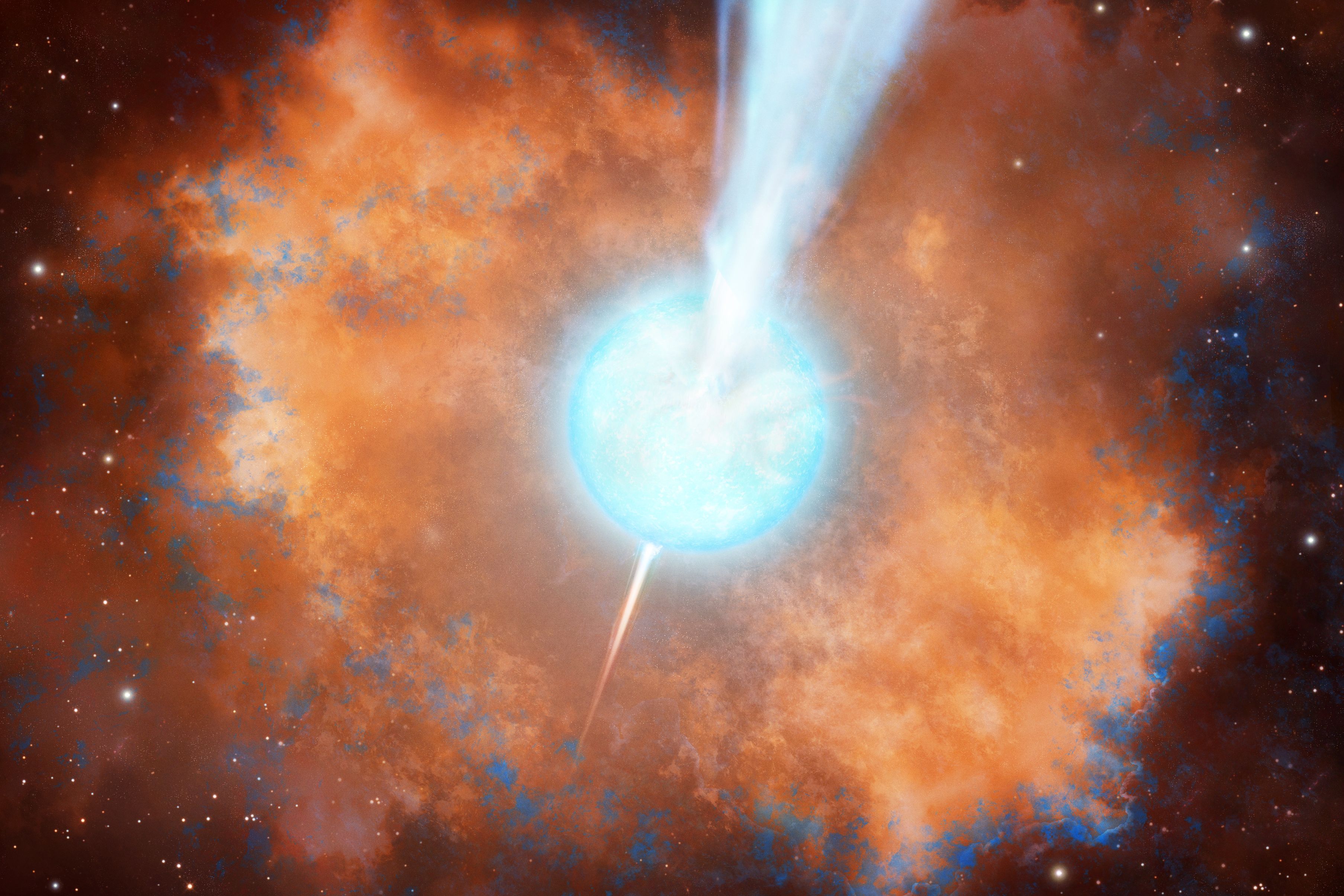
A fireball produced in a black-hole collision or by the collapse of a gigantic star can form jets in which protons and heavier nuclei are accelerated and shock waves produce a burst of gamma rays. The fireball model also predicts the creation of very high energy neutrinos, which ought to be detectable shortly after the gamma-ray burst becomes visible from Earth. (Image credit Dana Berry and NASA)

Accelerated protons in a GRB’s jets should interact with the intense gamma-ray background and strong magnetic fields to produce neutrinos with energies about five percent of the proton energy, together with much higher-energy neutrinos near the end of the acceleration process.

Neutrinos come in three different types that change and mix as they travel to Earth; the total flux can be estimated from the muon neutrinos that IceCube concentrates on. The muons these neutrinos create can travel up to 10 kilometers through the Antarctic ice. Thus many neutrino interactions occur outside the actual dimensions of the IceCube array but are nevertheless visible to IceCube’s detectors, effectively enlarging the telescope’s aperture.

“The way we search for GRB neutrinos is that we build a huge detector and then we just watch and wait,” says Klein. “When it comes to detecting neutrinos, size really does matter.”

IceCube watches with its over 5,000 DOMs, digital optical modules conceived, designed, and proven by Berkeley Lab physicists and engineers, which detect the faint light from each passing muon. Scientists can rely on their remarkable dependability to wait as long as necessary. Almost no failures occurred after the DOMs were installed; 98 percent are working perfectly and another one percent are usable. Now frozen in the ice, they will never be seen again.

IceCube records a million times more muon tracks moving downward through the ice than upward, mainly debris from direct cosmic-ray hits on the surface or secondary products of cosmic-ray collisions with Earth’s atmosphere. Muons moving upward, however, signal neutrinos that have passed all the way through Earth. When the telescope is searching for bright neutrino sources in the northern sky, the planet makes a marvelous filter.

Zeroing in on gamma-ray bursts

A network of satellites circles the globe and reports almost 700 GRBs each year, which readily stand out from the cosmic background. They’re timed, their positions are triangulated, and the data are distributed by an international group of researchers. Some blaze for less than two seconds and others for a few minutes. Neutrinos they produce should arrive at IceCube during the burst or close to it.

“IceCube’s precision timing and charge resolution, plus its large size, allow it to precisely determine where a neutrino comes from – often to within one degree,” says Lisa Gerhardt of Berkeley Lab, whose research has focused on detecting ultra-high-energy neutrino interactions. Indeed, a GRB neutrino should send a muon track through the ice with an angular resolution of about one degree with respect to the GRB’s position in the sky.

IceCube researchers sifted through data on 307 GRBs from two periods in 2008 and 2009 when IceCube was still under construction, looking for records of muon trails coincident in time and space with GRBs. (Forty strings, with 60 DOMs each, had been installed by 2008, and 59 strings by 2009. The finished IceCube has 86 strings.) The fireball model predicted that when the expected flux from all the samples had been summed, at least 8.4 related muon events would be found within 10 degrees of a GRB during the seconds or minutes when it was blazing brightly.

“Different calculations of the neutrino flux from GRBs are based on slightly different assumptions about how the neutrinos are produced and on uncertainties such as how fast the fireball is moving toward us,” says Klein. “Among the published predictions, the lowest estimate of neutrino production is about a quarter of what the fireball model predicts. That’s barely consistent with our zero observations.”

Says Halzen, “After observing gamma-ray bursts for two years, we have not detected the telltale neutrinos for cosmic ray acceleration.”

If it’s likely that GRBs aren’t up to the task of accelerating cosmic rays to ultra-high-energies, what are the options? Klein points to a salient fact about natural accelerators: a small, rapidly spinning object must accelerate particles very rapidly; this requires an extremely energy-dense environment, and there are many ways the particles could lose energy during the acceleration process.

“But remember the other popular model of ultra-high-energy cosmic rays, active galactic nuclei,” says Klein. “GRBs are small, but AGNs are big – great big accelerators that may be able to accelerate particles to very high energies without significant loss.”

Are AGNs the real source of the highest-energy cosmic rays? IceCube has looked for neutrinos from active galactic nuclei, but as yet the data sets are not sensitive enough to set significant limits. For now, IceCube has nothing to say on the subject – beyond the fact that the fireball model of GRBs can’t meet the specs.

###


“An absence of neutrinos associated with cosmic ray acceleration in gamma-ray bursts,” by R. Abbasi et al (the IceCube Collaboration), appears in the April 19, 2012, issue of Nature and is available online to subscribers at http://www.nature.com/nature/index.html. Collaboration members currently or formerly with Berkeley Lab include Keith Beattie, Kirill Filimonov, Lisa Gerhardt, Ariel Goldschmidt, Chang Hyon Ha, Spencer Klein, Howard Matis, Sandra Miarecki, David Nygren, Gerald Przybylski, Thorsten Stezelberger, and Robert Stokstad; Filimonov, Gerhardt, Ha, Klein, and Miarecki are also with the University of California at Berkeley.

The IceCube Collaboration includes over 260 researchers from 42 institutions in 11 countries and is supported by agencies and foundations in Belgium, Germany, Japan, and Sweden, with primary funding from the National Science Foundation and major support from the U.S. Department of Energy’s Office of Science. Visit the IceCube website at http://icecube.wisc.edu/, read the press release concerning this work at http://icecube.wisc.edu/news/view/52, and access a selection of images at http://icecube.wisc.edu/~norris/nature_press/.

At Berkeley Lab, DOE’s Office of Science supports participation in IceCube primarily through the National Energy Research Scientific Computing Center (NERSC). Visit http://www.nersc.gov/.

DOE’s Office of Science is the single largest supporter of basic research in the physical sciences in the United States, and is working to address some of the most pressing challenges of our time. For more information, please visit science.energy.gov.

Lawrence Berkeley National Laboratory addresses the world’s most urgent scientific challenges by advancing sustainable energy, protecting human health, creating new materials, and revealing the origin and fate of the universe. Founded in 1931, Berkeley Lab’s scientific expertise has been recognized with 13 Nobel prizes. The University of California manages Berkeley Lab for the U.S. Department of Energy’s Office of Science. For more, visit www.lbl.gov.

Scientific contact:

Spencer Klein,
510-486-5470,
Email: srklein@lbl.gov

More aboutWhere Do the Highest-Energy Cosmic Rays Come From? Probably Not from Gamma-Ray Bursts

NASA's Swift Finds a Gamma-Ray Burst With a Dual Personality

Posted by carsimulator on Thursday, December 1, 2011

This animation illustrates two wildly different explanations for GRB 101225A, better known as the "Christmas burst." First, a solitary neutron star in our own galaxy shreds and accretes an approaching comet-like body. In the second, a neutron star is engulfed by, spirals into and merges with an evolved giant star in a distant galaxy. (Credit: NASA/Goddard Space Flight Center) . Download this video and related content from NASA Goddard's Scientific Visualization Studio

WASHINGTON -- A peculiar cosmic explosion first detected by NASA's Swift observatory on Christmas Day 2010 was caused either by a novel type of supernova located billions of light-years away or an unusual collision much closer to home, within our own galaxy. Papers describing both interpretations appear in the Dec. 1 issue of the journal Nature.

Gamma-ray bursts (GRBs) are the universe's most luminous explosions, emitting more energy in a few seconds than our sun will during its entire energy-producing lifetime. What astronomers are calling the "Christmas burst" is so unusual that it can be modeled in such radically different ways.

"What the Christmas burst seems to be telling us is that the family of gamma-ray bursts is more diverse than we fully appreciate,” said Christina Thoene, the supernova study's lead author, at the Institute of Astrophysics of Andalusia in Granada, Spain. It's only by rapidly detecting hundreds of them, as Swift is doing, that we can catch some of the more eccentric siblings."

Common to both scenarios is the presence of a neutron star, the crushed core that forms when a star many times the sun's mass explodes. When the star's fuel is exhausted, it collapses under its own weight, compressing its core so much that about a half-million times Earth's mass is squeezed into a sphere no larger than a city.

The Christmas burst, also known as GRB 101225A, was discovered in the constellation Andromeda by Swift's Burst Alert Telescope at 1:38 p.m. EST on Dec. 25, 2010. The gamma-ray emission lasted at least 28 minutes, which is unusually long. Follow-up observations of the burst's afterglow by the Hubble Space Telescope and ground-based observatories were unable to determine the object's distance.

Thoene's team proposes that the burst occurred in an exotic binary system where a neutron star orbited a normal star that had just entered its red giant phase, enormously expanding its outer atmosphere. This expansion engulfed the neutron star, resulting in both the ejection of the giant's atmosphere and rapid tightening of the neutron star's orbit.

Once the two stars became wrapped in a common envelope of gas, the neutron star may have merged with the giant's core after just five orbits, or about 18 months. The end result of the merger was the birth of a black hole and the production of oppositely directed jets of particles moving at nearly the speed of light, followed by a weak supernova.

The particle jets produced gamma rays. Jet interactions with gas ejected before the merger explain many of the burst's signature oddities. Based on this interpretation, the event took place about 5.5 billion light-years away, and the team has detected what may be a faint galaxy at the right location.

"Deep exposures using Hubble may settle the nature of this object," said Sergio Campana, who led the collision study at Brera Observatory in Merate, Italy.

If it is indeed a galaxy, that would be evidence for the binary model. On the other hand, if NASA's Chandra X-ray Observatory finds an X-ray point source or if radio telescopes detect a pulsar, that goes against it.

Campana's team supports an alternative model that involves the tidal disruption of a large comet-like object and the ensuing crash of debris onto a neutron star located only about 10,000 light-years away. The scenario requires the break-up of an object with about half the mass of the dwarf planet Ceres. While rare in the asteroid belt, such objects are thought to be common in the icy Kuiper belt beyond Neptune. Similar objects located far away from the neutron star may have survived the supernova that formed it.

Gamma-ray emission occurred when debris fell onto the neutron star. Clumps of cometary material likely made a few orbits, with different clumps following different paths before settling into a disk around the neutron star. X-ray variations detected by Swift's X-Ray Telescope that lasted several hours may have resulted from late-arriving clumps that struck the neutron star as the disk formed.

In the early years of studying GRBs, astronomers had very few events to study in detail and dozens of theories to explain them. In the Swift era, astronomers have settled into two basic scenarios, either the collapse of a massive star or the merger of a compact binary system.

"The beauty of the Christmas burst is that we must invoke two exotic scenarios to explain it, but such rare oddballs will help us advance the field,” said Chryssa Kouveliotou, a co-author of the supernova study at NASA's Marshall Space Flight Center in Huntsville, Ala.

NASA's Swift was launched in November 2004 and is managed by Goddard. It is operated in collaboration with several U.S. institutions and partners in the United Kingdom, Italy, Germany and Japan.


Francis Reddy
NASA's Goddard Space Flight Center, Greenbelt, Md.

More aboutNASA's Swift Finds a Gamma-Ray Burst With a Dual Personality

VLT Observations of Gamma-ray Burst Reveal Surprising Ingredients of Early Galaxies

Posted by carsimulator on Wednesday, November 2, 2011

This artist’s impression shows two galaxies in the early Universe. The brilliant explosion on the left is a gamma-ray burst. The light from the burst travels through both galaxies on its way to Earth (outside the frame to the right). Analysis of observations of the light from this gamma-ray burst made using ESO’s Very Large Telescope have shown that these two galaxies are remarkably rich in heavier chemical elements.

This artist’s impression shows two galaxies in the early Universe. The brilliant explosion on the left is a gamma-ray burst. As the light from the burst passes through the two galaxies on the way to Earth (outside the frame to the right) some colours are absorbed by the cool gas in the galaxies, leaving characteristic dark lines in the spectrum. Careful study of these spectra has allowed astronomers to discover that these two galaxies are remarkably rich in heavier chemical elements.

An international team of astronomers has used the brief but brilliant light of a distant gamma-ray burst as a probe to study the make-up of very distant galaxies. Surprisingly the new observations, made with ESO’s Very Large Telescope, have revealed two galaxies in the young Universe that are richer in the heavier chemical elements than the Sun. The two galaxies may be in the process of merging. Such events in the early Universe will drive the formation of many new stars and may be the trigger for gamma-ray bursts.

Gamma-ray bursts are the brightest explosions in the Universe [1]. They are first spotted by orbiting observatories that detect the initial short burst of gamma rays. After their positions have been pinned down, they are then immediately studied using large ground-based telescopes that can detect the visible-light and infrared afterglows that the bursts emit over the succeeding hours and days. One such burst, called GRB 090323 [2], was first spotted by the NASA Fermi Gamma-ray Space Telescope. Very soon afterwards it was picked up by the X-ray detector on NASA’s Swift satellite and with the GROND system at the MPG/ESO 2.2-metre telescope in Chile (eso1049) and then studied in great detail using ESO’s Very Large Telescope (VLT) just one day after it exploded.

The VLT observations show that the brilliant light from the gamma-ray burst had passed through its own host galaxy and another galaxy nearby. These galaxies are being seen as they were about 12 billion years ago [3]. Such distant galaxies are very rarely caught in the glare of a gamma-ray burst.

“When we studied the light from this gamma-ray burst we didn’t know what we might find. It was a surprise that the cool gas in these two galaxies in the early Universe proved to have such an unexpected chemical make-up,” explains Sandra Savaglio (Max-Planck Institute for Extraterrestrial Physics, Garching, Germany), lead author of the paper describing the new results. “These galaxies have more heavy elements than have ever been seen in a galaxy so early in the evolution of the Universe. We didn't expect the Universe to be so mature, so chemically evolved, so early on.”

As light from the gamma-ray burst passed through the galaxies, the gas there acted like a filter, and absorbed some of the light from the gamma-ray burst at certain wavelengths. Without the gamma-ray burst these faint galaxies would be invisible. By carefully analysing the tell-tale fingerprints from different chemical elements the team was able to work out the composition of the cool gas in these very distant galaxies, and in particular how rich they were in heavy elements.

It is expected that galaxies in the young Universe will be found to contain smaller amounts of heavier elements than galaxies at the present day, such as the Milky Way. The heavier elements are produced during the lives and deaths of generations of stars, gradually enriching the gas in the galaxies [4]. Astronomers can use the chemical enrichment in galaxies to indicate how far they are through their lives. But the new observations, surprisingly, revealed that some galaxies were already very rich in heavy elements less than two billion years after the Big Bang. Something unthinkable until recently.

The newly discovered pair of young galaxies must be forming new stars at a tremendous rate, to enrich the cool gas so strongly and quickly. As the two galaxies are close to each other they may be in the process of merging, which would also provoke star formation when the gas clouds collide. The new results also support the idea that gamma-ray bursts may be associated with vigorous massive star formation.

Energetic star formation in galaxies like these might have ceased early on in the history of the Universe. Twelve billion years later, at the present time, the remains of such galaxies would contain a large number of stellar remnants such as black holes and cool dwarf stars, forming a hard to detect population of “dead galaxies”, just faint shadows of how they were in their brilliant youths. Finding such corpses in the present day would be a challenge.

“We were very lucky to observe GRB 090323 when it was still sufficiently bright, so that it was possible to obtain spectacularly detailed observations with the VLT. Gamma-ray bursts only stay bright for a very short time and getting good quality data is very hard. We hope to observe these galaxies again in the future when we have much more sensitive instruments, they would make perfect targets for the E-ELT,” concludes Savaglio.

Notes

[1] Gamma-ray bursts lasting longer than two seconds are referred to as long bursts and those with a shorter duration are known as short bursts. Long bursts, including the one in this study, are associated with supernova explosions of massive young stars in star-forming galaxies. Short bursts are not well understood, but are thought to originate from the merger of two compact objects such as neutron stars.

[2] The name refers to the date on which the burst was discovered, in this case it was spotted on 23 March 2009.

[3] The galaxies were seen at a redshift of 3.57, meaning that they are seen as they were 1.8 billion years after the Big Bang.

[4] The material produced by the Big Bang, 13.7 billion years ago, was almost entirely hydrogen and helium. Most heavier elements, such as oxygen, nitrogen and carbon, were produced later by thermonuclear reactions inside stars and fed back into the reserves of gas within galaxies as these stars die. So, it is expected that the amount of heavier elements in most galaxies gradually increases as the Universe ages.
More information

This research was presented in a paper "Super-solar Metal Abundances in Two Galaxies at z ~ 3.57 revealed by the GRB 090323 Afterglow Spectrum" to appear in Monthly Notices of the Royal Astronomical Society.

The team is composed of S. Savaglio (Max Planck Institute for Extraterrestrial Physics, Garching bei München, Germany [MPE]), A. Rau (MPE), J. Greiner (MPE), T. Krühler (MPE; Technische Universität München, Garching, Germany [TUM]; Dark Cosmology Centre, University of Copenhagen, Denmark), S. McBreen (University College Dublin, Ireland; MPE), D. H. Hartmann (Clemson University, Clemson, USA), A. C. Updike (Clemson; Dickinson College, Carlisle, USA), R. Filgas (MPE), S. Klose (Thüringer Landessternwarte Tautenburg, Germany), P. Afonso (MPE), C. Clemens (MPE), A. Küpcü Yoldas (ESO, Garching, Germany), F. Olivares E. (MPE), V. Sudilovsky (MPE; TUM) and G. Szokoly (Eötvös University, Budapest, Hungary).

ESO, the European Southern Observatory, is the foremost intergovernmental astronomy organisation in Europe and the world’s most productive astronomical observatory. It is supported by 15 countries: Austria, Belgium, Brazil, the Czech Republic, Denmark, France, Finland, Germany, Italy, the Netherlands, Portugal, Spain, Sweden, Switzerland and the United Kingdom. ESO carries out an ambitious programme focused on the design, construction and operation of powerful ground-based observing facilities enabling astronomers to make important scientific discoveries. ESO also plays a leading role in promoting and organising cooperation in astronomical research. ESO operates three unique world-class observing sites in Chile: La Silla, Paranal and Chajnantor. At Paranal, ESO operates the Very Large Telescope, the world’s most advanced visible-light astronomical observatory and two survey telescopes. VISTA works in the infrared and is the world’s largest survey telescope and the VLT Survey Telescope is the largest telescope designed to exclusively survey the skies in visible light. ESO is the European partner of a revolutionary astronomical telescope ALMA, the largest astronomical project in existence. ESO is currently planning a 40-metre-class European Extremely Large optical/near-infrared Telescope, the E-ELT, which will become “the world’s biggest eye on the sky”.

Links
Research paper
Photos of the VLT

Contacts

Sandra Savaglio
Astronomer, Max Planck Institute for Extraterrestrial Physics
Garching bei München, Germany
Tel: +49 89 30000 3358
Cell: +49 151 5194 4223
Email: savaglio@mpe.mpg.de

Richard Hook
ESO, La Silla, Paranal, E-ELT and Survey Telescopes Public Information Officer
Garching bei München, Germany
Cell: +49 151 1537 3591
Email: rhook@eso.org

More aboutVLT Observations of Gamma-ray Burst Reveal Surprising Ingredients of Early Galaxies

Gamma-ray bursts shed light on the nature of dark energy

Posted by carsimulator on Monday, September 19, 2011

An artistic image of the explosion of a star leading to a gamma-ray burst
Source: FUW/Tentaris/Maciej Frołow

Dark energy is the basic constituent of the Universe today, one that is responsible for its accelerated expansion. Although astronomers observe the cosmological effects of the impact of dark energy, they still do not know exactly what it is. A new method for measuring the largest distances in the Universe developed by scientists from the Faculty of Physics, University of Warsaw and the University of Naples Federico II helps solve the mystery. A key role is played by the most powerful cosmic explosions – gamma-ray bursts.

What is the nature of dark energy, a recently discovered dominant constituent of the Universe today? Is expansion-accelerating dark energy an intrinsic property of space-time itself or rather a field unknown to science? A new distance-measuring method developed by scientists from the Faculty of Physics, University of Warsaw (FUW) and the University of Naples Federico II can provide the answer. “We are able to determine the distance of an explosion on the basis of the properties of the radiation emitted during gamma-ray bursts. Given that some of these explosions are related to the most remote objects in space that we know about, we are able, for the first time, to assess the speed of space-time expansion even in the relatively early periods after the Big Bang,” says Prof. Marek Demiański (FUW). The method was used to verify models of the structure of the Universe containing dark energy.

In 1998, during the analysis of the brightness of Type Ia supernovae, it was discovered that the most remote explosions seemed to be too weak. Type Ia supernovae appear in binary systems. One of the stars is a white dwarf, a relic of an evolutionary cycle of stars similar to the Sun. When the second star of the system enters the red giant phase and swells up, its external layers, containing mainly hydrogen, begin to fall onto the white dwarf, which gradually grows in mass. When the white dwarf reaches 1.4 solar masses, it explodes and is completely torn apart. Since the conditions that trigger the explosion are similar every time, Type Ia supernovae always release more or less the same amount of energy. Astronomers rely on this property to measure distances in space.

The fainter brightness of remote Type Ia supernovae was a clear indication that they were even more distant than assumed. Instead of slowing down the expansion, the Universe was accelerating. A new form of mass-energy – dark energy – needed to be introduced into the theory in order to reconcile the previous models of the Universe with the observations. The calculations indicate the existence of a huge amount of dark energy, nearly 20 times greater than the amount of mass-energy related to the world accessible to human senses. “Overnight, dark energy became, quite literally, the greatest mystery of the Universe,” says Prof. Demiański.

To this day no one knows exactly what dark energy is. There are two models explaining its nature. According to the first one, dark energy is a property described by the famous cosmological constant introduced by Albert Einstein. According to the second model, the accelerated expansion is caused by some unknown scalar field. “In other words, it is either-or: either space-time expands by itself or is expanded by a scalar physical field inside it,” says Prof. Demiański.

Examining the density of dark energy in various periods after the Big Bang can help choose the correct model. If the density remained constant, it would mean that dark energy is related to the cosmological constant, that is to say, the property of space-time. But if the acceleration of the Universe is caused by a scalar field, then, given the swelling-up of space-time, the density of dark energy should change. “This used to be a problem. In order to assess the changes in the density of dark energy immediately after the Big Bang, one needs to know how to measure the distance to very remote objects. So remote that even Type Ia supernovae connected to them are too faint to be observed,” says Prof. Demiański.

The group of Polish and Italian astrophysicists suggested using gamma-ray bursts (GRBs), the most powerful explosions observed in the Universe today, to measure the largest distances in the Universe. They analyzed the so-called long bursts that probably arise during the collapse of the core of a large star. The process leads to the formation of a black hole. The gamma radiation emitted at that time is so intense that even objects that exploded 400 million years after the Big Bang can be observed.

The main problem was how to assess the total energy of a burst. To that end, the scientists analyzed databases of previous gamma explosions. It turned out that a part of the explosions occurred in galaxies the distance to which could be measured using other methods, for example, by means of Type Ia supernovae. “We focused on those instances. We knew the distance to the galaxy and we also knew how much energy of the burst reached the Earth. This allowed us to calibrate the burst, that is to say, to calculate the total energy of the explosion,” explains Prof. Demiański.

The next step was to find statistical dependencies between various properties of the radiation emitted during a gamma-ray burst and the total energy of the explosion. Such relations were discovered. “We cannot provide a physical explanation of why certain properties of gamma-ray bursts are correlated,” points out Prof. Demiański. “But we can say that if registered radiation has such and such properties, then the burst had such and such energy. This allows us to use bursts as standard candles, to measure distances.”

The team of scientists from the universities in Warsaw and Naples, headed by Dr Ester Piedipalumbo, analyzed data gathered by astronomers. Extremely remote gamma-ray bursts are quite rare. The Amanti catalogue listed 95 such phenomena and failed to provide enough clues as to the exact nature of dark energy. “It is quite a disappointment. But what is important is the fact that we have in our hands a tool for verifying hypotheses about the structure of the Universe. All we need to do now is wait for the next cosmic fireworks,” concludes Prof. Demiański.

The insufficient amount of observational data remains the main problem in the data analysis of gamma-ray bursts. For this reason, many groups of astronomers and astrophysicists combine their efforts in order to register them in the fastest and most accurate manner possible. One of such projects is “Pi of the Sky”, a system of robotic telescopes for real-time monitoring of large areas of the sky, co-organized by the Faculty of Physics, University of Warsaw.

More aboutGamma-ray bursts shed light on the nature of dark energy

Integral challenges physics beyond Einstein

Posted by carsimulator on Thursday, June 30, 2011

December 2004 that Philippe Laurent and colleagues have now analysed in detail. It was so bright that Integral could also measure its polarisation, allowing Laurent and colleagues to look for differences in the signal from different energies. The GRB shown here, on 25 November 2002, was the first captured using such a powerful gamma-ray camera as Integral’s. When they occur, GRBs shine as brightly as hundreds of galaxies each containing billions of stars. Credits: ESA/SPI Team/ECF

ESA’s Integral gamma-ray observatory has provided results that will dramatically affect the search for physics beyond Einstein. It has shown that any underlying quantum ‘graininess’ of space must be at much smaller scales than previously predicted.

Einstein’s General Theory of Relativity describes the properties of gravity and assumes that space is a smooth, continuous fabric. Yet quantum theory suggests that space should be grainy at the smallest scales, like sand on a beach.

One of the great concerns of modern physics is to marry these two concepts into a single theory of quantum gravity.

Now, Integral has placed stringent new limits on the size of these quantum ‘grains’ in space, showing them to be much smaller than some quantum gravity ideas would suggest.

According to calculations, the tiny grains would affect the way that gamma rays travel through space. The grains should ‘twist’ the light rays, changing the direction in which they oscillate, a property called polarisation.

High-energy gamma rays should be twisted more than the lower energy ones, and the difference in the polarisation can be used to estimate the size of the grains.

Philippe Laurent of CEA Saclay and his collaborators used data from Integral’s IBIS instrument to search for the difference in polarisation between high- and low-energy gamma rays emitted during one of the most powerful gamma-ray bursts (GRBs) ever seen.

GRBs come from some of the most energetic explosions known in the Universe. Most are thought to occur when very massive stars collapse into neutron stars or black holes during a supernova, leading to a huge pulse of gamma rays lasting just seconds or minutes, but briefly outshining entire galaxies.

GRB 041219A took place on 19 December 2004 and was immediately recognised as being in the top 1% of GRBs for brightness. It was so bright that Integral was able to measure the polarisation of its gamma rays accurately.

Dr Laurent and colleagues searched for differences in the polarisation at different energies, but found none to the accuracy limits of the data.

Some theories suggest that the quantum nature of space should manifest itself at the ‘Planck scale’: the minuscule 10-35 of a metre, where a millimetre is 10-3 m.

However, Integral’s observations are about 10 000 times more accurate than any previous and show that any quantum graininess must be at a level of 10-48 m or smaller.

“This is a very important result in fundamental physics and will rule out some string theories and quantum loop gravity theories,” says Dr Laurent.

Integral made a similar observation in 2006, when it detected polarised emission from the Crab Nebula, the remnant of a supernova explosion just 6500 light years from Earth in our own galaxy.

This new observation is much more stringent, however, because GRB 041219A was at a distance estimated to be at least 300 million light years.

In principle, the tiny twisting effect due to the quantum grains should have accumulated over the very large distance into a detectable signal. Because nothing was seen, the grains must be even smaller than previously suspected.

“Fundamental physics is a less obvious application for the gamma-ray observatory, Integral,” notes Christoph Winkler, ESA’s Integral Project Scientist. “Nevertheless, it has allowed us to take a big step forward in investigating the nature of space itself.”

Now it’s over to the theoreticians, who must re-examine their theories in the light of this new result.

Contact for further information

Markus Bauer
ESA Science and Robotic Exploration Communication Officer
Email: markus.bauer@esa.int
Tel: +31 71 565 6799
Mob: +31 61 594 3 954

Dr Philippe Laurent
Laboratoire APC, CEA/IRFU
Email: philippe.laurent@cea.fr
Tel: +33 1 69 08 80 66 or +33 1 57 27 60 72

Dr Christoph Winkler
ESA Integral Project Scientist
Email: christoph.winkler@rssd.esa.int
Tel: +31 71 5653591

Notes for editors

Constraints on Lorentz Invariance Violation using INTEGRAL/IBIS observations of GRB041219A by P. Laurent, D. Götz, P. Binetruy, S. Covino, A. Fernandez-Soto is published online at Physical Review D June, 28th 2011, Vol. 83, issue 12.

More aboutIntegral challenges physics beyond Einstein