Showing posts with label Dwarf Galaxy. Show all posts

Hubble Unmasks Ghost Galaxies

Posted by carsimulator on Tuesday, July 10, 2012

Ultra-Faint Dwarf Galaxy Leo IV
Credit: NASA, ESA, and T. Brown (STScI)
More Images

Astronomers have puzzled over why some puny, extremely faint dwarf galaxies spotted in our Milky Way galaxy's back yard contain so few stars.

These ghost-like galaxies are thought to be some of the tiniest, oldest, and most pristine galaxies in the universe. They have been discovered over the past decade by astronomers using automated computer techniques to search through the images of the Sloan Digital Sky Survey. But astronomers needed NASA's Hubble Space Telescope to help solve the mystery of these star-starved galaxies.

Hubble views of three of the small-fry galaxies reveal that their stars share the same birth date. The galaxies all started forming stars more than 13 billion years ago — and then abruptly stopped — all in the first billion years after the universe was born in the big bang.

The relic galaxies are evidence for a transitional phase in the early universe that shut down star-making factories in tiny galaxies. During this time, the first stars burned off a fog of cold hydrogen in a process called reionization.

"These galaxies are all ancient and they're all the same age, so you know something came down like a guillotine and turned off the star formation at the same time in these galaxies," said Tom Brown of the Space Telescope Science Institute in Baltimore, Md., the study's leader. "The most likely explanation is reionization."

The reionization of the universe began in the first billion years after the big bang. During this epoch, radiation from the first stars knocked electrons off primeval hydrogen atoms, ionizing the cool hydrogen gas. This process allowed the hydrogen gas to become transparent to ultraviolet light.

Ironically, the same radiation that sparked universal reionization appears to have squelched star-making activities in dwarf galaxies, such as those in Brown's study. The small irregular galaxies were born about 100 million years before reionization began and had just started to churn out stars. Roughly 2,000 light-years wide, the galaxies are the smaller cousins of the more luminous star-making dwarf galaxies near our Milky Way. Unlike their larger relatives, the puny galaxies were not massive enough to shield themselves from the harsh ultraviolet light. What little gas they had was stripped away as the flood of ultraviolet light rushed through them. Their gas supply depleted, the galaxies could not make new stars.

The discovery could help explain the so-called "missing satellite problem," where only a few dozen dwarf galaxies have been observed around the Milky Way while computer simulations predict that thousands should exist. One possible explanation is that there has been very little, or even no star formation in the smallest of these dwarf galaxies, making them difficult to detect.

The Sloan survey recently uncovered more than a dozen of these star-starved galaxies in our Milky Way's neighborhood while scanning just a quarter of the sky. Astronomers think the rest of the sky should contain dozens more of these objects, dubbed ultra-faint dwarf galaxies. The evidence for squelched star formation in some of the smallest of these dwarfs suggests that there may be thousands more where essentially no stars formed at all.

"By measuring the star formation histories of the observed dwarfs, Hubble has confirmed earlier theoretical predictions that star formation in the smallest clumps would be shut down by reionization," said Jason Tumlinson of the Space Telescope Science Institute, a member of the research team.

Brown's results appeared in the July 1 issue of The Astrophysical Journal Letters.

"These are the fossils of the earliest galaxies in the universe," Brown said. "They haven't changed in billions of years. These galaxies are unlike most nearby galaxies, which have long star-formation histories."

The stellar populations in these fossil galaxies range from a few hundred to a few thousand stars both fainter and brighter than our Sun. The galaxies may be star-deprived, but they have an abundance of dark matter, the underlying scaffolding upon which galaxies are built.

Normal dwarf galaxies near the Milky Way contain 10 times more dark matter than the ordinary matter that makes up gas and stars. In ultra-faint dwarf galaxies, dark matter outweighs ordinary matter by at least a factor of 100. "The small galaxies in our study are made up mostly of dark matter because their hydrogen gas was ionized and the stars got turned off," Brown explained.

These mostly dark-matter islands coexisted unseen with our Milky Way for billions of years, until astronomers began finding them in the Sloan survey.

When these galaxies were uncovered, astronomers began proposing many reasons for their shortage of stars. Some believed that internal dynamics, such as a supernova blast, blew out the gas needed to create more stars. Others suggested that the galaxies simply used up what little gas they had. And a few thought that the galaxies were born during the early universe and reionization had turned off their star formation.

Then, ground-based observations of two of the newly discovered galaxies revealed tantalizing evidence that the stars were indeed ancient. So Brown decided to use Hubble's Advanced Camera for Surveys to look deep inside six of the galaxies to study the population of stars and determine when they were born. So far, Brown and his team have finished analyzing the Hubble data of three of the galaxies, named Hercules, Leo IV, and Ursa Major. The galaxies' distance from Earth ranges from 330,000 light-years to 490,000 light-years.

"Astronomers have said before that certain galaxies should be ancient, and then someone studies them hard enough and finds younger stars," Brown said. "Some of us expected to uncover younger stars and prove that the galaxies are not relics from the early universe. We were surprised to find that all the stars were ancient."

Brown measured the stars' ages by analyzing their brightness and colors. For reference, Brown compared the galaxies' stars with the stars in the ancient globular cluster M92, located 26,000 light-years away. M92 is more than 13 billion years old, one of the oldest objects in the universe. The analysis revealed that the galaxies' stars are as old as those in M92.

"The stars in the ultra-faint dwarf galaxies are very sparse," Brown said. "This is one reason why no one went after them with Hubble. However, we thought they were good targets for Hubble, given Hubble's ability to measure precise ages. You look at the Hubble images and there are almost no stars, but the ones we have are enough to give us the ages of these galaxies."

The science team that did the investigation is led by Principal Investigator T.M. Brown (STScI) and further consists of J. Tumlinson (STScI), M. Geha (Yale University), E.N. Kirby (California Institute of Technology), D.A. VandenBerg (University of Victoria), R.R. Munoz (Universidad de Chile), J.S. Kalirai (STScI), J.D. Simon (Observatories of the Carnegie Institute of Washington), R.J. Avila (STScI), P. Guhathakurta (UCO/Lick Observatory), A. Renzini (Osservatorio Astronomico), and H.C. Ferguson (STScI).

CONTACT

Donna Weaver
Space Telescope Science Institute, Baltimore, Md.
410-338-4493
dweaver@stsci.edu

Tom Brown
Space Telescope Science Institute, Baltimore, Md.
410-338-4902
tbrown@stsci.edu

More aboutHubble Unmasks Ghost Galaxies

A Vapour of Stars

Posted by carsimulator on Monday, June 25, 2012

DDO 82- UGC 5692
Credit: ESA/Hubble & NASA

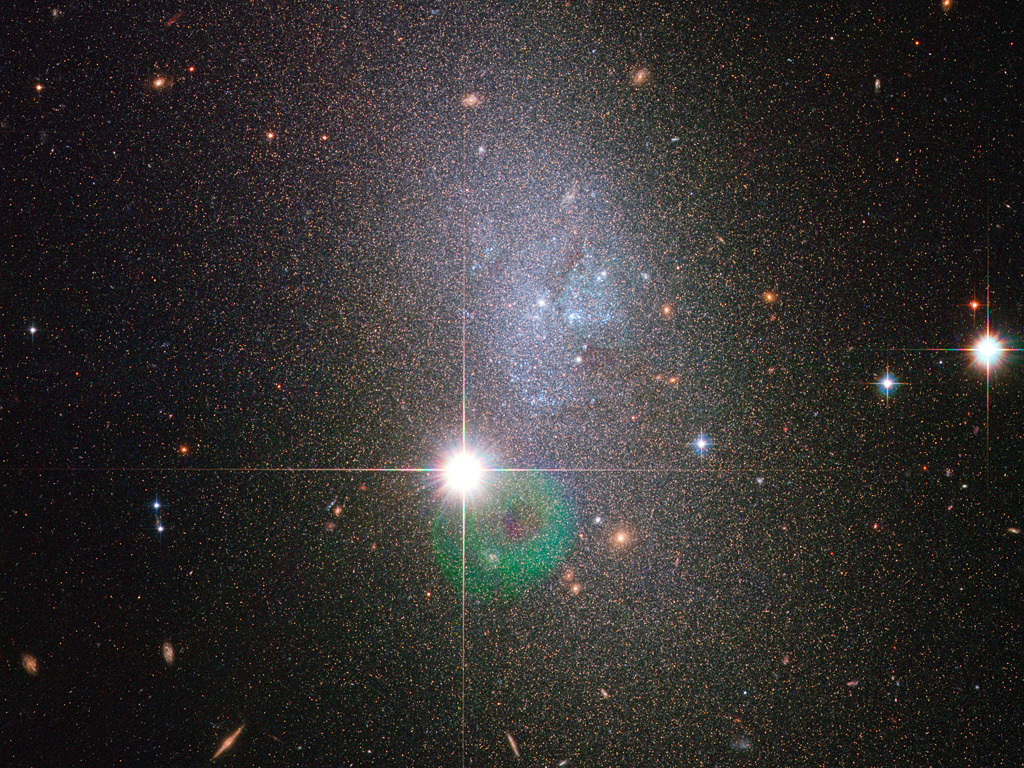
Relatively few galaxies possess the sweeping, luminous spiral arms or brightly glowing centre of our home galaxy the Milky Way. In fact, most of the Universe's galaxies look like small, amorphous clouds of vapour. One of these galaxies is DDO 82, captured here in an image from the NASA/ESA Hubble Space Telescope. Though tiny compared to the Milky Way, such dwarf galaxies still contain between a few million and a few billion stars.

DDO 82, also known by the designation UGC 5692, is not without a hint of structure, however. Astronomers classify it as an Sm galaxy, or Magellanic spiral galaxy, named after the Large Magellanic Cloud, a dwarf galaxy that orbits the Milky Way. That galaxy, like DDO 82, is said to have one spiral arm.

In the case of DDO 82, gravitational interactions over its history seem to have discombobulated it so that this structure is not as evident as in the Large Magellanic Cloud. Accordingly, astronomers also refer to DDO 82 and others of a similar unshapely nature as dwarf irregular galaxies.

DDO 82 can be found in the constellation of Ursa Major (the Great Bear) approximately 13 million light-years away. The object is considered part of the M81 Group of around three dozen galaxies. DDO 82 gets its name from its entry number in the David Dunlap Observatory Catalogue. Canadian astronomer Sidney van den Bergh originally compiled this list of dwarf galaxies in 1959.

The image is made up of exposures taken in visible and infrared light by Hubble’s Advanced Camera for Surveys. The field of view is approximately 3.3 by 3.3 arcminutes.

More aboutA Vapour of Stars

Compact Blue Dwarf Can’t Hide

Posted by carsimulator on Monday, June 11, 2012

UGC 5497
Credit: ESA/Hubble & NASA

The NASA/ESA Hubble Space Telescope has captured this view of the dwarf galaxy UGC 5497, which looks a bit like salt dashed on black velvet in this image.

The object is a compact blue dwarf galaxy that is infused with newly formed clusters of stars. The bright, blue stars that arise in these clusters help to give the galaxy an overall bluish appearance that lasts for several million years until these fast-burning stars explode as supernovae.

UGC 5497 is considered part of the M 81 group of galaxies, which is located about 12 million light-years away in the constellation Ursa Major (The Great Bear). UGC 5497 turned up in a ground-based telescope survey back in 2008 looking for new dwarf galaxy candidates associated with Messier 81.

According to the leading cosmological theory of galaxy formation, called Lambda Cold Dark Matter, there should be far more satellite dwarf galaxies associated with big galaxies like the Milky Way and Messier 81 than are currently known. Finding previously overlooked objects such as this one has helped cut into the expected tally — but only by a small amount.

Astrophysicists therefore remain puzzled over the so-called "missing satellite" problem.

The field of view in this image, which is a combination of visible and infrared exposures from Hubble’s Advanced Camera for Surveys, is approximately 3.4 by 3.4 arcminutes.

More aboutCompact Blue Dwarf Can’t Hide

Hubble Observes a Dwarf Galaxy with a Bright Nebula

Posted by carsimulator on Thursday, May 10, 2012

PR Image heic1207a
Hubble view of NGC 2366

PR Image heic1207b
Ground-based, wide-field view of NGC 2366

Videos

PR Video heic1207a
Zoom into NGC 2366

PR Video heic1207b
Pan across NGC 2366

The NASA/ESA Hubble Space Telescope has made detailed observations of the dwarf galaxy NGC 2366. While it lacks the elegant spiral arms of many larger galaxies, NGC 2366 is home to a bright, star-forming nebula and is close enough for astronomers to discern its individual stars.

The starry mist streaking across this image obtained by the NASA/ESA Hubble Space Telescope is the central part of the dwarf galaxy known as NGC 2366. The most obvious feature in this galaxy is a large nebula visible in the upper-right part of the image, an object listed just a few entries prior in the New General Catalogue as NGC 2363.

A nearby yellowish swirl is not in fact part of the nebula. It is a spiral galaxy much further away, whose light is shining right through NGC 2366. This is possible because galaxies are not solid objects. While we see the stars because they shine brightly, galaxies are overwhelmingly made up of the empty space between them. Hubble’s high-resolution image illustrates this perfectly: the stars are small points of light surrounded by the darkness of space.

The splendid interconnected objects of NGC 2366 and NGC 2363 are located about 10 million light-years away in the constellation of Camelopardalis (the Giraffe). As a dwarf galaxy, NGC 2366’s size is in the same ballpark as the two main satellite galaxies of our Milky Way, named the Large and Small Magellanic Clouds. Like the Magellanic clouds, NGC 2366's lack of well-defined structure leads astronomers to further classify it as an irregular galaxy.

Although NGC 2366 might be small by the standards of galaxies, many of its stars are not, and the galaxy is home to numerous gigantic blue stars. The blue dots scattered throughout the galaxy speak to the burst of star formation that the galaxy has undergone in recent cosmic time. A new generation of these stellar titans has lit up the nebula NGC 2363.

In gas-rich star-forming regions, the ultraviolet radiation from young, big, blue stars excites the hydrogen gas, making it glow. NGC 2363, as well as other, smaller patches seen throughout Hubble’s image, serve as the latest formation sites for stellar giants.

Imaged through green and infrared filters, these nebulae take on a blueish tinge in this image, though the actual colour is a shade of red.

This image was produced from two adjacent fields observed by Hubble’s Advanced Camera for Surveys. The field of view is approximately 5.5 arcminutes across, which is equivalent to a little over a fifth of the diameter of the full Moon. Although this is comparatively large by the standard of Hubble’s images, NGC 2366 is much too faint to observe with the naked eye.

Notes

The Hubble Space Telescope is a project of international cooperation between ESA and NASA.

Image credit: NASA & ESA

Links

Contacts

Oli Usher
Hubble/ESA
Garching, Germany
Tel: +49-89-3200-6855
Email: ousher@eso.org

More aboutHubble Observes a Dwarf Galaxy with a Bright Nebula

Antlia Dwarf Galaxy Peppers the Sky with Stars

Posted by carsimulator on Friday, March 9, 2012

Antlia Dwarf galaxy
Credit: ESA/Hubble & NASA

The myriad faint stars that comprise the Antlia Dwarf galaxy are more than four million light-years from Earth, but this NASA/ESA Hubble Space Telescope image offers such clarity that they could be mistaken for much closer stars in our own Milky Way. This very faint and sparsely populated small galaxy was only discovered in 1997.

Although small, the Antlia Dwarf is a dynamic site featuring stars at many different stages of evolution, from young to old. The freshest stars are only found in the central regions where there is significant ongoing star formation. Older stars and globular clusters are found in the outer areas.

It is not entirely clear whether the Antlia Dwarf is a member our galactic neighbourhood, called the Local Group. It probably lies just beyond the normally accepted outer limits of the group. Although it is fairly isolated, some believe it has interacted with other star groups. Evidence comes from galaxy NGC 3109, close to the Antlia Dwarf (but not visible in this image). Both galaxies feature rifts of stars moving at comparable velocities; a telltale sign that they were gravitationally linked at some point in the past.

This picture was created from observations in visible and infrared light taken with the Wide Field Channel of Hubble’s Advanced Camera for Surveys. The field of view is approximately 3.2 by 1.5 arcminutes.

More aboutAntlia Dwarf Galaxy Peppers the Sky with Stars

Subaru Telescope Captures Images of the "Stealth Merger" of Dwarf Galaxies

Posted by carsimulator on Wednesday, February 8, 2012

Figure 1: Suprime-Cam captured this image of the nearby dwarf galaxy NGC 4449 (lower left) and its companion (upper right), a dwarf galaxy that has been gravitationally pulled apart into a stellar stream. It shows individual stars composing the galaxies. R. Jay GaBany (Blackbird Observatory) produced the composite: blue hues in the center of the larger galaxy are brought about by a burst of recent star formation, while the red in its periphery and in its satellite indicates the presence of older, red-giant stars. (Hi-Res image)

An international team of scientists led by David Martinez-Delgado (Max Planck Institute for Astronomy, Germany) has conducted research that reveals a "stealth merger" of dwarf galaxies, where an in-falling satellite galaxy is nearly undetectable by conventional means yet has a substantial influence on its host galaxy. Aaron Romanowsky (University of California Observatories in Santa Cruz) along with graduate student Jacob Arnold (UCSC) used the Subaru Telescope to obtain high-resolution images of individual stars in a dense stream of stars in the outer regions of a nearby dwarf galaxy (NGC 4449); these outlying stars are the remains of an even smaller companion galaxy in the process of merging with its host (Figure 1). NGC 4449, the host galaxy, is the smallest primary galaxy in which a stellar stream from an ongoing merger has been identified and studied in detail. Romanowsky commented, "I don't think I'd ever seen a picture of a galaxy merger where you can see the individual stars. It's really an impressive image."

Martinez-Delgado organized a campaign to follow up on an initial report of the stellar stream in NGC 4449, first detected by Russian astronomers as a mysterious, faint smudge in digitized photographic plates from the Digitized Sky Survey project. Had the objects been slightly fainter, more diffuse, or farther from the host galaxy, the stellar stream could easily have been missed. NGC 4449 is located 12.5 million light years from Earth and is a member of a group of galaxies in the constellation Canes Venatici. Martinez-Delgado recruited astrophotographer R. Jay GaBany (recipient of the 2010 AAS Chambliss Amateur Achievement Award) to obtain deep, wide-field images with the half-meter telescope at Black Bird Observatory; these images confirmed the presence of a faint substructure in the galaxy's halo. Romanowsky and Arnold then took advantage of the wide field of view and light collecting power of Subaru Telescope's 8.2 meter mirror and its prime focus camera (Suprime-Cam) to capture high resolution images of the faint objects in the halo. These final observations at Subaru in 2011 clearly showed the stealth merger of two dwarf galaxies.

Modern cosmological theory posits that large galaxies were built up from smaller ones through an orderly succession of mergers. Although astronomers have observed many mergers involving massive galaxies, it has been difficult to find mergers of two dwarf galaxies. Theory suggests that similar processes of merging should occur on a smaller scale, with small galaxies eating even smaller ones; this is how galaxies grow. Romanowsky commented on the significance of the Subaru image: "Now we have this beautiful image of a dwarf galaxy consuming a smaller dwarf. You can see a smaller galaxy coming in and getting shredded, eventually leaving its stars scattered through the halo of the host galaxy. "

The new observations support the idea that the stellar halos around many dwarf galaxies are the remnants of smaller satellites that were shredded in past merger events. The ongoing merger in NGC 4449 may also be responsible for the intense burst of star formation seen in the galaxy. "This galaxy is famous for its starburst activity, and it seems we've found the reason for that. The gravitational interaction with the incoming galaxy has probably disturbed the gas in the main galaxy and caused it to start forming stars," Romanowsky said.


Notes:

This research was supported by the National Science Foundation (NSF, USA), National Aeronautics and Space Administration (NASA, USA) and the University of California at Santa Cruz-University Affiliated Research Center (UCSC-UARC) Aligned Research Program.


The paper describing the research, “Dwarfs gobbling dwarfs: A stellar tidal stream around NGC 4449 and hierarchical galaxy formation on small scales”, will be published in Astrophysical Journal Letters. Coauthors of this international study include:

D. Martinez-Delgado (Max Planck Institute for Astronomy, Germany)
A. Romanowsky (University of California Observatories at Santa Cruz, USA)
J. Arnold (University of California at Santa Cruz, USA)
R. J. GaBany (astrophotographer, amateur astronomer, USA)
J. Brodie (UC Santa Cruz, USA)
F. Annibali (Astronomical Observatory of Bologna, Italy)
J. Fliri (Observatory of Paris, France)
S. Zibetti (University of Copenhagen, Denmark)
R. van der Marel (Space Telescope Science Institute, USA)
A. Aloisi (Space Telescope Science Institute, USA)
H.-W. Rix (Max Planck Institute for Astronomy, Germany)
A. Macciò (Max Planck Institute for Astronomy, Germany)
T. Chonis (University of Texas at Austin, USA)
J. Carballo-Bello (Canary Astrophysics Institute, Spain)
J. Gallego-Laborda (Fosca Nit Observatory Spain)
M. Merrifield (University of Nottingham, UK)

More aboutSubaru Telescope Captures Images of the "Stealth Merger" of Dwarf Galaxies

Most Distant Dwarf Galaxy Detected

Posted by carsimulator on Wednesday, January 18, 2012

The gravitational lens B1938+666 as seen in the infrared when observed with the 10-meter Keck II telescope with Adaptive Optics on Mauna Kea, Hawaii. In the center is a massive red galaxy 9.8 billion light-years from Earth that acts like a cosmic magnifying glass, distorting the light from an even more distant galaxy, 17.3 billion light-years away. The result is a spectacular Einstein ring image of the background galaxy. The team used distortions within the ring to find evidence for a low-mass dark galaxy, which is a satellite of the foreground lensing galaxy. Using this gravitational lensing effect the mass of the dark galaxy was found to be 200 million times the mass of the Sun, which is similar to the masses of the satellite galaxies found around our own Milky Way, but is 9.8 billion light-years further away.Credit: D. Lagattuta / W. M. Keck Observatory

Kamuela, HI—Scientists have long struggled to detect the dim dwarf galaxies that orbit our own galaxy. So it came as a surprise on Jan. 18 when a team of astronomers using Keck II telescope’s adaptive optics has announced the discovery of a dwarf galaxy halfway across the universe.

The new dwarf galaxy found by MIT’s Dr. Simona Vegetti and colleagues is a satellite of an elliptical galaxy almost 10 billion light-years away from Earth. The team detected it by studying how the massive elliptical galaxy, called JVAS B1938 + 666, serves as a gravitational lens for light from an even more distant galaxy directly behind it. Their discovery was published in the Jan. 18 online edition of the journal Nature.

Like all supermassive elliptical galaxies, JVAS B1938 + 666’s gravity can deflect light passing by it. Often the light from a background galaxy gets deformed into an arc around the lens galaxy, and sometimes what’s called an Einstein ring. In this case, the ring is formed mainly by two lensed images of the background galaxy. The size, shape and brightness of the Einstein ring depends on the distribution of mass throughout the foreground lensing galaxy.

Vegetti and her team obtained extra sharp near-infrared image of JVAS B1938 + 666 by using the 10-meter Keck II telescope and its adaptive optics system, which corrects for the blurring effects of Earth’s atmosphere, and provides stunningly sharp images. With these data, they neatly determined the mass distribution of JVAS B1938 + 666 as well as the shape and brightness of the background galaxy.

The researchers used a sophisticated numerical technique to derive a model of the lens galaxy’s mass, as well as to map any excess lens mass that could not be accounted for by the galaxy. What they found was an excess mass near the Einstein ring that they attributed to the presence of a satellite, or “dwarf,” galaxy. Vegetti’s team also used a separate analytical model to test the detected excess mass. They found that a satellite galaxy is indeed required to explain the data.

“This satellite galaxy is exciting because it was detected in the excess-mass map despite its low mass,” commented Robert Schmidt of the Center for Astronomy at Heidelberg University, in a related Nature article. “A natural question to ask is whether the satellite galaxy can be observed directly rather than by its gravitational effect on the shape of a background object. With current instrumentation, the answer is no. The object is simply too distant to be imaged directly. But the message here is that it is possible to spot these elusive objects around distant lens galaxies without knowing where to look for them.”

Galaxies like our own are believed to form over billions of years through the merging of many smaller galaxies. So it’s expected that there should be many smaller dwarf galaxies buzzing around the Milky Way. However, very few of these tiny relic galaxies have been observed which has led astronomers to conclude that many of them must have very few stars or possibly may be made almost exclusively of dark matter.

Scientists theorize the existence of dark matter to explain observations that suggest there is far more mass in the universe than can be seen. However, because the particles that make up dark matter do not absorb or emit light, they have so far proven impossible to detect and identify. Computer modeling suggests that the Milky Way should have about 10,000 satellite dwarf galaxies, but only 30 have been observed.

“It could be that many of the satellite galaxies are made of dark matter, making them elusive to detect, or there may be a problem with the way we think galaxies form”, says Vegetti.

In the new study, Vegetti worked with Prof. Leon Koopmans of the University of Groningen, Netherlands; Dr. David Lagattuta and Prof. Christopher Fassnacht of the University of California at Davis; Dr. Matthew Auger of the University of California at Santa Barbara; and Dr. John McKean of the Netherlands Institute for Radio Astronomy.

“The existence of this low-mass dark galaxy is just within the bounds we expect if the Universe is composed of dark matter which has a low temperature. However, further dark satellites will need to be found to confirm this conclusion,” says Vegetti.

The W. M. Keck Observatory operates two 10-meter optical/infrared telescopes on the summit of Mauna Kea on the Big Island of Hawaii. The twin telescopes feature a suite of advanced instruments including imagers, multi-object spectrographs, high-resolution spectrographs, integral-field spectroscopy and a world-leading laser guide star adaptive optics system which cancels out much of the interference caused by Earth’s turbulent atmosphere. The Observatory is a private 501(c) 3 non-profit organization and a scientific partnership of the California Institute of Technology, the University of California and NASA.


Adapted from a MIT press release.

For more information please visit
http://web.mit.edu/physics/people/pappalardo/vegetti_simona.html
http://web.mit.edu/physics/index.html
http://web.mit.edu/newsoffice/2009/dark-matter-091709.html

More aboutMost Distant Dwarf Galaxy Detected

Little Galaxies Are Big on Dark Matter

Posted by carsimulator on Friday, December 30, 2011

The stellar stream in the halo of the nearby dwarf starburst galaxy NGC 4449 is resolved into its individual starry constituents in this exquisite image taken with the 8.2-meter Subaru Telescope and Suprime-Cam. Image credit: R. Jay GaBany and Aaron J. Romanowsky (UCSC) in collaboration with David Martinez-Delgado (MPIA) and NAOJ. Image processed by R. Jay GaBany

Dark matter… It came into existence at the moment of the Big Bang. Within its confines, galaxies formed and evolved. If you add up all the parts contained within any given galaxy you derive its mass, yet its gravitational effects can only be explained by the presence of this mysterious subatomic particle. It would be easy to believe that the larger the galaxy, the larger the amount of dark matter should be present, but new research shows that isn’t so. Dwarf galaxies have even higher proportions of dark matter than their larger counterparts. Although the dwarfs are the most common of all, we know very little about them – even when they consume each other. Enter the star stream…

“Several of my previous images feature the fossil remnants of these ancient mergers as faint stellar rivers called tidal streams. These stellar streams are the table crumbs from small dwarf galaxies that were gravitationally dismembered as they were devoured by the larger galaxy they orbited.” says astrophotographer, R. Jay Gabany. “The theory implies dwarf galaxies also merged and are still merging with each other. But, there has never been clear photographic evidence or a close investigation of dwarf galactic mergers until now.”

The target is NGC 4449, a small, irregular dwarf galaxy much like the the Milky Way’s Large Magellanic Cloud. What makes it interesting to astronomers is the presence of thousands of hot blue stars and massive red regions interspaced with thick dust clouds. It isn’t just forming new stars… it’s experiencing an explosion of star birth! According to current theory, dwarf galaxies such as this one could be undergoing a merger event, but there hasn’t been photographic proof until now.

“The picture I am sharing is of a small, dwarf galaxy known as NGC 4449 that’s located about 12.5 million light years from Earth towards the northern constellation of Canes Venatici, the Hunting Dogs. This galaxy is about the size of our Milky Way’s largest satellite galaxy, the Magellanic Cloud. But, NGC 4449 is much farther away and it is experiencing a major star burst event- an episode characterized by the production of new stars at a furious rate.” says Gabany. “This image is unique because is it captures the first dwarf galaxy known to have its own tidal stream of stars. Therefore, it represents the first closely studied example of a dwarf galaxy merging with an even smaller dwarf star system! The professional astronomers with whom I work also suspect the merger may have contributed to the ferocious production rate of new stars inside NGC 4449.”

The research done by the team led by Dr. David Martinez-Delgado has some very interesting ramifications and their paper has been accepted for publication in the Astrophysical Journal Letters.. As so well put in Jay’s photographic explanation in his webpage; “Although the cold dark matter theory predicts mergers and interactions between dwarf galaxies, there is scant observational evidence that these types of mergers are still happening in the nearby local Universe. Interactions between dwarf galaxies invoke the possibility of exploring a very different merger regime. For example, research has shown that multiple dwarf galaxies with different stellar masses may exist in similar sized dark matter halos, hence what appears as a minor merger of stars could be a major dark matter merger. Studying interactions on a small scale, such as NGC 4449, provides unique insights on the role of stars versus dark matter in galactic merger events.”

Where once amateur astrophotographers painted beautiful portraits of what lay just beyond human perception in deep space, they are now crafting images capable of true science. The eyes of their telescopes are being combined with professional instruments and producing amazing results.

“We live in an age where science has become unfettered from examining the Universe with only our physical six senses.” concludes Gabany. “This has unlocked a profound new level of understanding, resolved ancient mysteries and unlatched a Pandora’s chest filled with new questions begging for answers. We still have much to learn.”

For Further Reading: Dwarfs Gobbling Dwarfs: A Stellar Tidal Stream Around NGC 4449 and Hierarchical Galaxy Formation On Small Scales and The Big Deal About Dwarf Galaxies.

by Tammy Plotner


Tammy is a professional astronomy author, President Emeritus of Warren Rupp Observatory and retired Astronomical League Executive Secretary. She’s received a vast number of astronomy achievement and observing awards, including the Great Lakes Astronomy Achievement Award, RG Wright Service Award and the first woman astronomer to achieve Comet Hunter's Gold Status.

More aboutLittle Galaxies Are Big on Dark Matter

Faint Galaxy with Popping Pink Features

Posted by carsimulator on Monday, December 26, 2011


IC 2574
Credit: ESA/Hubble & NASA

The NASA/ESA Hubble Space Telescope has imaged a region of space containing the intriguing object IC 2574. Pink bubbles blown by supernova explosions abound in this faint galaxy. The colour of these shells comes from hydrogen gas irradiated by newborn stars. The formation of the stars was triggered by shock waves from earlier supernova detonations that compressed material together.

IC 2574 is commonly known as Coddington's Nebula after the American astronomer Edwin Coddington, who discovered it in 1898. Astronomers classify IC 2574 as a dwarf irregular galaxy due to its relatively small size and lack of organisation or structure. These galaxies are thought to resemble some of the earliest that formed in the Universe. Dwarf irregular galaxies thus serve as useful "living fossils" for studying the evolution of more complex galaxy types such as our home, the Milky Way, with its central bar and spiral arms. The expanding shells in IC 2574 are of particular interest to astronomers as they reveal how supernova-driven explosions ignite round after round of star formation.

The constellation containing IC 2574 is Ursa Major (The Great Bear). IC 2574 is located about 12 million light-years away, belonging to the Messier 81 group of galaxies. This group is named after the most prominent galaxy in its midst, the big, bright and accordingly well-studied spiral galaxy Messier 81.

This picture was produced with Hubble’s Advanced Camera for Surveys, and covers a field of view of around 3.3 by 3.3 arcminutes.

More aboutFaint Galaxy with Popping Pink Features

A Beast With Four Tails

Posted by carsimulator on Sunday, December 4, 2011

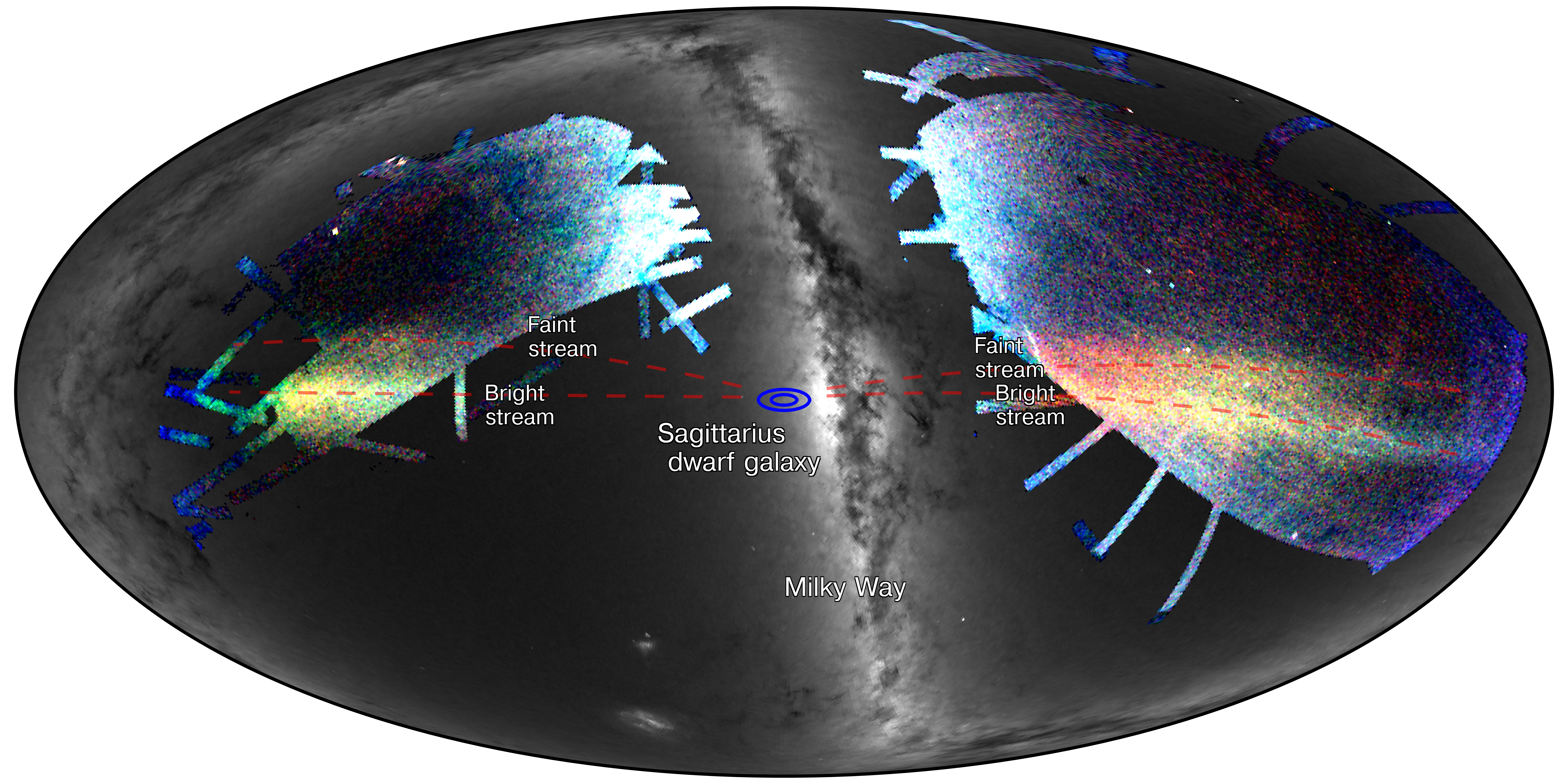
A map of the sky showing the numbers of stars counted in the Sagittarius streams. The colors indicate the distances to the stars identified in the study - stars located in red areas are further away, while stars in the blue areas are closer. The dotted red lines trace out the Sagittarius streams, and the blue ellipses in the center show the current location of the Sagittarius Dwarf Galaxy. Figure credit: S. Koposov and the SDSS-III collaboration. Click here for a larger (300 DPI) version.

The Milky Way galaxy continues to devour its small neighboring dwarf galaxies and the evidence is spread out across the sky.

A team of astronomers led by Sergey Koposov and Vasily Belokurov of the University of Cambridge recently discovered two streams of stars in the Southern Galactic hemisphere that were torn off the Sagittarius dwarf galaxy. This discovery came from analyzing data from the latest Sloan Digital Sky Survey (SDSS-III) and was announced in a paper released December 1, 2011 (arXiv paper #1111.7042) that connects these new streams with two previously known streams in the Northern Galactic hemisphere.

"We have long known that when small dwarf galaxies fall into bigger galaxies, elongated streams, or tails, of stars are pulled out of the dwarf by the enormous tidal field," said Sergey Koposov.

The Sagittarius dwarf galaxy used to be one of the brightest of the Milky Way satellites. Its disrupted remnant now lies on the other side of the Galaxy, breaking up as it is crushed and stretched by huge tidal forces. It is so small that it has lost half of its stars and all its gas over the last billion years.

Before SDSS-III, Sagittarius was known to have two tails, one in front of and one behind the remnant. Previous SDSS imaging had already found the Sagittarius tidal tail in the Northern Galactic sky in 2006 and revealed that one of the tails was forked into two.

"That was an amazing discovery," said Vasily Belokurov, "but the remaining piece of the puzzle, the structure in the South, was missing until now."

Sergey Koposov and colleagues analyzed density maps of over 13 million stars in the latest release of Sloan Digital Sky Survey data, including the crucial coverage of the Southern Galactic sky. The new data show that the Sagittarius stream in the South is also split into two, a fatter and brighter stream alongside a thinner and fainter stream. This brighter stream is more enriched with iron and other metals than its dimmer companion. Because each generation of stars makes and distributes more metals into the next generation, the Cambridge astronomers concluded that the brighter stream is younger than the older fainter one.

"Sagittarius is like a beast with four tails," observed Wyn Evans, from the Institute of Astronomy, University of Cambridge.

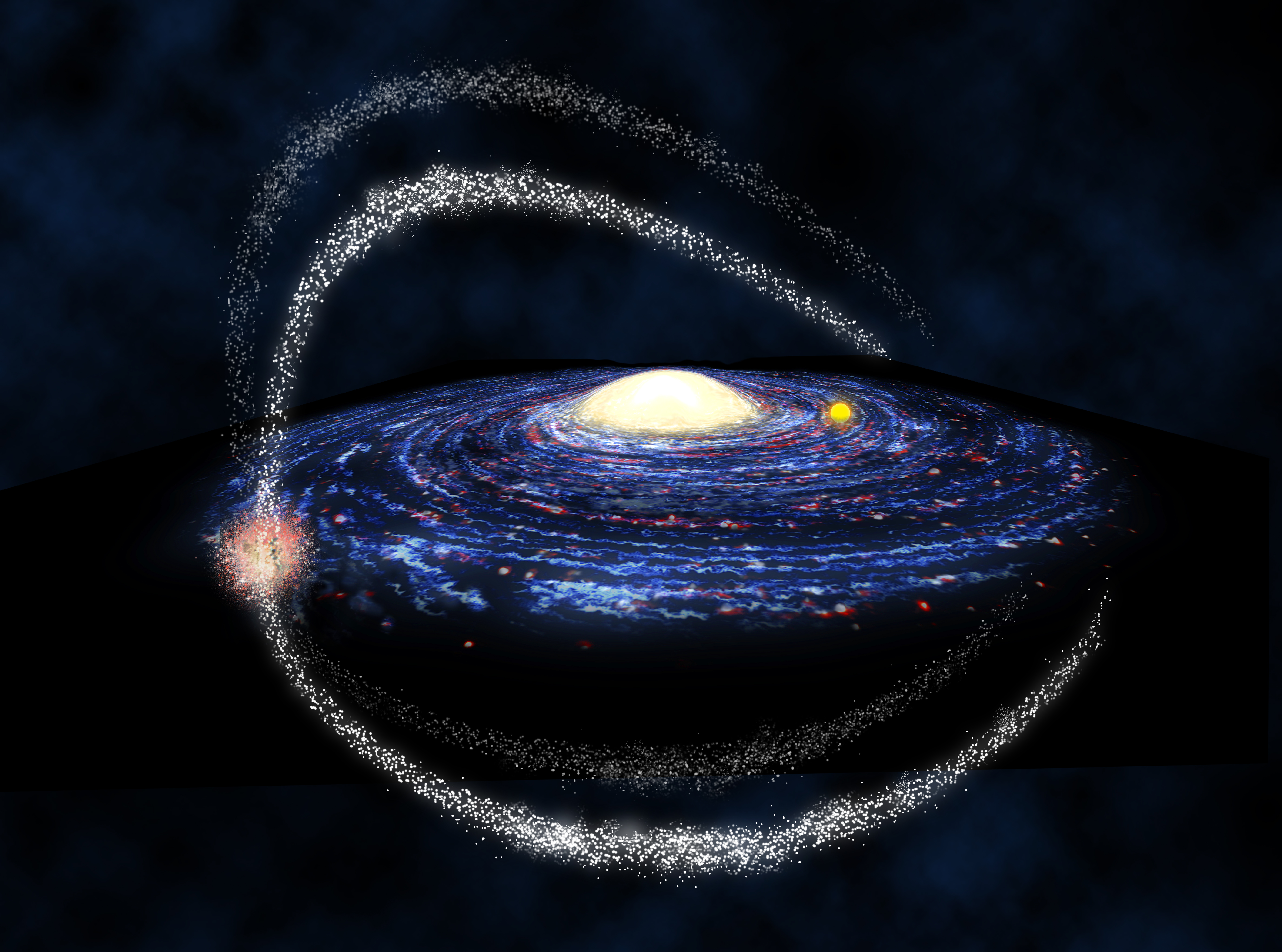
An artist's impression of the four tails of the Sagittarius Dwarf Galaxy (the orange clump on the left of the image) orbiting the Milky Way. The bright yellow circle to the right of the galaxy's center is our Sun (not to scale). Figure credit: Amanda Smith, Institute of Astronomy, University of Cambridge

The Sagittarius dwarf galaxy is on the other side of the galaxy from us, but we can see its tidal tails of stars (white in this image) stretching across the sky as they wrap around our galaxy. Click here for a larger (300 DPI) version.

No one knows the mechanism that caused the splitting of the tidal tails. However, scientists believe that perhaps the Sagittarius dwarf galaxy was once a part of a binary galactic system, similar to the present day Large and Small Magellanic Clouds. Each of these could have produced a leading and trailing tail on falling into the Milky Way Galaxy, yielding four in all.

But co-author Geraint Lewis of Sydney University has another idea. He says, "Perhaps the Sagittarius dwarf galaxy has suffered an encounter with an object in the game of Galactic billiards. Maybe a collision with a massive clump of dark matter, or even another satellite galaxy, has split each of the streams into two."

A final theory suggests that, just as meteors have spread into different streams through evolution in the Solar system, debris from Sagittarius may have spread into different streams at different points in time. Different epochs may suffer different amounts of precession in the Galaxy, causing the split streams. "I have been running hundreds of simulations of the disruption of the Sagittarius dwarf and this idea looks very plausible," commented Jorge Penarrubia of the IAA, Granada, who was also involved in the study.

Whatever the explanation, SDSS-III has provided a wealth of new information on the engorgement of the Sagittarius galaxy. The disruption of smaller galaxies has occurred many times in the history of the Milky Way and other galaxies like ours throughout the Universe.

The wagging of the four tails of Sagittarius will shed new light on both the structure and formation of the Milky Way.

Additional Resources

The paper is available from the arXiv Preprint Server (paper number 1111.7042)

The following YouTube video is an illustration of the streams produced by the Sagittarius dwarf galaxy wrapping around the Milky Way.


This YouTube movie shows an illustration of multiple streams produced by the disruption of the Sagittarius dwarf galaxy in the Milky Way halo. The orange sphere shows the location of the Sun in the Galaxy. The Sagittarius dwarf galaxy itself is located in the middle of the stream. The size of the area shown in the movie is approximately 600 thousands light years (200 kiloparsecs). Figure credit: S. Koposov and the SDSS-III collaboration

About SDSS-III

Funding for SDSS-III has been provided by the Alfred P. Sloan Foundation, the Participating Institutions, the National Science Foundation, and the U.S. Department of Energy. The SDSS-III web site is http://www.sdss3.org/.

SDSS-III is managed by the Astrophysical Research Consortium for the Participating Institutions of the SDSS-III Collaboration including the University of Arizona, the Brazilian Participation Group, Brookhaven National Laboratory, University of Cambridge, University of Florida, the French Participation Group, the German Participation Group, the Instituto de Astrofisica de Canarias, the Michigan State/Notre Dame/JINA Participation Group, Johns Hopkins University, Lawrence Berkeley National Laboratory, Max Planck Institute for Astrophysics, New Mexico State University, New York University, Ohio State University, Pennsylvania State University, University of Portsmouth, Princeton University, the Spanish Participation Group, University of Tokyo, University of Utah, Vanderbilt University, University of Virginia, University of Washington, and Yale University.

Contacts:

Sergey Koposov,
University of Cambridge,

koposov@ast.cam.ac.uk, +44 01223 337551

Vasily Belokurov,
University of Cambridge,

vasily@ast.cam.ac.uk, +44 01223 337515

Wyn Evans, University of Cambridge,
nwe@ast.cam.ac.uk, +44 01223 765847

Michael Wood-Vasey,
SDSS-III Spokesperson,
University of Pittsburgh,
wmwv@pitt.edu, +1 412-624-2751

Jordan Raddick,
SDSS Public Information Officer,

raddick@jhu.edu, +1 410-516-8889

Copyright © 2010 SDSS-III

More aboutA Beast With Four Tails

Quadruply Lensed Dwarf Galaxy 12.8 Billion Light Years Away

Posted by carsimulator on Saturday, November 26, 2011

Galaxy Cluster MACS J0329.6-0211 lenses several background galaxies including a distant dwarf galaxy. CREDIT: A. Zitrin, et al.

Gravitational lensing is a powerful tool for astronomers that allows them to explore distant galaxies in far more detail than would otherwise be allowed. Without this technique, galaxies at the edge of the visible universe are little more than tiny blobs of light, but when magnified dozens of times by foreground clusters, astronomers are able to explore the internal structural properties more directly.

Recently, astronomers at the University of Heidelberg discovered a gravitational lensed galaxy that ranked among the most distant ever seen. Although there’s a few that beat this one out in distance, this one is remarkable for being a rare quadruple lens.

The images for this remarkable discovery were taken using the Hubble Space Telescope in August and October of this year, using a total of 16 different colored filters as well as additional data from the Spitzer infrared telescope. The foreground cluster, MACS J0329.6-0211, is some 4.6 billion light years distant. In the above image, the background galaxy has been split into four images, labelled by the red ovals and marked as 1.1 – 1.4. They are enlarged in the upper right.

Assuming that the mass of the foreground cluster is concentrated around the galaxies that were visible, the team attempted to reverse the effects the cluster would have on the distant galaxy, which would reverse the distortions. The restored image, also corrected for redshift, is shown in the lower box in the upper right corner.

After correcting for these distortions, the team estimated that the total mass of the distant galaxy is only a few billion times the mass of the Sun. In comparison, the Large Magellanic Cloud, a dwarf satellite to our own galaxy, is roughly ten billion solar masses. The overall size of the galaxy was determined to be small as well. These conclusions fit well with expectations of galaxies in the early universe which predict that the large galaxies in today’s universe were built from the combination of many smaller galaxies like this one in the distant past.

The galaxy also conforms to expectations regarding the amount of heavy elements which is significantly lower than stars like the Sun. This lack of heavy elements means that there should be little in the way of dust grains. Such dust tends to be a strong block of shorter wavelengths of light such as ultraviolet and blue. Its absence helps give the galaxy its blue tint.

Star formation is also high in the galaxy. The rate at which they predict new stars are being born is somewhat higher than in other galaxies discovered around the same distance, but the presence of brighter clumps in the restored image suggest the galaxy may be undergoing some interactions, driving the formation of new stars.

Jon is a science educator currently living in Missouri. He is a high school teacher and does outreach with the St. Louis Astronomical society as well as presenting talks on science and related topics at regional conventions. He graduated from the University of Kansas with his BS in Astronomy in 2008 and has maintained the Angry Astronomer blog since 2006. For more of his work, you can find his website here.

More aboutQuadruply Lensed Dwarf Galaxy 12.8 Billion Light Years Away

Hubble Uncovers Tiny Galaxies Bursting with Star Birth in Early Universe

Posted by carsimulator on Thursday, November 10, 2011

GOODS South Deep (GSD)
Credit: NASA, ESA, A. van der Wel (Max Planck Institute for Astronomy, Heidelberg, Germany), H. Ferguson and A. Koekemoer (Space Telescope Science Institute, Baltimore, Md.), and the CANDELS team. More Images

Using its near-infrared vision to peer 9 billion years back in time, NASA's Hubble Space Telescope has uncovered an extraordinary population of tiny, young galaxies that are brimming with star formation. The galaxies are typically a hundred times less massive than the Milky Way galaxy, yet they churn out stars at such a furious pace that their stellar content would double in just 10 million years. By comparison, the Milky Way would take a thousand times longer to double its population.

These newly discovered dwarf galaxies are extreme even for the young universe, when most galaxies were forming stars at higher rates than they are today. The universe is 13.7 billion years old. Hubble spotted the galaxies because the radiation from young, hot stars has caused the oxygen in the gas surrounding them to light up like a bright neon sign. The rapid star birth likely represents an important phase in the formation of dwarf galaxies, the most common galaxy type in the cosmos.

"The galaxies have been there all along, but up until recently astronomers have been able only to survey tiny patches of sky at the sensitivities necessary to detect them," said Arjen van der Wel of the Max Planck Institute for Astronomy in Heidelberg, Germany. Van der Wel is the lead author of a paper that will be published online Nov. 14 in The Astrophysical Journal. "We weren't looking specifically for these galaxies, but they stood out because of their unusual colors."

The observations were part of the Cosmic Assembly Near-infrared Deep Extragalactic Legacy Survey (CANDELS), an ambitious three-year survey to analyze the most distant galaxies in the universe. CANDELS is the census of dwarf galaxies at such an early epoch in the universe's history.

"In addition to the images, Hubble has captured spectra that show us the oxygen in a handful of galaxies and confirm their extreme star-forming nature," said co-author Amber Straughn at NASA's Goddard Space Flight Center in Greenbelt, Md. "Spectra are like fingerprints — they tell us the galaxies' chemical composition."

The observations are somewhat at odds with recent detailed studies of the dwarf galaxies that are orbiting as satellites of the Milky Way.

"Those studies suggest that star formation was a relatively slow process, stretching out over billions of years," explained Harry Ferguson of the Space Telescope Science Institute (STScI) in Baltimore, Md., co-leader of the CANDELS survey. "The CANDELS finding that there were galaxies of roughly the same size forming stars at very rapid rates at early times is forcing us to re-examine what we thought we knew about dwarf galaxy evolution."

Added team member Anton Koekemoer, also of STScI, who is producing all the Hubble imaging data for the survey: "As our observations continue, we should find many more of these young galaxies and gather more details on their star-forming histories."

The CANDELS team uncovered the 69 young dwarf galaxies in near-infrared images taken with Hubble's Wide Field Camera 3 and Advanced Camera for Surveys. The galaxies were found in two regions of the sky called the Great Observatories Origins Deep Survey South and the UKIDSS Ultra Deep Survey (part of the UKIRT Infrared Deep Sky Survey).

The observations suggest that the newly discovered galaxies were very common 9 billion years ago. It is a mystery, however, why the newly found dwarf galaxies were making batches of stars at such a high rate. Computer simulations show that star formation in small galaxies may be episodic. Gas cools and collapses to form stars. The stars then reheat the gas through, for example, supernova explosions, which blow the gas away. After some time, the gas cools and collapses again, producing a new burst of star formation, continuing the cycle.

"While these theoretical predictions may provide hints to explain the star formation in these newly discovered galaxies, the observed 'bursts' are much more intense than what the simulations can reproduce," van der Wel said.

The James Webb Space Telescope, an infrared observatory scheduled to launch later this decade, will be able to probe these faint galaxies at an even earlier era to see the glow of the first generation of stars, providing detailed information of the galaxies' chemical composition.

"With Webb, we'll probably see even more of these galaxies, perhaps even pristine galaxies that are experiencing their first episode of star formation," Ferguson said. "Being able to probe down to dwarf galaxies in the early universe will help us understand the formation of the first stars and galaxies."

CONTACT

Donna Weaver / Ray Villard
Space Telescope Science Institute, Baltimore, Md.
410-338-4493 / 410-338-4514
dweaver@stsci.edu / villard@stsci.edu

Henry Ferguson
Space Telescope Science Institute, Baltimore, Md.
410-338-5098
ferguson@stsci.edu

More aboutHubble Uncovers Tiny Galaxies Bursting with Star Birth in Early Universe

New Dwarf Galaxy Discovered near the Andromeda Galaxy

Posted by carsimulator on Monday, October 24, 2011

Figure 1: Central region of the GMOS-N observations of And XXIX against the less dense field of stars. The image is 4.3 arcminutes on a side, corresponding to 900 parsecs (or 3000 lightyears square) at the distance of And XXIX.

Figure 2: The solid points show the stars of dwarf galaxy And XXIX observed with GMOS on a color-magnitude diagram; open diamonds were measured from SDSS observations. The near-vertical lines show the predicted location of the red giant branch stars, for two different assumptions about metal abundance. The horizontal line marks the magnitude of the tip of the red giant branch, which implies a distance to And XXIX of about 730 kiloparsecs (nearly 2.4 million light years).

New observations with the Gemini Multi-Object Spectrograph on Gemini North confirm a new dwarf companion to the Andromeda Galaxy.

The Local Group of galaxies includes many smaller dwarf galaxies in addition to the large Milky Way and Andromeda spiral galaxies. These dwarfs tend to contain a high proportion of dark matter, and theories of galaxy formation and dark matter make specific predictions about their presence and quantity. The Local Group contains many fewer dwarf galaxies than “standard” models of galaxy formation in a dark matter-dominated universe predict and at least two outstanding questions remain: 1) whether astronomers have missed some of the dwarfs (which, even though these in the Local Group are relatively close, are hard to see because they are intrinsically faint), or 2) whether dark matter theories need to be revised.

Now, adding new evidence to the debate, Eric Bell (University of Michigan) and collaborators report the discovery of another dwarf spheroidal companion to the Andromeda Galaxy, called Andromeda XXIX (And XXIX). Fainter than some individual stars in the Milky Way (e.g., eta Carina), this dwarf is particularly interesting owing to its distance from the Andromeda Galaxy. It is over 200 kiloparsecs (650 thousand light years) from Andromeda, where the distribution and properties of dwarf companions to Andromeda are very poorly understood. The team first identified the candidate in the Sloan Digital Sky Survey, where it appeared as a slightly more populated region of the sky at the outskirts of the Andromeda Galaxy.

In this new work Bell et al. followed up with deeper observations using GMOS on the Gemini North telescope - allowing them to confirm the dwarf’s existence and measure its properties. The deep GMOS imaging data (Figure 1) show the clear signature of red giant branch stars with no sign of other, more luminous, bluer stars (Figure 2). These data led to its confirmed identification as a dwarf spheroidal galaxy. The team also measured other physical properties of And XXIX, finding that it is typical of other dwarf in the Local Group in terms of size and ellipticity, given its luminosity.

Complete results are accepted for publication in The Astrophysical Journal Letters.

More aboutNew Dwarf Galaxy Discovered near the Andromeda Galaxy

Dark Matter Mystery Deepens

Posted by carsimulator on Monday, October 17, 2011

This artist's conception shows a dwarf galaxy seen from the surface of a hypothetical exoplanet. A new study finds that the dark matter in dwarf galaxies is distributed smoothly rather than being clumped at their centers. This contradicts simulations using the standard cosmological model known as lambda-CDM. Credit: David A. Aguilar (CfA)

Cambridge, MA - Like all galaxies, our Milky Way is home to a strange substance called dark matter. Dark matter is invisible, betraying its presence only through its gravitational pull. Without dark matter holding them together, our galaxy's speedy stars would fly off in all directions. The nature of dark matter is a mystery -- a mystery that a new study has only deepened.

"After completing this study, we know less about dark matter than we did before," said lead author Matt Walker, a Hubble Fellow at the Harvard-Smithsonian Center for Astrophysics.

The standard cosmological model describes a universe dominated by dark energy and dark matter. Most astronomers assume that dark matter consists of "cold" (i.e. slow-moving) exotic particles that clump together gravitationally. Over time these dark matter clumps grow and attract normal matter, forming the galaxies we see today.

Cosmologists use powerful computers to simulate this process. Their simulations show that dark matter should be densely packed in the centers of galaxies. Instead, new measurements of two dwarf galaxies show that they contain a smooth distribution of dark matter. This suggests that the standard cosmological model may be wrong.

"Our measurements contradict a basic prediction about the structure of cold dark matter in dwarf galaxies. Unless or until theorists can modify that prediction, cold dark matter is inconsistent with our observational data," Walker stated.

Dwarf galaxies are composed of up to 99 percent dark matter and only one percent normal matter like stars. This disparity makes dwarf galaxies ideal targets for astronomers seeking to understand dark matter.

Walker and his co-author Jorge Peñarrubia (University of Cambridge, UK) analyzed the dark matter distribution in two Milky Way neighbors: the Fornax and Sculptor dwarf galaxies. These galaxies hold one million to 10 million stars, compared to about 400 billion in our galaxy. The team measured the locations, speeds and basic chemical compositions of 1500 to 2500 stars.

"Stars in a dwarf galaxy swarm like bees in a beehive instead of moving in nice, circular orbits like a spiral galaxy," explained Peñarrubia. "That makes it much more challenging to determine the distribution of dark matter."

Their data showed that in both cases, the dark matter is distributed uniformly over a relatively large region, several hundred light-years across. This contradicts the prediction that the density of dark matter should increase sharply toward the centers of these galaxies.

"If a dwarf galaxy were a peach, the standard cosmological model says we should find a dark matter 'pit' at the center. Instead, the first two dwarf galaxies we studied are like pitless peaches," said Peñarrubia.

Some have suggested that interactions between normal and dark matter could spread out the dark matter, but current simulations don't indicate that this happens in dwarf galaxies. The new measurements imply that either normal matter affects dark matter more than expected, or dark matter isn't "cold." The team hopes to determine which is true by studying more dwarf galaxies, particularly galaxies with an even higher percentage of dark matter.

The paper discussing this research was accepted for publication in The Astrophysical Journal and is available online.

Headquartered in Cambridge, Mass., the Harvard-Smithsonian Center for Astrophysics (CfA) is a joint collaboration between the Smithsonian Astrophysical Observatory and the Harvard College Observatory. CfA scientists, organized into six research divisions, study the origin, evolution and ultimate fate of the universe.

For more information, contact: David A. Aguilar Director of Public Affairs Harvard-Smithsonian Center for Astrophysics 617-495-7462
daguilar@cfa.harvard.edu

Christine Pulliam Public Affairs Specialist Harvard-Smithsonian Center for Astrophysics 617-495-7463
cpulliam@cfa.harvard.edu

More aboutDark Matter Mystery Deepens

Galaxy Caught Blowing Bubbles

Posted by carsimulator on Thursday, September 29, 2011

PR Image heic1114a
Hubble image of irregular galaxy Holmberg II

Wide-field image of irregular galaxy Holmberg II (ground-based image)

PR Video heic1114a
Zooming in on galaxy Holmberg II

PR Video heic1114b
Panning across galaxy Holmberg II

Hubble’s famous images of galaxies typically show elegant spirals or soft-edged ellipses. But these neat forms are only representative of large galaxies. Smaller galaxies like the dwarf irregular galaxy Holmberg II come in many shapes and types that are harder to classify. This galaxy’s indistinct shape is punctuated by huge glowing bubbles of gas, captured in this image from the NASA/ESA Hubble Space Telescope.

The intricate glowing shells of gas in Holmberg II were created by the energetic lifecycles of many generations of stars. High-mass stars form in dense regions of gas, and later in life expel strong stellar winds that blow away the surrounding material. At the very end of their lives, they explode in as a supernova. Shock waves rip through these less dense regions blowing out and heating the gas, forming the delicate shells we see today.

Holmberg II is a patchwork of dense star-forming regions and extensive barren areas with less material, which can stretch across thousands of light-years. As a dwarf galaxy, it has neither the spiral arms typical of galaxies like the Milky Way nor the dense nucleus of an elliptical galaxy. This makes Holmberg II, gravitationally speaking, a gentle haven where fragile structures such as these bubbles can hold their shape.

While the galaxy is unremarkable in size, Holmberg II does have some intriguing features. As well as its unusual appearance — which earned it a place in Halton Arp’s Atlas of Peculiar Galaxies, a treasure trove of weird and wonderful objects — the galaxy hosts an ultraluminous X-ray source in the middle of three gas bubbles in the top right of the image. There are competing theories as to what causes this powerful radiation — one intriguing possibility is an intermediate-mass black hole which is pulling in material from its surroundings.

This colourful image is a composite of visible and near-infrared exposures taken using the Wide Field Channel of Hubble’s Advanced Camera for Surveys.

Notes

The Hubble Space Telescope is a project of international cooperation between ESA and NASA.

Contacts

Oli Usher
Hubble/ESA
Garching, Germany
Tel: +49-89-3200-6855
Email: ousher@eso.org

More aboutGalaxy Caught Blowing Bubbles

Milky Way’s Spiral Arms are the Product of an Intergalactic Collision Course

Posted by carsimulator on Friday, September 16, 2011

Computer model of the Milky Way and its smaller neighbor, the Sagittarius dwarf galaxy. The flat disk is the Milky Way, and the looping stream of material is made of stars torn from Sagittarius as a result of the strong gravity of our galaxy. The spiral arms began to emerge about two billion years ago, when the Sagittarius galaxy first collided with the Milky Way disk. Credit: Image by Tollerud, Purcell and Bullock/UC Irvine

UC Irvine models show dark matter packs a punch

Irvine, Calif., UC Irvine astronomers have shown how the Milky Way galaxy’s iconic spiral arms form, according to research published today in the journal Nature.

A dwarf galaxy named Sagittarius loaded with dark matter has careened twice through our much larger home galaxy in the past two billion years, according to telescope data and detailed simulations, and is lined up to do it again. As the galaxies collide, the force of the impact sends stars streaming from both in long loops. Those continue to swell with stars and are gradually tugged outward by the Milky Way’s rotation into a familiar ringed arm.

It’s the weighty dark matter from Sagittarius that provided the initial push, the researchers said.

“It’s kind of like putting a fist into a bathtub of water as opposed to your little finger,” said James Bullock, a theoretical cosmologist who studies galaxy formation.

The smaller galaxy pays a steep price though – sucked inward repeatedly by the Milky Way’s mightier gravity, it’s being ripped apart by the blows, sending huge amounts of its stars and dark matter reeling into the new arms.

“When all that dark matter first smacked into the Milky Way, 80 percent to 90 percent of it was stripped off,” explained lead author Chris Purcell, who did the work with Bullock at UCI and is now at the University of Pittsburgh. “That first impact triggered instabilities that were amplified, and quickly formed spiral arms and associated ring-like structures in the outskirts of our galaxy.”

The Sagittarius galaxy is due to strike the southern face of the Milky Way disk fairly soon, Purcell said – in another 10 million years or so.

Additional authors are UCI doctoral students Erik Tollerud and Miguel Rocha, and Sukanya Chakrabarti of Florida Atlantic University in Boca Raton.

About the University of California, Irvine: Founded in 1965, UCI is a top-ranked university dedicated to research, scholarship and community service. Led by Chancellor Michael Drake since 2005, UCI is among the most dynamic campuses in the University of California system, with nearly 28,000 undergraduate and graduate students, 1,100 faculty and 9,000 staff. Orange County’s largest employer, UCI contributes an annual economic impact of $4.2 billion. For more UCI news, visit www.today.uci.edu.

News Radio: UCI maintains on campus an ISDN line for conducting interviews with its faculty and experts. Use of this line is available for a fee to radio news programs/stations that wish to interview UCI faculty and experts. Use of the ISDN line is subject to availability and approval by the university.

Photo Links: Larger image of computer model

Web Links: Milky Way spiral arm formation video

Media Contact

Janet Wilson

University Communications

949-824-3969

janethw@uci.edu

Experts available: UCI maintains an online directory of faculty available as experts to the media.

More aboutMilky Way’s Spiral Arms are the Product of an Intergalactic Collision Course

Astronomical Vision Test

Posted by carsimulator on Tuesday, August 30, 2011

ESO 540-030

Credit: ESA/Hubble & NASA


Peering into the depths of space, the sharp-eyed NASA/ESA Hubble Space Telescope has imaged the nearby but faint dwarf galaxy ESO 540-030. This object itself appears as a huge swarm of dim stars, but ESO 540-030 is actually just one point of interest in the picture.


ESO 540-030 is just over 11 million light-years distant, and is part of the Sculptor group of galaxies. This collection is the closest neighbour to our own Local Group of galaxies that includes the Milky Way. Due to its proximity the Sculptor group contains some of the brightest galaxies in the southern skies, although ESO 540-030 is not one of these; dwarf galaxies generally have low surface brightness, which make observations difficult.


Hubble has captured a snapshot of galaxy types in the background, with spirals, barred spirals, ellipticals and irregulars on display. Careful examination of this picture should allow examples of each galaxy type to be found. Some galaxies lie directly behind ESO 540-030, increasing the challenge. As well as the galaxies there are also five bright stars, which are much closer to us than the galaxies. The telltale diffraction spikes — four sharp lines of light emanating at 90 degree angles, caused by light diffracting in the telescope — are unmistakable signs of the stars in the picture.


Cataloguing galaxy types is an important task for scientists attempting to understand more about how our Universe evolved. Our own eyes are excellent tools for this, as participants of the Galaxy Zoo Hubble project will confirm [1].


This picture was created from images taken with the Wide Field Channel of Hubble’s Advanced Camera for Surveys. Images through a yellow-orange filter (F606W, coloured blue) were combined with images taken in the near-infrared (F814W, coloured red). The total exposure times were 4480 s and 3360 s, respectively and the field of view is about 3.1 arcminutes across.


Links


[1] http://www.galaxyzoo.org/

More aboutAstronomical Vision Test

Found: Heart of Darkness

Posted by carsimulator on Friday, July 29, 2011

This is the portion of sky in which astronomers found the Segue 1 dwarf galaxy. Can you see it? Credit: Marla Geha

Using the DEIMOS instrument on the Keck II telescope, astronomers could identify which stars were moving together as a group. They are circled here in green. Credit: Marla Geha

By subtracting out all the other objects in the image and leaving the Segue I member stars, the “darkest galaxy” emerges. Credit: Marla Geha

All three images above are combined in this captioned mosaic
Credit: Marla Geha, Keck Observatory

Kamuela, HI – Astronomers using the 10-meter Keck II telescope in Hawaii have confirmed in a new paper that a troupe of about 1,000 small, dim stars just outside the Milky Way comprise the darkest known galaxy, as well as something else: a treasure trove of ancient stars.

By “dark” astronomers are not referring to how much light the galaxy, called Segue 1, puts out, but the fact that the dwarf galaxy appears to have 3,400 times more mass than can be accounted for by its visible stars. In other words, Segue 1 is mostly an enormous cloud of dark matter decorated with a sprinkling of stars.

The initial announcement of the “Darkest Galaxy” was made two years ago by Marla Geha, a Yale University astronomer, Joshua Simon from the Carnegie Institution of Washington, and their colleagues. This original claim was based on data from the Sloan Digital Sky Survey and the Keck II telescope. Those observations indicated the stars were all moving together and were a diverse group, rather than simply a cluster of similar stars that had been ripped out of the nearby and more star-rich Sagittarius dwarf galaxy. A competing group of astronomers at Cambridge University were, however, not convinced.

So Simon, Geha and their group returned to Keck and went to work with the telescope’s Deep Extragalactic Imaging Multi-Object Spectrograph (DEIMOS) to measure how the stars move not just in relation to the Milky Way, but also in relation to each other.

If the 1,000 or so stars were all there was to Segue 1, with just a smidgeon of dark matter, the stars would all move at about the same speed, said Simon. But the Keck data show they do not. Instead of moving at a steady 209 km/sec relative to the Milky Way, some of the Segue 1 stars are moving at rates as slow as 194 kilometers per second while others are going as fast as 224 kilometers per second.

“That tells you Segue 1 must have much more mass to accelerate the stars to those velocities,” Geha explained. The paper confirming Segue 1’s dark nature appeared in the May 2011 issue of The Astrophysical Journal.

The mass required to cause the different star velocities seen in Segue 1 has been calculated at 600,000 solar masses. But there are only about 1,000 stars in Segue 1, and they are all close to the mass of our Sun, Simon said. Virtually all of the remainder of the mass must be dark matter.

Stellar Old Folks Home

Equally exciting news from Segue 1 is its unusual collection of nearly primordial stars. One way to tell how long ago a star formed is by its heavy element content, which can be gleaned from the characteristic absorption features in the star’s spectrum. Very old or primitive stars come from a time when the universe was young and few large stars had yet grown old enough to fuse lightweight atoms like hydrogen and helium into heavier elements like iron and oxygen. Early, and therefore ancient, stars that formed from early gas clouds are therefore very low in heavy elements.

The researchers managed to gather iron data on six stars in Segue 1 with the Keck II telescope, and a seventh Segue 1 star was measured by an Australian team using the Very Large Telescope. Of those seven, three proved to have less than one 2,500th as much iron as our own Sun.

“That suggests these are some of the oldest and least evolved stars that are known,” said Simon.

Searches for such primitive stars among the Milky Way’s billions have yielded less than 30.

“In Segue 1 we already have 10 percent of the total in the Milky Way,” Geha said. “For studying these most primitive stars, dwarf galaxies are going to be very important.”

Dark Matter Demolition Derby

The confirmation of the large concentration of dark matter in Segue 1 underscores the importance of other research that has focused on Segue 1. In particular, some researchers have been looking with the space-based Fermi Gamma Ray Telescope in hopes of catching sight of a faint glimmer of gamma rays which could be created, theoretically, by the collision and annihilation of pairs of dark matter particles.

So far the Fermi telescope has not detected anything of the sort, which isn’t entirely surprising and doesn’t mean the dark matter isn’t there, said Simon.

“The current predictions are that the Fermi telescope is just barely strong enough or perhaps not quite strong enough to see these gamma rays from Segue 1,” Simon explained. So there are hopes that Fermi will detect at least the hint of a collision.
“A detection would be spectacular,” said Simon. “People have been trying to learn about dark matter for 35 years and not made much progress. Even a faint glow of the predicted gamma rays would be a powerful confirmation of theoretical predictions about the nature of dark matter.”

In the meantime, astronomers suspect there are other, perhaps even darker dwarf galaxies hovering around the Milky Way, waiting to be discovered. “We’d like to find more objects like Segue 1,” Simon said.

More aboutFound: Heart of Darkness